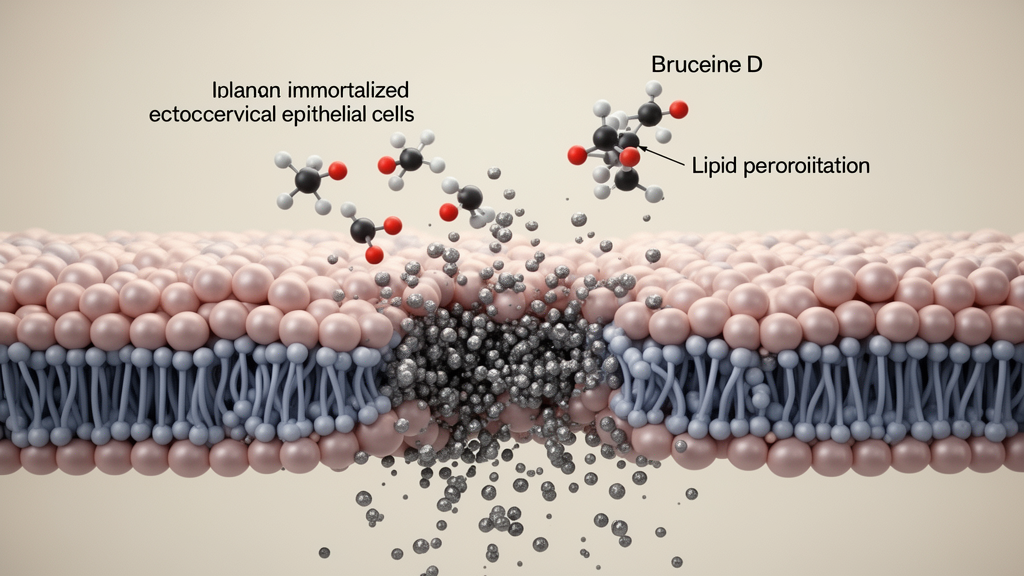
A plant-derived compound called bruceine D significantly reduced the survival of human papillomavirus-immortalized cervical cells by triggering ferroptosis, an iron-dependent form of cell death. Researchers identified the quassinoid, isolated from Brucea javanica, as an active agent capable of impairing ectocervical cells expressing HPV16 E6 and E7 oncogenes in laboratory culture. Because persistent infection with high-risk human papillomavirus strains represents the primary underlying cause of cervical precancerous lesions and cervical cancer, evaluating compounds that trigger regulated cellular demise in affected tissues has become an area of active therapeutic investigation.
To evaluate the biological effects of the natural compound, investigators conducted experiments on HPV16 E6/E7-immortalized ectocervical epithelial cells, designated as Ect1/E6E7. The team assessed cellular proliferation and health through multiple experimental assays, measuring cell viability, colony formation capacity, EdU incorporation, and cell-cycle progression. Across these assays, the treatment significantly inhibited cell proliferation and provoked cell-cycle arrest at the G0/G1 transition in a concentration-dependent manner, indicating that exposure prevented the cells from dividing normally.
Subsequent laboratory tests demonstrated that the cellular death induced by bruceine D possessed the classical molecular hallmarks of ferroptosis. Following compound administration, the cervical cells showed a substantial increase in lipid peroxidation and elevated levels of malondialdehyde, a primary byproduct of lipid damage. In parallel, intracellular levels of the antioxidant glutathione were depleted, and mitochondrial function was severely disrupted, matching the metabolic imbalances typically observed when ferroptotic cascades are initiated.
The study also analyzed the expression of ferroptosis-related proteins to characterize the molecular cascades governed by the treatment. Exposure to bruceine D treatment downregulated GPX4 in the cultured cells. The functional contribution of this pathway was further validated through pharmacological rescue experiments, in which specific ferroptosis inhibitors partially reversed cell death, confirming that iron-dependent oxidative lethality contributed directly to the observed cytotoxicity.
To uncover the regulatory networks acting alongside GPX4 downregulation, the researchers utilized network pharmacology analysis coupled with experimental validation. These integrated analyses implicated glutathione S-transferase P1, designated GSTP1, and mitogen-activated protein kinase 14, known as MAPK14, as central components in the cellular response to bruceine D. When the scientists applied pharmacological inhibitors targeting MAPK14, the ferroptotic responses were markedly attenuated, demonstrating that GSTP1 and MAPK14 signaling serves as an important regulatory pathway during compound exposure.
Beyond single-agent administration, the researchers evaluated the impact of combining bruceine D with established small-molecule modulators of ferroptotic signaling. When administered alongside the known ferroptosis inducer erastin, the quassinoid exhibited synergistic antiproliferative effects, leading to an enhanced suppression of Ect1/E6E7 cell growth compared to individual treatments. The researchers noted that these preclinical findings warrant further experimental investigation into bruceine D and ferroptosis-targeted strategies in the context of HPV-associated cervical disease.
Subject of Research: Preclinical evaluation of bruceine D inducing ferroptotic cell death in HPV16-immortalized ectocervical cells
Article Title: Bruceine D induces ferroptosis in ectocervical Ect1/E6E7 cells by modulating GSTP1 and MAPK14 signaling and downregulating GPX4
Article References: Han, M., Lian, S., Zhu, J., Shaie, K. M., Feng, R., Wang, Y., & Hu, Y. (2026). Bruceine D induces ferroptosis in ectocervical Ect1/E6E7 cells by modulating GSTP1 and MAPK14 signaling and downregulating GPX4. Molecular Biology Reports, 53(1), Article 1988. https://doi.org/10.1007/s11033-026-13142-6
Image Credits: AI Generated
DOI: 10.1007/s11033-026-13142-6
Keywords: bruceine D, ferroptosis, HPV16, human papillomavirus, Ect1/E6E7 cells, GPX4, GSTP1, MAPK14, Brucea javanica, lipid peroxidation, malondialdehyde, glutathione depletion, cell-cycle arrest, quassinoids, erastin, cervical epithelial cells, cervical precancer
News Source: Drew Townsend. (November 19, 2026). Bruceine D Induces Ferroptosis in Immortalized Ectocervical Epithelial Cells. Scienmag.