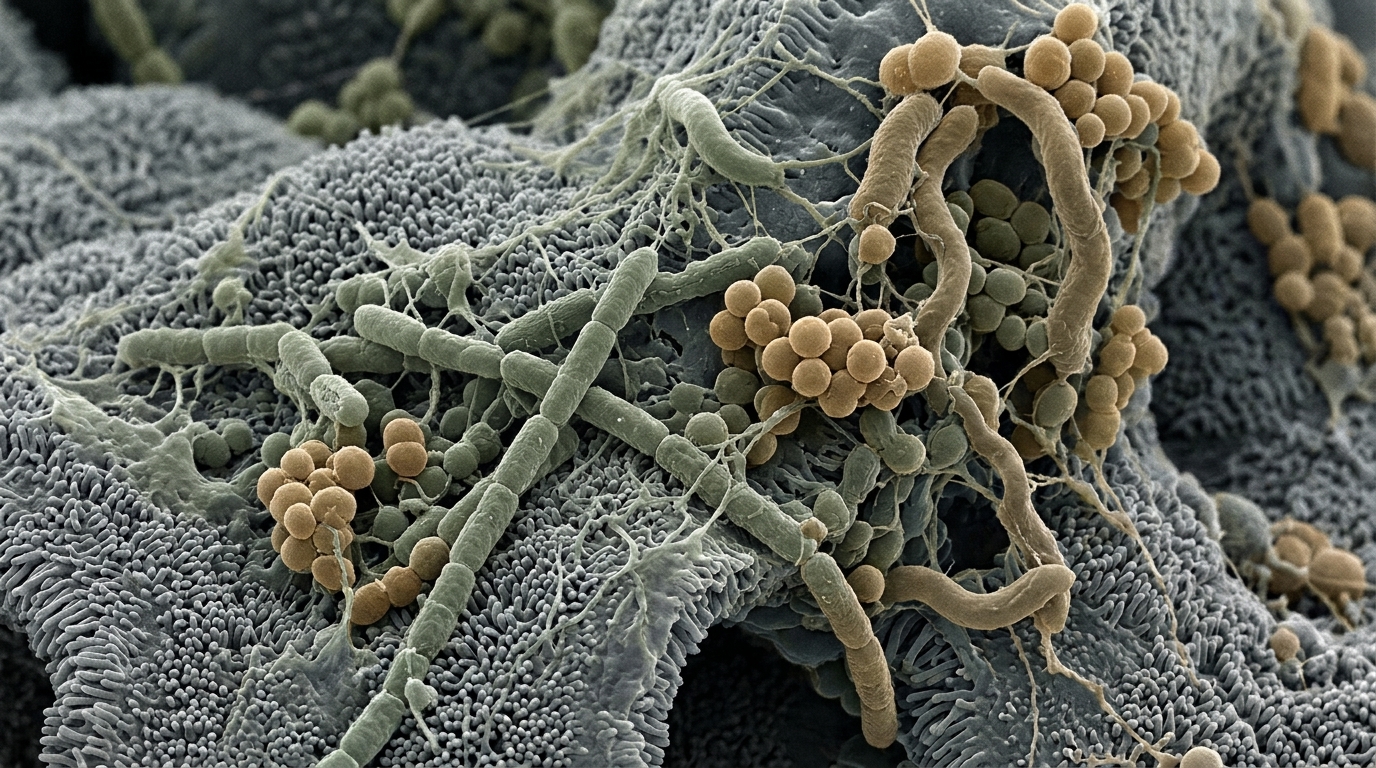
A genomic study published in Gut Pathogens has examined how taxonomy, repertoire composition, and shared annotations organize resistance and host-associated protein profiles across human gut microbial lineages. The research team evaluated a total of 2,221 gut-associated genomes, combining 2,084 metagenomic assemblies with 137 assemblies derived from cultured isolates. By assessing this combined genomic dataset, the investigators addressed how functional repertoires vary across distinct bacterial lineages in the human intestinal environment, focusing specifically on distinguishing true biological co-distribution from statistical artifacts generated by overlapping annotations.
In evaluating taxonomic hierarchy and predictive performance, the researchers found that family-level taxonomy provided the strongest predictive resolution among the genomic assemblies. When assessed against baseline models, incorporating family-level classification added between 0.249 and 0.509 to species-grouped out-of-fold R² values. The analysis also demonstrated marked structural variation across bacterial groups, where the family Enterobacteriaceae exhibited concentrated multidomain enrichment. In contrast, other microbial lineages displayed selective category profiles that separated antimicrobial resistance, virulence factors, and mobile elements into distinct patterns rather than broad multidomain clustering.
The investigators next evaluated how overlapping protein content affected observed statistical relationships among functional categories. Across a subset of 1,233 genomes representing 116 bacterial genera, the initial correlation between resistance profiles and virulence resources was measured at 0.537. However, when the authors applied shared-protein exclusion to remove overlapping annotations, this correlation dropped markedly to 0.162. The team observed that statistical associations with pathogen–host interaction (PHI) homologues also varied substantially depending on the specific match definitions and sequence thresholds used during functional profiling.
To further test these interactions, the authors implemented phenotype selection, a 50 percent sequence identity filter, and renewed shared-protein exclusion. Under these conditions, the resistance–PHI correlation remained positive at 0.278, while the virulence-resource–PHI correlation remained positive at 0.342. Normalization against protein-FASTA records similarly retained positive associations, though the measured magnitudes were comparatively smaller. The study concluded that taxonomic structure, shared protein content, and lineage-specific composition jointly define gut microbial profiles, while noting that stringent filtering produced sparse profiles and cross-project prediction remained limited.
Subject of Research: Genomic analysis of resistance and host-associated protein profiles across human gut microbial lineages
Article Title: Taxonomic structure and annotation overlap shape resistance and host-associated profiles in human gut microbial genomes
Article References: He, L., Zhang, M., Xin, H., & Zhu, B. (2026). Taxonomic structure and annotation overlap shape resistance and host-associated profiles in human gut microbial genomes. Gut Pathogens. https://doi.org/10.1186/s13099-026-00904-7
Image Credits: AI Generated
DOI: 10.1186/s13099-026-00904-7
Keywords: Gut Pathogens, human gut microbiome, microbial genomics, metagenomic assemblies, cultured isolates, Enterobacteriaceae, family-level taxonomy, species-grouped out-of-fold R², antimicrobial resistance, virulence factors, mobile genetic elements, pathogen-host interactions, shared-protein exclusion, protein-FASTA normalization, phenotype selection, repertoire composition, annotation overlap
News Source: Morgan Morrow. (November 19, 2026). Gut Microbial Lineages and Annotation Overlaps Shape Resistance Profiles. Scienmag.