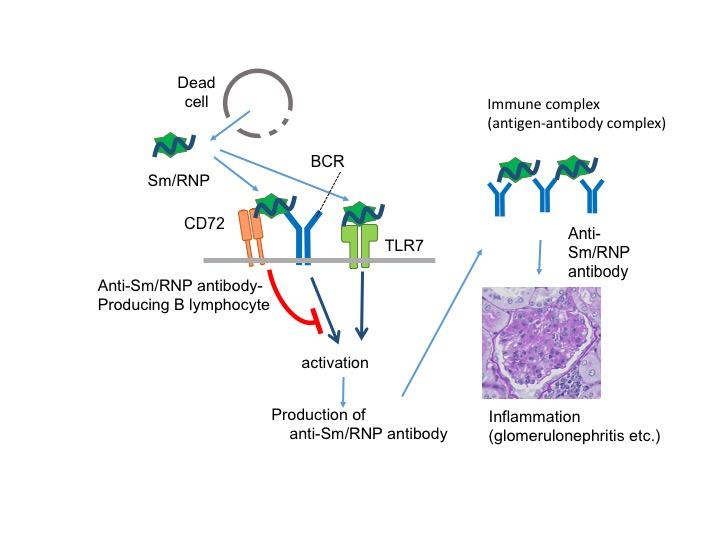
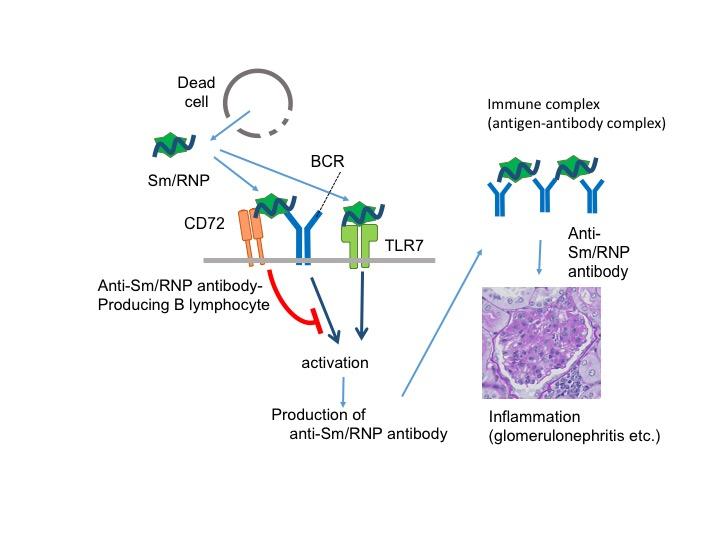
Credit: Department of Immunology, Medical Research Institute, Tokyo Medical and Dental University(TMDU)
A group of researchers at Tokyo Medical and Dental University(TMDU) have identified a molecule that stops the immune system from mistakenly reacting to a component of the body's own cells, which could improve our ability to treat systemic lupus erythematosus (SLE), a disease associated with inflammation of various organs including kidney, brain, skin, heart and lung.
Tokyo, Japan – Systemic lupus erythematosus (SLE) is a disease that affects various organs including kidney, brain, skin, heart and lung, due to immune cells mistakenly attacking molecular complexes within it. Although there are treatments that can ameliorate the symptoms, there is no cure. People with lupus suffer increased risks of infection and metabolic diseases due to treatments. In a major breakthrough in the fight against this disease, researchers at TMDU and their colleagues have studied a molecule expressed on immune cells that prevents these cells from reacting with the body and causing SLE, and explained the mechanism behind its action, raising hopes for new treatments of this disease.
The immune system features cells that can recognize potentially damaging agents, such as toxins, cancerous cells, and bacteria and viruses. Upon encountering such agents, immune cells act to neutralize and remove them; these actions include labeling them as dangerous, engulfing and destroying them, or releasing proteins called antibodies that can specifically identify the same agents elsewhere in the body. However, this recognition can sometimes go awry, leading the immune system to attack healthy cells or tissues, which can have devastating results. Such conditions are known as autoimmune diseases, which include lupus, a disease in which various organs are damaged by inflammation.
Previous studies have suggested some cells and molecules that could be involved in this condition, but definitive proof has not been obtained and the exact mechanism by which SLE develops, or by which it is prevented from developing in healthy individuals, has not been determined. Building on this previous work, a team including researchers at TMDU has shown that a molecule called CD72 prevents a certain type of immune cell from mistakenly reacting with a protein complex within the body. The team confirmed this by analyzing immune responses in cells in which CD72 had been removed, and by comparing the ability of different variants of CD72 to prevent SLE.
"When we knocked out CD72 in mouse B cells, they were specifically stimulated by the self-antigen Sm/RNP and released antibodies against this antigen," says Takeshi Tsubata of the Department of Immunology at TMDU. "The lack of CD72 meant that another receptor on B cells could bind to Sm/RNP, which activated the B cells and led to the symptoms of SLE."
To confirm these findings, the team analyzed different variants of CD72, one of which was suggested to be defective. They found that these variants differed in their potency of preventing development of SLE. They also used X-ray crystallography to show the exact mechanisms of compromised binding of these variants to Sm/RNP.
"We now know that CD72 prevents immune responses which lead to SLE without affecting responses to microbes and cancer cells," Takeshi Tsubata of TMDU says. "If we can develop a method to augments capability of CD72, this will treat patients with SLE without unwanted effects."
###
The article "CD72 negatively regulates B lymphocyte responses to the lupus-related endogenous Toll-like receptor 7 ligand Sm/RNP" was published in The Journal of Experimental Medicine at doi: 10.1084/jem.20160560.
Media Contact
Takeshi Tsubata
[email protected]
http://www.tmd.ac.jp/english/