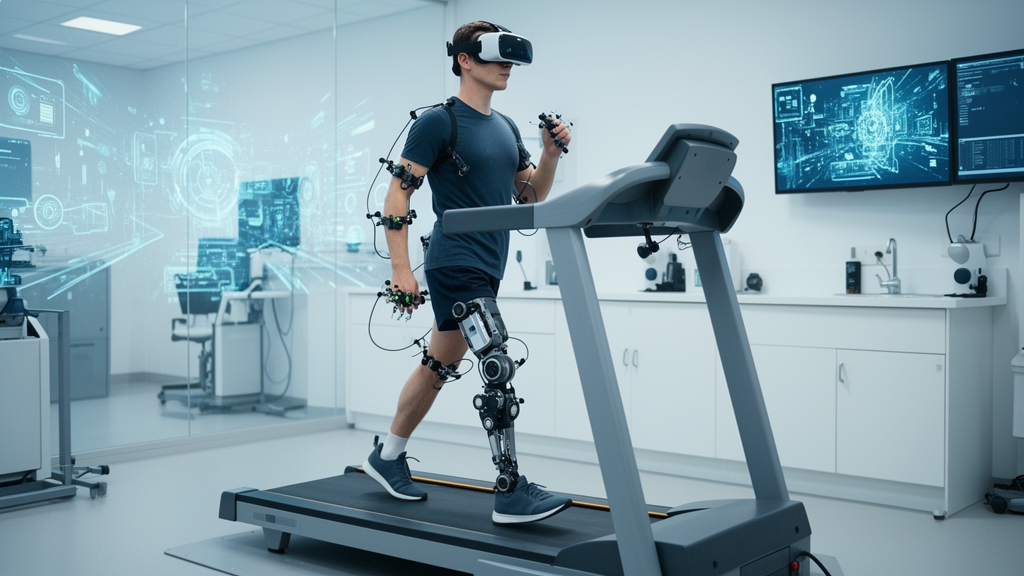
Immersive virtual reality environments with progressively increasing complexity induce distinct walking adaptations in individuals with lower-limb amputation while maintaining high rates of participant tolerance, according to an experimental investigation published in the Journal of NeuroEngineering and Rehabilitation. Researchers evaluated the feasibility, safety, and functional movement effects of simulating diverse walking conditions using virtual reality technology to determine how environmental demands influence gait mechanics in patients with existing mobility impairments.
Virtual reality has emerged as a promising tool for physical rehabilitation because it permits controlled reproduction of ecologically valid, complex real-world situations.
To evaluate these dynamics, an investigative team led by Louis Riglet and colleagues recruited twenty-five individuals with lower-limb amputation. Each participant performed walking trials across flat and inclined walking surfaces under five distinct experimental conditions. The experimental protocol contrasted two physical real-world environments against three immersive virtual reality environments designed with progressively increasing levels of environmental complexity.
The study protocol measured locomotor mechanics using wearable inertial measurement units across all experimental setups. Following exposure to each virtual reality condition, participants completed standardized tolerance and preference questionnaires to assess the acceptability of the intervention. Investigators also performed post-trial postural stability assessments using a specialized baropodometric platform to monitor changes in balance and center-of-pressure dynamics.
The recorded tolerance rate reached 96.0 percent, with a 95 percent confidence interval from 79.6 to 99.9 percent, for flat surface walking. During slope walking, the measured tolerance rate was 95.8 percent, with a corresponding 95 percent confidence interval spanning from 78.9 to 99.9 percent.
Postural control measurements taken immediately after immersion revealed selective balance responses depending on task difficulty and environmental complexity. Confidence ellipse area increased solely following slope walking in the simple immersion condition, rising by 132 square millimeters with a p-value of 0.024.
Locomotor kinematic analyses showed that virtual reality immersion directly modified spatial and temporal gait patterns, with walking speed and stride length decreasing most noticeably in the complex virtual environment. Foot clearance on the healthy side increased significantly during flat walking in both simple immersion, gaining 0.53 centimeters with a p-value of 0.003, and complex immersion, gaining 0.31 centimeters with a p-value below 0.001.
The researchers concluded that these observed adaptations support the safety and clinical relevance of virtual reality gait training, indicating that modulating environmental complexity offers a practical method to tailor rehabilitation interventions.
Subject of Research: Virtual reality environment complexity and gait rehabilitation in lower-limb amputation
Article Title: Effect of virtual reality environment complexity on tolerance and locomotor performance in individuals with lower-limb amputation
Article References: Riglet, L., Lordon, L., Frenot, N., Claquesin, L., Fournel, I., Gouteron, A., Ornetti, P., & Gueugnon, M. (2026). Effect of virtual reality environment complexity on tolerance and locomotor performance in individuals with lower-limb amputation. Journal of NeuroEngineering and Rehabilitation. https://doi.org/10.1186/s12984-026-02189-y
Image Credits: AI Generated
DOI: 10.1186/s12984-026-02189-y
Keywords: gait rehabilitation, virtual reality, lower-limb amputation, locomotor performance, biomechanics, postural control, foot clearance, circumduction, walking speed, stride length, rehabilitation engineering, inertial measurement units, baropodometry, slope walking, center of pressure, assistive technology
News Source: Ophelia Keating. (November 19, 2026). Virtual Reality Complexity Alters Gait Adaptations After Lower-Limb Amputation. Scienmag.