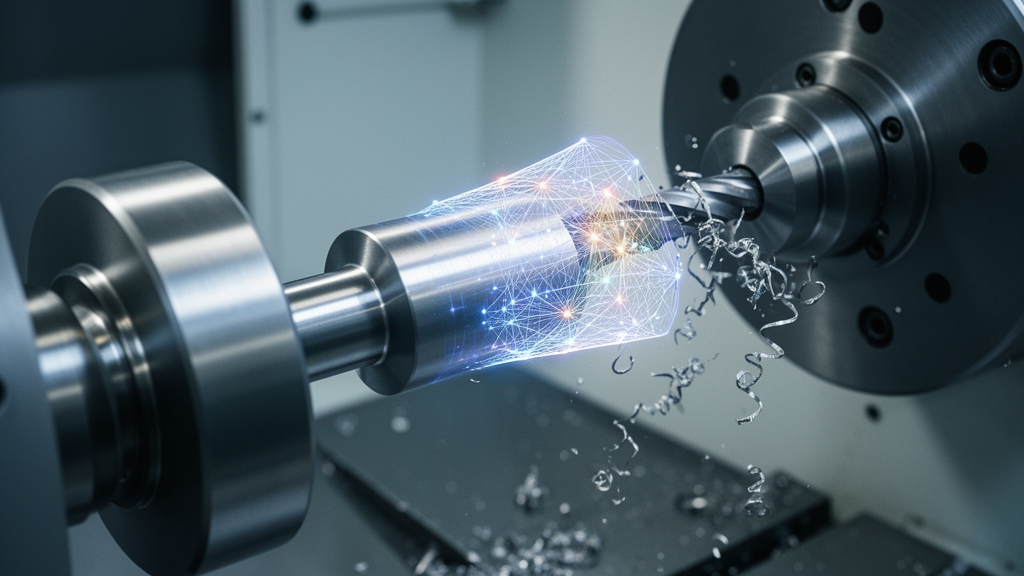
Researchers have demonstrated a data-driven machine learning approach capable of predicting cutting forces and classifying high-force machining risk conditions during computer numerical control turning operations. In modern manufacturing environments, the mechanical forces generated between a cutting tool and a rotating workpiece govern critical operational variables including tool wear rates, dimensional tolerances, final surface finish quality, overall power consumption, and mechanical stability. Developing reliable predictive models for these forces enables manufacturing facilities operating under Industry 4.0 and Industry 5.0 frameworks to establish smart process monitoring and avoid costly breakdown maintenance on production equipment. The experimental study focused on turning hardened D3 tool steel, a high-carbon, high-chromium cold-work alloy widely recognized for exceptional compressive strength and abrasive wear resistance, using a standardized TNMG160408EMTT cutting insert paired with formulated hybrid biodegradable cutting fluids.
The physical turning trials were systematically structured using a Taguchi L27 orthogonal array experimental design to rigorously evaluate cutting behavior across three operational factors adjusted across three discrete settings. Specifically, cutting speed was set to 90, 120, and 150 meters per minute, feed rate was configured at 0.04, 0.06, and 0.08 millimeters per revolution, and depth of cut was varied between 0.4, 0.7, and 1.0 millimeter. These parameter bands were selected to encompass both moderate and severe cutting regimes. To investigate environmentally conscious lubrication alternatives, three hybrid bio-coolants formulated from waste vegetable oils were synthesized and evaluated: a 50:50 blend of waste sunflower and soybean oils, a 50:50 blend of waste soybean and cottonseed oils, and a 50:50 blend of waste sunflower and cottonseed oils. Throughout all 27 distinct machining cycles, cutting forces were continuously recorded across three orthogonal components—main cutting force along the tangential axis, feed or axial force, and radial force—using a multi-component Kistler piezoelectric dynamometer mounted directly beneath the tool holder with a specified measurement accuracy of plus or minus 2 percent.
During continuous data acquisition across the 27 operational runouts, the piezoelectric dynamometer captured approximately 151,000 discrete sensor observations, with individual runs recording between 10,000 and 27,000 points. To prepare the experimental records for computational modeling without overwhelming processing pipelines, the researchers implemented a data reduction routine that selected the 1,000 most representative data points from each runout, establishing a standardized baseline collection of 27,000 effective samples. An inspection of the resulting data distributions revealed that the primary cutting force demonstrated the greatest overall variation across cutting conditions, while the feed force remained comparatively stable apart from a mid-trial drop, and radial force exhibited both positive and negative fluctuations reflecting directional shifts. Because input parameters remained fixed during each Taguchi trial while cutting forces varied continuously, the dataset provided an extensive empirical foundation for supervised algorithm training.
To ensure robust statistical validity and prevent biased model training, the gathered experimental dataset was subjected to preprocessing procedures including missing value imputation, standard normalization, and sample rebalancing. The original experimental classification records exhibited a significant class imbalance of roughly 80 to 20 between stable and severe operating conditions. To address this disparity, the researchers applied the Synthetic Minority Over-Sampling Technique, generating synthetic examples of minority instances to establish balanced training sets. The refined dataset of 27,000 points was subsequently partitioned into an 80 percent training subset for algorithm fitting and a completely isolated 20 percent testing subset reserved for final performance assessment. Additional verification was conducted through k-fold cross-validation utilizing 5,400 data samples, where 4,860 samples were allocated for testing cycles and 540 samples were evaluated during internal validation splits.
For continuous force estimation, the research team implemented a multi-variable linear regression model alongside ensemble and tree-based methods, treating cutting parameters and secondary force signals as inputs to predict the main cutting force response. Model performance was evaluated using the root mean square error and the coefficient of determination. Across the test evaluations, the linear regression framework achieved a coefficient of determination of 0.86, demonstrating that the statistical model accounted for 86 percent of the observed variance in main cutting force. Overall deviations between measured dynamometer outputs and predicted force values remained tightly bounded within plus or minus 15 percent, with typical trial percentage errors spanning from 13.01 percent to 14.96 percent. The observed force trends aligned with physical machining dynamics, including instances where elevated cutting speeds induced slight thermal softening of the workpiece, counteracting the elevated forces driven by higher feed rates and deeper depths of cut.
To address tool condition monitoring, the authors deployed classification algorithms, specifically Decision Tree and Random Forest architectures, to identify critical operating states from predicted cutting force values. Rather than serving as a direct quantitative measurement of tool wear, the classification model was designed to flag operational risk zones using an experimentally established threshold of 275 Newtons for the main cutting force. This benchmark was derived from an empirical baseline force of approximately 250 Newtons combined with a 10 percent safety buffer. Machining trials producing forces exceeding 275 Newtons were categorized as higher-force risk conditions, whereas operations remaining at or below 275 Newtons were classified as stable machining states. In performance testing using a confusion matrix evaluation of the 20 percent test partition, the classification model demonstrated balanced diagnostic accuracy, reaching an F1-score and an overall classification accuracy of approximately 87 percent.
Following predictive modeling, the researchers implemented Grey Relational Analysis to simultaneously optimize multiple turning responses and identify the most favorable cutting parameters. By normalizing experimental outputs under a smaller-the-better criterion, the Grey Relational Grade converted multiple competing force components into a unified quantitative ranking. Among all 27 evaluated combinations, Experiment Number 1 attained the highest Grey Relational Coefficient of 0.5834, securing Rank 1 as the optimal parameter combination for minimal cutting forces. Experiment Number 8 achieved the second-highest grade of 0.5420, followed by Experiment Number 16 with a grade of 0.5289. Combining predictive machine learning with Grey Relational Analysis allowed the researchers to utilize algorithmic force forecasts to support comprehensive, data-driven multi-response manufacturing optimization rather than relying strictly on conventional single-variable empirical assessments.
To verify the consistency of the analytical pipeline, confirmation trials were conducted by repeating the top five machining trials identified by Grey Relational Analysis. These top-ranked conditions corresponded predominantly to lower depths of cut around 0.4 millimeter, where reduced material removal rates naturally limited force generation. In all five confirmation trials, the machining conditions remained categorized under the non-critical stable state, with no transition into high-risk cutting behavior. The quantitative percentage error between measured and predicted cutting forces across these validation runs ranged between 13.27 percent and 14.49 percent. Specifically, Trial 14 exhibited the lowest prediction discrepancy at 13.27 percent, whereas Trial 12 demonstrated the maximum deviation of 14.49 percent, confirming consistent model generalization across independent experimental repetitions.
Despite the successful demonstration of cutting force prediction and condition classification, the authors outlined clear methodological boundaries governing their findings. The computational analysis was intentionally restricted to traditional machine learning techniques, specifically linear regression, decision trees, and random forests, without evaluating advanced deep learning architectures, artificial neural networks, or gradient-boosted algorithms such as XGBoost. Furthermore, the empirical scope was constrained to a single tool geometry, a specific D3 tool steel alloy, and three formulated bio-coolants, leaving the impacts of broader workpiece material properties, tool wear micro-geometry variations, and coolant aging unexplored. Future research directions proposed by the authors highlight the necessity of collecting larger, multi-source industrial datasets, incorporating real-time physical tool wear measurements, and embedding the predictive framework into closed-loop smart manufacturing control systems.
Subject of Research: Data-driven cutting force prediction and machining condition classification in CNC turning using machine learning
Article Title: Novel data driven modeling for cutting force prediction in CNC turning by machine learning approach
Article References: Jamadade, S., Bhapkar, U., Patil, S., Pujari, J., Banne, A., Mahadik, V., Mali, H., & Sutar, R. (2026). Novel data driven modeling for cutting force prediction in CNC turning by machine learning approach. Discover Mechanical Engineering, 5(1), Article 221. https://doi.org/10.1007/s44245-026-00420-7
Image Credits: AI Generated
DOI: 10.1007/s44245-026-00420-7
Keywords: CNC turning, cutting force prediction, machine learning, linear regression, random forest, decision tree, D3 tool steel, Kistler dynamometer, SMOTE, Grey Relational Analysis, bio-based cutting fluid, manufacturing engineering, process optimization, tool wear monitoring, Industry 4.0, Taguchi method
News Source: Denise Maddox. (November 19, 2026). Machine Learning Predicts CNC Turning Cutting Forces and Assesses Machining Risks. Scienmag.