Credit: Scully et al. JAMA Surgery Sept. 2017
Boston, MA–A new study led by researchers at the Center for Surgery and Public Health at Brigham and Women's Hospital analyzed opioid prescription data from the Department of Defense Military Health System Data Repository, identifying more than 200,000 opioid-naïve individuals who had undergone one of eight common surgical procedures between 2006 and 2014 and were subsequently prescribed opioid pain medication. Their findings appear in JAMA Surgery as a featured article for the week of Sept. 27.
Every day, more than 90 Americans die after overdosing on opioids, according to the National Institute on Drug Abuse. Misuse of and addiction to opioids has become a public health crisis with more than 2 million Americans suffering from substance abuse issues related to prescription opioid pain medication. While over-prescription of pain medications has been implicated as a driver of this growing opioid epidemic, few guidelines exist on how to appropriately prescribe opioid pain medication following surgery with the goal of balancing pain with risk of addiction. There have been several recent governmental efforts to address the rise in opioid pain medication prescriptions, which quadrupled between 1999 and 2012. In Mass. and New York, legislation has limited initial prescription lengths to less than seven days and driven the development of drug monitoring programs.
To determine optimal opioid pain medical prescribing practices, particularly in the setting of postoperative, outpatient pain management, researchers from the CSPH at BWH investigated opioid pain medical prescription patterns following common surgical procedures. The team sought to identify the appropriateness of the prescription as indicated by the rate of prescription refills and to develop recommendations.
Using a nationally representative sample of people who were opiate naïve undergoing common procedures, researchers found that median prescription length for the first-time prescriptions was four to seven days, and that the number of people who required a refill of their opiate prescription varied from 11.3 percent to 39.3 percent depending on the type of procedure performed. The duration of the prescription also varied depending on the category of procedure, from nine days for general surgery procedures to 15 days for musculoskeletal procedures.
"While seven days may be more than adequate for many patients undergoing common general surgery and gynecological procedures, prescription length limits may need to be extended to 10 days, recognizing that as many as 40 percent of patients may still require a refill at a seven-day limit for pain management, particularly following many orthopedic and neurosurgical procedures," said first author Rebecca Scully, MD, MPH, a resident in the Department of Surgery at BWH who works in the CSPH.
Researchers used data from the Military Health System Data Repository, which tracks care delivered to active, disabled and retired members of the U.S armed forces and their dependents. Researchers identified 215,140 individuals aged 18-64 who had undergone one of eight common surgical procedures (cholecystectomy, appendectomy, inguinal hernia repair, ACL reconstruction, rotator cuff tear repair, discectomy, mastectomy and hysterectomy) between 2006 and 2014 and had filled at least one opioid pain medication prescription in the 14 days following the procedure. The study excluded individuals with a prior diagnosis of chronic pain, substance dependence or an opioid prescription within six months preceding the index procedure. General surgery procedures were performed on 122,435 individuals, while 47,998 underwent musculoskeletal procedures, and 44,707 received a mastectomy or hysterectomy.
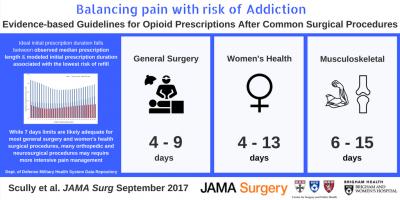
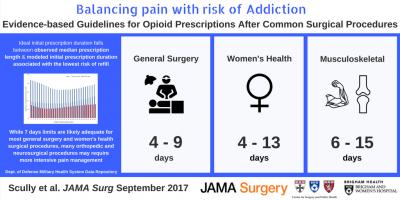
Using a mathematical model, researchers determined that the optimal length of opiate prescription was four to nine days for general surgery procedures, four to 13 days for women's health procedures, and six to 15 days for musculoskeletal procedures.
"We recognize that the opiate crisis is being addressed on many social, legislative, and policy levels," said senior author Louis Nguyen, MD, MBA, MPH. "We hope our paper provides a quantitative analysis of current prescribing patterns and sheds light on the optimal prescription in patients undergoing surgical procedures."
###
This work was funded by a grant from the Department of Defense / Henry M. Jackson Foundation HU0001-11-1-0023: The Comparative Effectiveness and Provider Induced Demand Collaboration (EPIC): A Clinical and Economic Analysis of Variation in Healthcare.
The Center for Surgery and Public Health (CSPH) at Brigham and Women's Hospital was established in 2005 as a joint program of Harvard Medical School and the Harvard T. H. Chan School of Public Health. Its mission is to advance the science of surgical care delivery by studying effectiveness, quality, equity, and value at the population level, and developing surgeon-scientists committed to excellence in these areas. CSPH works with a diverse set of collaborators, including academic institutions, non-profit and for-profit organizations nationally and internationally, in order to eliminate disparities and foster patient-centered care through policy and practice.
Brigham and Women's Hospital (BWH) is a 793-bed nonprofit teaching affiliate of Harvard Medical School and a founding member of Partners HealthCare. BWH has more than 4.2 million annual patient visits and nearly 46,000 inpatient stays, is the largest birthing center in Massachusetts and employs nearly 16,000 people. The Brigham's medical preeminence dates back to 1832, and today that rich history in clinical care is coupled with its national leadership in patient care, quality improvement and patient safety initiatives, and its dedication to research, innovation, community engagement and educating and training the next generation of health care professionals. Through investigation and discovery conducted at its Brigham Research Institute (BRI), BWH is an international leader in basic, clinical and translational research on human diseases, more than 1,000 physician-investigators and renowned biomedical scientists and faculty supported by nearly $600 million in funding. For the last 25 years, BWH ranked second in research funding from the National Institutes of Health (NIH) among independent hospitals. BWH continually pushes the boundaries of medicine, including building on its legacy in transplantation by performing a partial face transplant in 2009 and the nation's first full face transplant in 2011. BWH is also home to major landmark epidemiologic population studies, including the Nurses' and Physicians' Health Studies and the Women's Health Initiative as well as the TIMI Study Group, one of the premier cardiovascular clinical trials groups. For more information, resources and to follow us on social media, please visit BWH's online newsroom.
Media Contact
Elaine St. Peter
[email protected]
617-525-6375
@BrighamWomens
http://www.brighamandwomens.org
Related Journal Article
http://dx.doi.org/10.1001/jamasurg.2017.3132