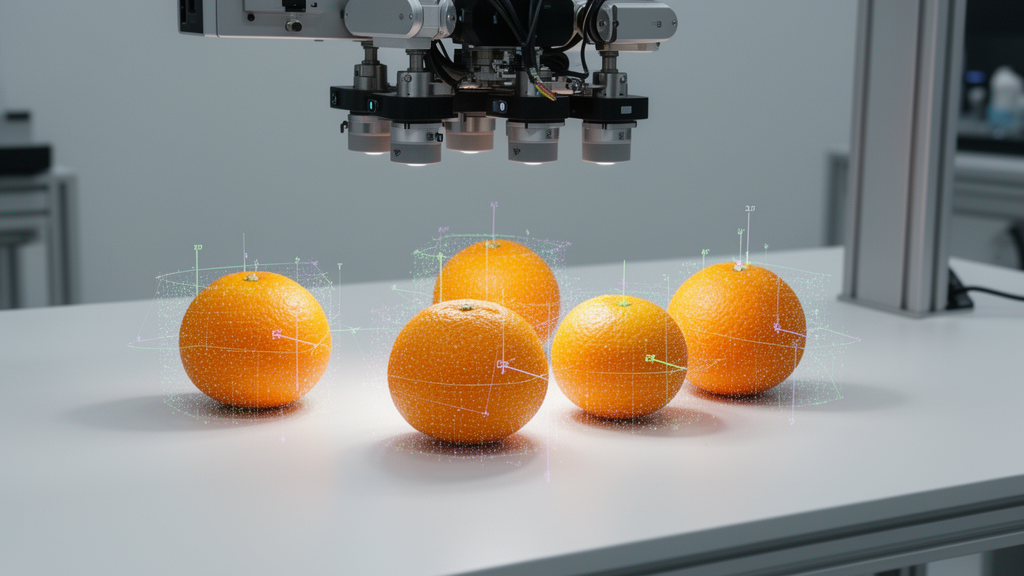
Automated postharvest sorting and robotic packaging systems require reliable real-time knowledge of agricultural produce in three-dimensional space, yet commercial sorting lines present formidable technical hurdles for computer vision algorithms. Citrus fruits travelling along motorized roller conveyors continuously rotate and translate, presenting naturally irregular curvatures and scales that confound conventional pose estimation pipelines reliant on pre-existing computer-aided design templates. Furthermore, the smooth, waxy peel of citrus varieties contains predominantly low-frequency visual textures with few distinctive features, which are frequently degraded by specular highlights and inter-frame motion blur during mechanical conveyance. To address these operational constraints, engineering researchers have introduced SDM-Citrus6D, a template-free dynamic pose estimation architecture designed to track the six-degree-of-freedom motion of individual citrus fruits across consecutive video frames without requiring synthetic rendering or object-specific geometric models. By coupling robust target segmentation with an enhanced semi-dense feature matcher and dual-stage point cloud registration, the system establishes reliable geometric correspondences directly from conveyor camera imagery, achieving high tracking accuracy under stringent positional thresholds.
Six-degree-of-freedom pose estimation resolves three translational and three rotational coordinates in spatial coordinates, providing the geometric foundation necessary for automated robotic manipulation and full-surface optical grading. In modern postharvest processing, machines must inspect the entire surface area of each fruit to quantify exterior defects, surface blemishes, and coloration percentages before directing items toward downstream packing stations. Previous agricultural handling frameworks have largely approached spatial tracking through single-frame absolute estimation, deploying convolutional regression networks, Transformer backbones, or offline template matching algorithms such as GDR-Net, NOPE, FoundationPose, and SAC-ICP. Although these approaches perform adequately when grasping stationary produce in structured harvesting settings, they struggle across high-speed packing belts where fruits exhibit extensive intra-class morphological variability. Alternative category-level frameworks, such as PLANTPose and Deep-ToMaToS, attempt to accommodate variations in fruit ripeness and size but require extensive synthetic training datasets generated through labor-intensive simulation software. In contrast, sequential tracking establishes dynamic correspondences across continuous temporal image frames, bypassing instance-specific geometric templates by exploiting the continuous physical trajectory of moving produce.
The operational workflow of the SDM-Citrus6D framework begins with semantic segmentation to isolate individual citrus targets from cluttered sorting line backgrounds and conveyor machinery. The researchers implemented PrioriFormer, a segmentation network developed on the SegFormer-B0 backbone that expands the feature representation space to segment fruits against mechanical rollers and ambient apparatus. When evaluated on citrus fruit imagery, PrioriFormer achieved a mean Intersection over Union of 99.2 percent, ensuring that subsequent matching operations operate exclusively on the fruit surface rather than background conveyor noise. Once background pixels are removed and target masks are extracted, consecutive masked image frames are passed to CitrusMatch, a detector-free semi-dense image matching architecture adapted from EfficientLoFTR to establish reliable correspondences across smooth peel surfaces.
Feature extraction within CitrusMatch begins with a lightweight convolutional neural network built on the RepVGG backbone, which constructs multi-scale feature hierarchies balancing computational latency and representational power. The network outputs coarse feature maps at one-eighth resolution alongside fine feature representations at one-fourth and one-half resolution. Because smooth citrus peels are dominated by broad, low-frequency textural structures, the investigators developed the Wavelet Feature Enhancement Module to process these extracted multi-scale representations. The module incorporates a four-branch convolutional layout wherein one branch applies a residual structure to preserve base feature representations while three parallel branches employ cascaded convolutions to widen contextual dependencies. Within these branches, two-dimensional discrete Wavelet Transforms decompose input features into low-frequency sub-bands capturing global geometry and high-frequency sub-bands preserving localized boundary details. Small convolution kernels process each frequency band independently before Inverse Wavelet Transforms reconstruct the enriched frequency responses back into the spatial feature domain, substantially enlarging the network receptive field.
Following multi-scale extraction and wavelet enhancement, coarse feature maps undergo transformation through an aggregation attention module that alternates between self-attention and cross-attention operations. This attention module utilizes deep convolutional layers and max-pooling operations to concentrate salient cues, subsequently applying vanilla attention mechanisms incorporating relative positional encodings to capture spatial arrangements across consecutive images. The transformed coarse features are then compared by calculating an inner-product score matrix scaled by an empirical temperature coefficient, followed by a dual-softmax normalization that determines mutual matching probabilities between image pairs. Correspondence candidates that satisfy a mutual nearest neighbor criterion and surpass a predefined confidence threshold are retained as coarse matches. The entire coarse matching pipeline is supervised using Focal Loss, which incorporates an optional overlap weighting factor to mitigate imbalances between positive correspondences and hard negative background samples.
To transition from coarse grid regions to precise continuous spatial coordinates, CitrusMatch employs a top-down Feature Pyramid Network that blends deep semantic features with shallow texture details. Feature dimensions are aligned using one-by-one convolutions, upsampled through bilinear interpolation, and integrated with multi-scale feature maps through element-wise additions, three-by-three convolutions, batch normalization, and LeakyReLU activations. The refined local features are then separated along the channel dimension into independent localization and regression pathways. To supervise this fine matching process, the authors formulated the Adaptive Fuzzy Region Matching mechanism, which dynamically adjusts the softmax distribution sharpness according to the mean confidence score of positive correspondences. In uncertain or motion-blurred regions, this adaptive formulation sharpens the resulting response heatmaps to suppress ambiguous matches. After an initial integer-pixel localization step corrects broad deviations, the Differentiable Spatial to Numerical Transform calculates spatial expectations across a local three-by-three neighborhood supervised by squared Euclidean L2 distance loss, yielding final sub-pixel correspondence coordinates.
Once two-dimensional sub-pixel correspondences are generated between adjacent image frames, SDM-Citrus6D back-projects these pixel coordinates into three-dimensional space using calibrated depth maps and camera intrinsic parameters. This back-projection reconstructs paired spatial point clouds representing the visible fruit surface across successive inspection intervals. To align these point clouds efficiently without suffering from numerical instability, the system randomly samples a subset of the three-dimensional correspondence pairs and computes an initial coarse rigid transformation via the Kabsch algorithm. Residual Euclidean distances between transformed source points and corresponding target points are calculated across the full set of matches, and correspondence pairs exceeding a predefined residual threshold are discarded as spatial outliers. The retained inlier set is subsequently processed by the Iterative Closest Point algorithm, which refines the rotation matrix and translation vector by iteratively minimizing alignment distances, yielding the final estimated six-degree-of-freedom transformation.
The CitrusMatch component was trained and evaluated using two tailored agricultural vision datasets created by the research team. The first, MegaDepth-Citrus, was constructed using 127 Bingtang sweet orange samples mounted on an electric turntable inside a diffuse reflection chamber equipped with dual linear lights and an Orbbec Gemini 335 RGB-D camera. Capturing images at 1.2-degree rotational intervals generated 300 multi-view images per sample, which were processed with COLMAP sparse reconstruction into training, validation, and test splits following a 7:1:2 ratio. The second benchmark, HPatches-Citrus, was compiled from 756 industrial sorting line images captured in Yunnan, China, each subjected to five random homographic transformations encompassing rotation, scaling, translation, and affine distortion. Ablation benchmarks revealed that while incorporating the Adaptive Fuzzy Region Matching mechanism alone increased matching precision from 92.6 percent to 96.8 percent on MegaDepth-Citrus, adding the Wavelet Feature Enhancement Module expanded relative pose recovery accuracy, raising the area under the cumulative curve at five degrees from 71.0 percent to 74.1 percent. On HPatches-Citrus, the combined CitrusMatch model achieved 97.09 percent accuracy under a five-pixel threshold, outperforming representative sparse matchers like SuperPoint and DISK coupled with LightGlue, the semi-dense baseline LoFTR, and dense matching networks including DKM and RoMa.
To evaluate dynamic tracking under realistic sorting conditions, the researchers constructed an eye-to-hand robotic validation platform comprising a Universal Robots UR5e robotic manipulator, a Mech-Mind PRO S-GL industrial structured-light RGB-D camera, and a vacuum pneumatic gripper connected to an air compressor. Physical motion trials evaluated 40 Bingtang oranges sourced from Hangzhou, China, exhibiting an average equatorial diameter of 73.8 millimeters within an observed range of 65.4 to 79.6 millimeters. The robotic manipulator guided fruits through programmed conveyor trajectories combining 0.02-meter translations along the conveyor axis, 15-degree rotations around the primary rotational axis, and random directional perturbations. The platform coordinate frames were aligned using the Horaud hand-eye calibration method, while five independent camera calibration cycles yielded an average reprojection error of 0.0149 pixels. Under standard diffuse illumination measuring 195.4 Lux, sequence-averaged absolute rotational errors along the orthogonal axes were 0.20 degrees, 0.48 degrees, and 0.95 degrees, while translation errors measured 9.03 millimeters, 2.88 millimeters, and 15.44 millimeters. When evaluated using the strict Average Distance of Model Points metric thresholded at five percent of fruit diameter—corresponding to a 3.65-millimeter tolerance—the framework attained an inter-frame relative tracking success rate of 92.50 percent, maintaining a 91.48 percent success rate under low-light illumination measuring 122.6 Lux. Runtime profiling showed an overall processing latency of 437 milliseconds for a complete seven-frame video sequence, with segmentation requiring 35.8 milliseconds, image matching taking 30.8 milliseconds, and pose estimation taking 21.3 milliseconds per frame pair.
Despite demonstrating robust tracking performance across variable lighting levels, the researchers highlighted several technical constraints inherent to the current methodology. The substantial translation error observed along the camera optical axis, which reached 15.44 millimeters, stems from systematic depth noise caused by structured-light sensor reflections on waxy citrus skins, compounded by the near-planar distribution of surface keypoints relative to the camera imaging plane. Furthermore, because absolute poses are accumulated recursively from consecutive inter-frame relative transformations, registration deviations inevitably drift across longer sequential trajectories, pointing to the future necessity of incorporating pose graph optimization to impose global temporal consistency. The setup also remains dependent on external structured-light depth cameras, prompting future investigations into end-to-end monocular depth estimation architectures to reduce hardware costs. Finally, because physical robotic validation was conducted exclusively on Bingtang sweet oranges, the generalizability of the pipeline across diverse citrus cultivars possessing disparate aspect ratios, surface textures, and morphological contours—such as lemons, mandarins, and navel oranges—remains to be systematically benchmarked in future postharvest packaging investigations.
Subject of Research: Dynamic six-degree-of-freedom citrus pose tracking via semi-dense image matching
Article Title: SDM-Citrus6D: dynamic 6D pose estimation of citrus based on semi-dense image matching
Article References: Xu, X., Guo, K., Jiang, H., Xu, T., Wei, Z., Guo, R., Li, Z., Yu, T., Chen, J., & Rao, X. (2026). SDM-Citrus6D: dynamic 6D pose estimation of citrus based on semi-dense image matching. Journal of King Saud University Computer and Information Sciences, 38(9), Article 1011. https://doi.org/10.1007/s44443-026-01399-7
Image Credits: AI Generated
DOI: 10.1007/s44443-026-01399-7
Keywords: citrus sorting, 6D pose estimation, semi-dense image matching, CitrusMatch, point cloud registration, Kabsch algorithm, iterative closest point, agricultural robotics, computer vision, PrioriFormer, wavelet transform, hand-eye calibration, postharvest automation, Bingtang orange, optical sorting, conveyor inspection, deep learning
News Source: Denise Maddox. (November 19, 2026). Semi-Dense Image Matching Model Accurately Tracks Dynamic Citrus 6D Poses. Scienmag.