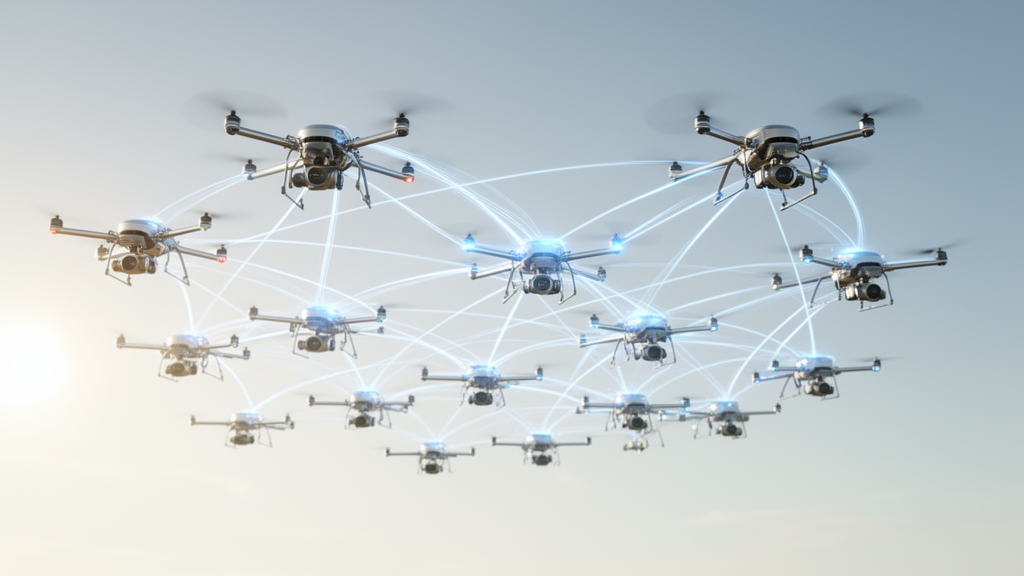
Researchers have developed an integrated flying ad hoc network optimization framework termed OSCER-FANET that combines kernel fuzzy c-means clustering with a battle field assisted greylag goose optimization algorithm to prolong aerial network operational lifetime and reduce communication delays. In computer simulation evaluations, the architecture maintained operational communication over 3520 rounds for a network of 100 unmanned aerial vehicles and 3643 rounds for 200 aerial nodes. The system demonstrated efficient power conservation by sustaining 0.56 joules of residual energy alongside an end-to-end transmission delay of 0.137 seconds after 2000 rounds of simulation. Statistical validation confirmed the significance of these performance gains across Friedman, Student t, and Wilcoxon non-parametric tests evaluated at a significance threshold of 0.05. By coordinating cluster formation and data forwarding through dual optimization stages, the system directly targets the physical constraints of dynamic multi-drone communications.
Flying ad hoc networks deploy autonomous unmanned aerial vehicles across civilian and defense operations, including emergency rescue missions, agricultural monitoring, aerial communications, wildfire detection, and traffic surveillance. However, establishing reliable, high-speed communication links across moving aerial platforms introduces distinct technical obstacles compared to conventional mobile or vehicular ad hoc networks. Rapid aerial mobility causes frequent shifts in network topology, intermittent communication links, and fragile multi-hop paths, while onboard drone hardware remains strictly limited by constrained battery reserves. Traditional routing protocols such as optimized link state routing, ad hoc on-demand distance vector routing, dynamic source routing, and greedy perimeter stateless routing frequently suffer from high control message overhead, path instability, and transmission delays when node positions change unpredictably. Similarly, standard clustering techniques like traditional k-means and basic fuzzy c-means struggle to maintain durable cluster groupings under nonlinear spatial dynamics, motivating the search for integrated swarm-based clustering and routing solutions.
The structural model of the proposed flying ad hoc network organizes autonomous aerial vehicles into a hierarchical, cluster-based arrangement to relieve individual drones of excessive routing burdens. Member aerial nodes capture operational data and forward their packets directly to designated cluster heads via intra-cluster wireless links. These cluster heads act as local coordinating hubs that aggregate incoming data streams and manage inter-cluster transmissions directed toward a centralized ground station gateway. To prevent network segmentation across vast or sparsely populated mission regions, the network architecture incorporates specialized ferry unmanned aerial vehicles that physically traverse separated operational zones to bridge isolated clusters. Evaluating this networked layout under varying node densities of 100 and 200 aerial units demonstrates that expanding the available node pool provides additional routing alternatives, distributing transmission loads more evenly across platforms and preventing rapid power depletion among frontline aerial relays.
The foundational phase of the framework employs a kernel fuzzy c-means algorithm to group unmanned aerial vehicles into stable clusters while accommodating spatial nonlinearity and topological uncertainty. Traditional fuzzy clustering techniques partition data points in original Euclidean space, often failing when mobile nodes form complex geometric patterns. In contrast, the kernel-extended algorithm executes an implicit nonlinear mapping of aerial node coordinates into a high-dimensional feature space using an analytical Gaussian kernel function. The objective function minimizes the fuzzy membership-weighted squared distance between transformed data vectors and abstract cluster prototypes without requiring explicit physical relocation of cluster centers in the input domain. Mathematical updates iteratively refine fuzzy membership degrees and cluster centers until convergence is achieved. This kernelized formulation limits unnecessary re-clustering events triggered by minor positional fluctuations, striking a balance between topological stability, signaling overhead, and computational energy expenditure.
Following cluster formation, the system executes an optimal cluster head selection process using the battle field assisted greylag goose optimization algorithm to designate coordinators for each partition. Electing inappropriate cluster heads can rapidly drain individual batteries, precipitating premature node exhaustion and overall communication collapse. The selection protocol assesses four explicit operational constraints: node residual energy, inter-cluster distance, intra-cluster distance, and cluster load balancing. Residual energy measures the proportion of remaining battery power across all aerial nodes compared to the cluster leaders, ensuring that selected heads possess sufficient reserves for continuous message coordination. Inter-cluster distance calculates the aggregate spatial separation between cluster heads and the destination ground station, directly affecting long-range transmission energy. Intra-cluster distance evaluates the average physical proximity between member drones and their respective cluster heads, measuring cluster compactness, while cluster load balancing calculates deviations in cluster sizes to ensure communication tasks remain evenly partitioned across the network.
The optimization engine powering cluster head selection and subsequent path routing adapts the population-based greylag goose optimization metaheuristic by incorporating positional mechanisms derived from the battlefield optimization algorithm. The baseline greylag goose algorithm models the collective social movement and foraging patterns of geese flocks, assigning portions of the search population to global exploration while directing the remainder toward local exploitation. To overcome premature convergence and prevent candidate solutions from trapping around local optima, the hybrid algorithm replaces the conventional secondary position formulation with a battlefield-inspired update mechanism. Search agents continuously adjust their positions based on guiding sentry vectors, dynamic weighting factors, and exponential damping parameters. If optimization progress stalls over three consecutive iterations, the algorithm deliberately expands the exploratory segment, enhancing population diversity and allowing search agents to discover superior cluster configurations across complex multi-dimensional search spaces.
After designating optimal cluster heads, the battle field assisted greylag goose optimization algorithm executes a secondary path discovery process to establish energy-smart inter-cluster transmission routes. Dynamic routing challenges such as sudden aerial congestion, fluctuating traffic intensity, and relay node failures require continuous path optimization to preserve delivery reliability. The routing objective function simultaneously evaluates four performance metrics: network lifetime, transmission delay, packet delivery ratio, and network throughput. Network lifetime is modeled as the ratio between initial node energy and maximum dissipated energy, concluding when critical relay drones exhaust operational power. Transmission delay measures the mean time required for successful end-to-end packet transfer across the network, while the packet delivery ratio calculates the proportion of delivered data against total transmitted constant bit rate packets. Throughput quantifies the average rate of successful data transfer between communicating node pairs in kilobits per second, with hyperbolic tangent normalization weighting each routing constraint.
The performance of the proposed framework was evaluated through extensive computer simulations executed in Python on a workstation equipped with a twelfth-generation Intel Core i5 processor running at 2.40 gigahertz and 12.0 gigabytes of memory. Simulations modeled network scenarios across operational durations of 500, 1000, 1500, and 2000 rounds under node variations of 100 and 200 unmanned aerial vehicles. Performance tracking focused on identifying lower values for delay, inter-cluster distance, and intra-cluster distance alongside higher measurements for residual energy, packet delivery ratio, and data throughput across identical simulation constraints.
Simulation results confirmed that the proposed framework consistently maintained superior energy preservation and clustering compactness across extended operational rounds. In tests examining 100 nodes, baseline optimizers such as pufferfish and coati retained residual energy levels between 0.40 and 0.50 joules after 500 rounds, declining to between 0.30 and 0.35 joules at 2000 rounds. In contrast, the battle field assisted greylag goose framework preserved 0.60 joules after 1500 rounds and 0.56 joules after 2000 rounds. For spatial compactness, baseline algorithms yielded inter-cluster distances ranging from 120 to 140 meters, whereas the proposed framework achieved 105 meters at 500 rounds and 100 meters at 2000 rounds. Intra-cluster distances followed an identical trajectory, with the proposed method recording 99 meters at 500 rounds and 95 meters at 2000 rounds, compared to pufferfish distances exceeding 121 meters. These tighter structural spans directly reduced wireless transmission power requirements during regular intra-cluster messaging.
Data transmission latency and delivery metrics further highlighted the operational advantages of the hybrid optimization strategy during routing evaluations. Under 100-node testing, hippo and pufferfish optimizers incurred end-to-end delays reaching 0.160 to 0.167 seconds after 2000 rounds, reflecting queueing delays and network congestion. The proposed framework restricted transmission delay to 0.100 seconds at 500 rounds, 0.110 seconds at 1000 rounds, and 0.137 seconds at 2000 rounds, with observed variations attributed to transient processing latency and dynamic network overhead. In packet delivery evaluations over 2000 rounds, coati and hippo models dropped to delivery ratios between 0.58 and 0.60, while pufferfish achieved a throughput score of 1.8. The proposed framework sustained a packet delivery ratio of 0.75, representing seventy-five percent successful packet arrival, alongside a throughput score of 2.75, confirming dependable message transport under persistent aerial node mobility.
Comparative lifetime assessments demonstrated substantial longevity improvements for networks managed by the hybrid framework across both small and large node configurations. In 100-node evaluations, pufferfish, coati, and hippo algorithms exhausted network functionality after 2922, 2974, and 3026 rounds respectively, while advanced schemes like hierarchically coordinated multi-hop routing attained 3376 rounds. The proposed method surpassed all baselines by sustaining operation across 3520 rounds. When node density expanded to 200 aerial platforms, coati reached 2996 rounds, pufferfish reached 3045 rounds, and the proposed framework achieved 3643 rounds.
Scalability testing and computational runtime assessments established the framework’s practical feasibility across expanding unmanned aerial vehicle deployments. When network dimensions were systematically scaled from 100 to 500 aerial nodes over 2000 rounds, the framework maintained stable packet delivery and residual energy levels while accommodating throughput growth, demonstrating that communication quality does not suffer abrupt degradation in dense airspace. Computational execution benchmarks recorded runtime durations of 1.885 seconds for 100 nodes and 2.127 seconds for 200 nodes, validating low computational overhead during clustering and path computation. The authors note that current selection constraints do not explicitly incorporate predictive mobility vectors, future energy availability, or dynamic wireless link reliability, highlighting opportunities to integrate reconfigurable intelligent surfaces and movable antenna technologies in future flying ad hoc network architectures.
Subject of Research: Swarm-driven clustering and energy-smart routing optimization for flying ad hoc networks
Article Title: A swarm driven clustering and energy smart routing in FANET environment
Article References: Rathi, V. O., Dhamdhere, S. D., Pawar, D., Gaikwad, K. P., & Dhamdhere, P. B. (2026). A swarm driven clustering and energy smart routing in FANET environment. Discover Artificial Intelligence, 6(1), Article 1903. https://doi.org/10.1007/s44163-026-02740-9
Image Credits: AI Generated
DOI: 10.1007/s44163-026-02740-9
Keywords: Flying Ad Hoc Networks, Unmanned Aerial Vehicles, Kernel Fuzzy C-Means, Greylag Goose Optimization, Battlefield Optimization Algorithm, Cluster Head Selection, Energy-Smart Routing, Network Lifetime, Residual Energy, End-to-End Delay, Packet Delivery Ratio, Throughput, Inter-Cluster Communication, Ferry UAVs, Swarm Intelligence, Metaheuristic Optimization, Clustering Compactness, Scalability Analysis
News Source: Denise Maddox. (November 19, 2026). Swarm Optimization Framework Improves Flying Ad Hoc Network Energy and Routing Lifetime. Scienmag.