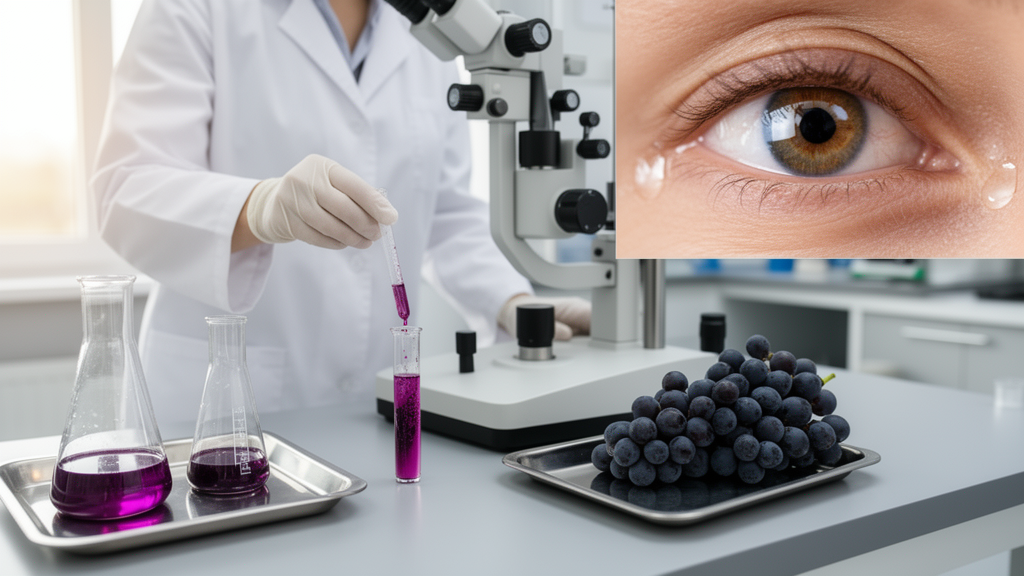
Oral grape skin enzyme fermentation extract demonstrated preliminary improvements in tear production and subjective eye fatigue over twelve weeks compared to placebo in adults with ocular discomfort, according to an exploratory randomized controlled trial conducted at Dankook University Hospital. The study evaluated adults assigned to consume either a daily 400-milligram capsule of the fermented extract, known as KL-GEFE, or an identical maltodextrin placebo. Participants receiving the active extract achieved a statistically significant baseline-adjusted between-group increase of 4.46 millimeters on the Schirmer I test of tear secretion and a 4.29-point reduction in an adapted Eye Strain Questionnaire total score relative to placebo. However, the trial observed no statistically significant between-group differences across several other objective ocular assessments, including noninvasive tear break-up time, fluorescein tear break-up time, corneal or conjunctival staining, critical flicker fusion frequency, and twelve-week Ocular Surface Disease Index scores. Because the trial lacked a prospectively defined endpoint hierarchy and multiplicity control framework, investigators characterized the clinical findings as exploratory observations requiring verification.
Dry eye disease ranks among the most prevalent ocular surface conditions globally, with epidemiological surveys estimating that between 5 and 50 percent of the adult population experiences symptoms depending on diagnostic criteria and geography. In South Korea, prevalence estimates reach approximately 33 percent among adults aged 65 years and older, while symptomatic complaints are increasingly reported by younger individuals facing heightened digital screen exposure. Beyond daily physical discomfort, ocular surface disorders impose substantial financial and personal burdens, encompassing direct medical expenses for artificial tear substitutes and prescription therapies as well as indirect costs linked to decreased workplace productivity and impaired visual functioning. The proliferation of digital screens has fostered an expanding demographic with computer-related dry eye symptoms and digital eye strain, characterized by reduced blink rates and incomplete blinks during prolonged near-vision focus. These behavioral alterations accelerate tear film destabilization and aqueous tear deficiency, prompting growing consumer interest in accessible oral nutraceutical options.
In addition, individuals with mild-to-moderate symptoms frequently require multiple concurrent eyedrop medications to maintain adequate symptom control. These treatment obstacles have fueled interest in oral nutraceuticals that offer convenient administration while potentially addressing systemic physiological factors such as oxidative stress and chronic low-grade inflammation. However, whether these experimental mechanisms translate into measurable clinical benefits when grape-derived anthocyanin preparations are administered orally in humans requires rigorous investigation.
The investigational product evaluated in this trial, designated KL-GEFE and commercially known as Nunaezone by Kitto Life Co., Ltd., is an enzymatic fermentation extract of grape skin standardized for anthocyanin oligomer content. Enzymatic fermentation is intended to enhance compound bioavailability relative to conventional grape skin extracts, and the ingredient previously obtained individual recognition as a functional food ingredient from the Korean Ministry of Food and Drug Safety under its dry eye health claims framework. The trial utilized capsules from clinical batch AO202504, using cyanidin as the quantitative release marker. High-performance liquid chromatography testing with ultraviolet-visible detection verified that the clinical batch contained 35.51 milligrams of cyanidin per gram, satisfying the predetermined specification range of 80 to 120 percent of the labeled 34.2 milligrams per gram. Participants randomized to the active arm received one medium-brown gelatin capsule containing 400 milligrams of the extract daily with water for twelve weeks, while the control group took an identical-appearing maltodextrin capsule.
Conducted at the Department of Ophthalmology at Dankook University Hospital in Cheonan, Republic of Korea, the randomized, double-blind, placebo-controlled trial enrolled adults aged 18 years or older reporting ocular fatigue and dry eye symptoms such as irritation, foreign-body sensation, eye pain, or visual disturbance. Eligible participants were required to exhibit baseline tear instability with a fluorescein break-up time of 10 seconds or less and a baseline Schirmer I value of at least 5 millimeters, without clinically apparent organic ocular surface damage or overt meibomian gland disease. Individuals with corneal epithelial erosion scoring 10 or higher on the 15-point National Eye Institute scale, recent ophthalmic surgery, allergic conjunctivitis, contact lens usage, or elevated intraocular pressure above 21 millimeters of mercury were excluded. Enrolled participants agreed to abstain from using artificial tears, related ophthalmic therapies, and dietary supplements known to affect ocular health throughout the twelve-week intervention period.
A total of 70 candidates underwent screening, with 68 participants successfully randomized in a 1:1 allocation to either the KL-GEFE arm (34 participants) or the placebo arm (34 participants). Randomization was performed using computer-generated permuted blocks, and allocation details remained concealed from participants, clinical coordinators, and outcome assessors throughout the study. Baseline demographic and clinical parameters were balanced between cohorts, with a mean participant age of 42.8 years in the active group and 44.7 years in the placebo group. Three participants withdrew consent before week 8, leaving 65 participants in the per-protocol analysis set, comprising 33 active and 32 control participants. Overall product adherence was robust, with mean compliance exceeding 93 percent across all scheduled clinic visits.
The Schirmer I test of tear secretion, performed without topical anesthesia by positioning a standardized paper strip in the lateral third of the lower conjunctival sac for five minutes, revealed steady divergence between study arms across follow-up visits. In the KL-GEFE cohort, participant-level mean tear secretion rose from 8.74 millimeters at baseline to 10.48 millimeters at week 4, 10.83 millimeters at week 8, and 10.97 millimeters at week 12, reflecting a within-group mean change of 2.23 millimeters. Conversely, participants assigned to placebo exhibited a decline from 8.36 millimeters at baseline to 6.22 millimeters at week 8 and 6.31 millimeters at week 12, representing a mean change of negative 2.05 millimeters. Baseline-adjusted analysis of covariance demonstrated statistically significant between-group differences favoring KL-GEFE at week 4 (2.31 millimeters), week 8 (4.36 millimeters), and week 12 (4.46 millimeters; 95% confidence interval, 2.96 to 5.95; P < 0.001). A supportive full analysis set using last observation carried forward yielded a consistent 4.36-millimeter difference.
Subjective symptom questionnaires provided contrasting outcomes between the trial’s customized survey instrument and the validated disease index. The adapted Eye Strain Questionnaire, a 10-item Korean-language survey rating ocular fatigue, irritation, pain, and eyelid twitching on a 0-to-60 scale, showed a progressive score reduction in the active group from 17.42 points at baseline to 10.03 points at week 12. In contrast, the validated 12-item Ocular Surface Disease Index, which scores dry eye severity from 0 to 100, showed score reductions across both cohorts. While an exploratory week-4 assessment revealed a statistically significant difference, the week-12 adjusted difference of negative 7.22 points failed to reach statistical significance (95% confidence interval, -14.76 to 0.32; P = 0.060).
Unlike the tear secretion measurements, comprehensive examinations of tear film stability and ocular surface epithelial integrity failed to detect statistically significant between-group differences at twelve weeks. Automated noninvasive keratograph tear break-up evaluations, capturing both first break time and average break time, produced adjusted between-group differences of 0.14 seconds and 0.16 seconds, respectively, neither showing statistical significance. Similarly, conventional fluorescein tear break-up time assessments demonstrated a negligible adjusted between-group difference of negative 0.18 seconds. Corneal and conjunctival epithelial staining scores, graded using the National Eye Institute classification scale, improved over time within both groups, resulting in non-significant between-group differences of 0.02 and 0.10 points.
Safety evaluations demonstrated that oral KL-GEFE was well tolerated, with only two mild, unrelated adverse events reported across the 68 participants—one respiratory infection in the extract group and one case of plantar fasciitis in the control group—and no serious adverse events, vital sign abnormalities, or ophthalmic complications on slit-lamp or funduscopic examinations. Nonetheless, the trial authors underscored notable methodological limitations that require cautious interpretation of the positive findings. The trial was registered retrospectively on the Clinical Research Information Service under registration identifier KCT0012279 on July 14, 2026, after study completion, and the pre-enrollment protocol lacked a prospectively defined endpoint hierarchy or multiplicity adjustment framework. In addition, the single-center setting, predominantly female population (85.3 percent), twelve-week duration, and absence of mechanistic evaluations—such as tear osmolarity, inflammatory cytokines, lacrimal gland imaging, and meibography—preclude definitive causal claims. The researchers concluded that larger multicenter trials with prospectively defined primary endpoints are required before recommending the fermented extract for clinical use.
Subject of Research: Oral grape skin enzyme fermentation extract for dry eye and ocular fatigue
Article Title: Effects and Safety of Grape Skin Enzyme Fermentation Extract for Eye Fatigue and Dry Eye Symptoms: An Exploratory Randomized Controlled Trial
Article References: Kim, H., Yang, H. P., Park, Y., & Cho, K. (2026). Effects and Safety of Grape Skin Enzyme Fermentation Extract for Eye Fatigue and Dry Eye Symptoms: An Exploratory Randomized Controlled Trial. Ophthalmology and Therapy, 15(11), 3869-3886. https://doi.org/10.1007/s40123-026-01509-8
Image Credits: AI Generated
DOI: 10.1007/s40123-026-01509-8
Keywords: dry eye disease, grape skin extract, enzyme fermentation, anthocyanins, Schirmer test, Eye Strain Questionnaire, tear secretion, ocular fatigue, randomized controlled trial, Dankook University Hospital, cyanidin, Ocular Surface Disease Index, tear film stability, nutraceuticals, corneal staining, digital eye strain, retrospective trial registration
News Source: Ophelia Keating. (November 19, 2026). Exploratory Trial Finds Fermented Grape Skin Extract May Increase Tear Secretion. Scienmag.