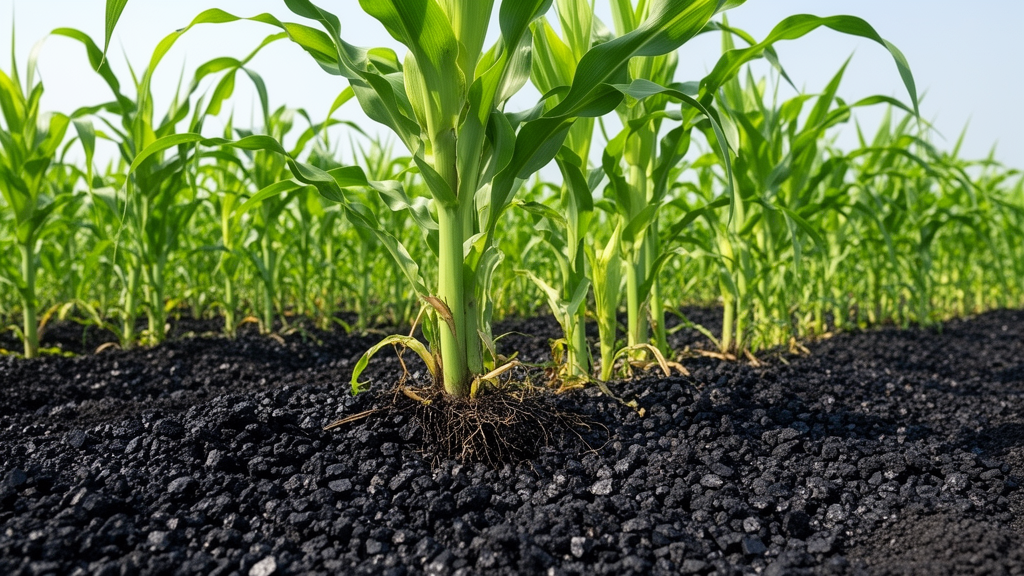
Field trials conducted across the 2023 and 2024 cropping seasons in southwest Nigeria demonstrate that amending coarse-textured Alfisols with carbon-dense palm kernel shell biochar significantly enhances soil physical properties, reduces nitrate-nitrogen concentrations in soil leachate, and more than doubles maize grain yields. Conducted on experimental plots at the Teaching and Research Farm of Bowen University in Iwo, Osun State, the investigation systematically compared four distinct biochar materials against an unamended control under uniform inorganic nitrogen fertilization. While all tested biochar types contributed to measurable gains in soil condition and crop performance, materials derived from lignocellulosic feedstocks possessing higher organic carbon content and elevated carbon-to-nitrogen ratios outperformed nutrient-rich manure biochar. Over the two-year evaluation period, palm kernel shell biochar emerged as the most effective amendment, increasing average maize grain yield by 138.5 percent relative to untreated plots while simultaneously lowering nitrate-nitrogen concentrations in collected drainage water across multiple soil depths.
The study addressed persistent agronomic challenges that constrain cereal cultivation throughout the humid and derived savanna zones of southwestern Nigeria, where sandy loam Alfisols predominate. These weathered basement-complex soils are naturally characterized by low organic matter reserves, weak structural aggregation, and depleted cation exchange capacity. Because the topsoil contains approximately 68 percent sand and less than 13 percent clay, percolating rainwater moves rapidly through the profile, accelerating the downward displacement of dissolved plant nutrients away from active crop rooting zones. Nitrate represents a negatively charged anion that mineral soil particles retain weakly, making it especially susceptible to severe leaching during the intense precipitation events typical of the tropical early cropping season. Although the national attainable grain yield for maize in Nigeria ranges from 9 to 12 tonnes per hectare, subsistence and commercial growers typically harvest only 1.3 to 2 tonnes per hectare, a persistent yield gap exacerbated by soil nutrient depletion and inefficient mineral fertilizer utilization.
To evaluate whether tailored organic amendments could mitigate these structural and nutritional constraints, the agronomic researchers produced four distinct biochar amendments using local feedstock biomass. The raw materials consisted of rice straw, hardwood harvested from Prosopis africana, palm kernel shells, and poultry manure. Each feedstock underwent slow pyrolysis inside an enclosed metal drum container measuring 70 centimeters in height and 46 centimeters in diameter, heated by natural gas to a sustained internal temperature of 500 degrees Celsius for 12 continuous hours. Following thermal conversion and cooling, the pyrolyzed materials were pulverized and sieved through a 2-millimeter mesh. Subsequent laboratory characterization revealed profound differences in the chemical and physical architecture of the finished amendments. Palm kernel shell biochar demonstrated the highest organic carbon content at 48.5 percent, the highest carbon-to-nitrogen ratio at 60.63, the highest estimated porosity at 75.86 percent, and the lowest bulk density at 0.461 grams per cubic centimeter. In contrast, poultry manure biochar exhibited the lowest carbon content at 30.6 percent and a narrow carbon-to-nitrogen ratio of 19.13, but supplied substantially higher initial concentrations of nitrogen and phosphorus alongside a slightly alkaline pH of 7.10.
The experimental field design was organized as a randomized complete block design featuring four independent replications per treatment across 20 experimental plots each season, occupying an aggregate experimental area of 255 square meters. Individual plots measured 3 meters by 3 meters, separated by designated buffer spacing, with treatments established on separate but pedologically comparable farm sites during 2023 and 2024 to avoid confounding residual carryover effects. Following conventional plowing and harrowing, the biochars were manually incorporated into the upper soil layer at an application rate of 10 tonnes per hectare, corresponding to 9 kilograms per plot. Plots were seeded in May of each year with a high-yielding, medium-maturing hybrid maize variety biofortified with vitamin A. Sowing took place at a spacing of 75 centimeters between rows and 25 centimeters within rows, before stands were thinned to a single plant per station two weeks after sowing. Mineral nitrogen was uniformly supplied across all treatments at that time as granular urea applied at 120 kilograms of nitrogen per hectare using ring placement, supported by standardized chemical weed and fall armyworm control regimens.
Baseline soil characterization confirmed that the experimental plots represented typical low-fertility Egbeda soil series classified as Plinthic Kandiudalfs under the United States Department of Agriculture Soil Taxonomy. Prior to planting, topsoil core samples from the 0 to 15 centimeter depth revealed an acidic reaction with water pH values between 5.60 and 5.68, compact initial bulk density averaging 1.45 to 1.48 grams per cubic centimeter, and sub-critical baseline nutrient reserves. Soil organic carbon measured 1.48 percent in 2023 and 1.50 percent in 2024, falling well beneath the regional critical threshold of 1.74 percent established for tropical crop production. Baseline total nitrogen measured 0.17 percent, available Bray-1 phosphorus ranged between 6.92 and 7.41 milligrams per kilogram, and exchangeable potassium remained depressed between 0.11 and 0.13 centimoles per kilogram. These low fertility indices confirmed that continuous cropping and high weathering had left the site severely nutrient-deficient and reliant on external nutrient conservation interventions.
Periodic monitoring initiated four weeks post-incorporation indicated that biochar amendments significantly restructured the physical matrix of the topsoil. Soil bulk density declined markedly across all amended treatments, with the magnitude of reduction following the sequence of palm kernel shell biochar, wood biochar, rice straw biochar, poultry manure biochar, and the unamended control. Plots receiving palm kernel shell biochar achieved the lowest seasonal mean bulk densities of 1.19 grams per cubic centimeter in 2023 and 1.20 grams per cubic centimeter in 2024, compared to compact control values of 1.55 and 1.58 grams per cubic centimeter. Total soil porosity increased accordingly, reaching 55.19 percent in 2023 and 54.72 percent in 2024 under palm kernel shell biochar, compared to roughly 40 to 41 percent in unamended soil. Gravimetric soil moisture retention also peaked under palm kernel shell biochar at 20.52 percent in 2023 and 19.81 percent in 2024, providing substantial moisture buffering relative to the 11.70 to 12.18 percent observed in control plots.
Post-harvest chemical analyses demonstrated broad fertility enhancements, though individual soil parameters responded differently depending on whether amendments supplied direct labile nutrients or recalcitrant carbon fractions. Soil organic carbon was maximized under palm kernel shell biochar, reaching 1.91 percent in 2023 and 1.96 percent in 2024, representing an average two-year increase of 71.7 percent relative to control plots. Wood and rice straw biochars produced intermediate carbon increases of approximately 55 percent, whereas poultry manure biochar achieved a 36.3 percent rise. Conversely, poultry manure biochar induced the highest concentrations of total nitrogen at 0.28 percent, available phosphorus exceeding 17 milligrams per kilogram, and exchangeable calcium and magnesium. Wood biochar and palm kernel shell biochar exhibited no statistically significant differences from one another regarding residual soil nitrogen, phosphorus, or exchangeable cations, indicating that physical dilution, carbon persistence, and surface charge interactions played a more decisive agronomic role than feedstock nutrient content alone.
Soil was repacked to field-equivalent bulk density of 1.30 grams per cubic centimeter and leached over three consecutive weeks with simulated rainfall totaling 91.5 millimeters weekly, applied in three discrete pulses. Colorimetric analysis of collected drainage water demonstrated that biochar amendments substantially suppressed nitrate-nitrogen concentrations in leachate relative to the unamended control. Palm kernel shell biochar achieved the lowest nitrate concentrations across every evaluated depth and season. At the 15 to 30 centimeter depth in 2024, nitrate-nitrogen concentration dropped from 172.77 milligrams per liter in the control to 97.46 milligrams per liter under palm kernel shell biochar, representing a 43.6 percent reduction. Nitrate concentrations consistently increased with depth across all treatments, peaking in the 45 to 60 centimeter layer.
The physical and chemical improvements imparted by the amendments translated into pronounced agronomic gains for the maize crop. Plant height, leaf counts, individual plant leaf area, and shelled grain weight all increased significantly across biochar-amended plots relative to untreated controls. Stand leaf area measured at the tasseling stage expanded from 499.6 square centimeters in unamended control plots to 1101.7 square centimeters under palm kernel shell biochar during 2024. In the same cropping season, harvested grain yield reached 4.31 tonnes per hectare under palm kernel shell biochar, compared to 1.85 tonnes per hectare in control plots. Averaged across both cropping seasons, palm kernel shell biochar yielded 4.33 tonnes per hectare, outperforming rice straw biochar and wood biochar, which averaged 3.945 tonnes per hectare, and poultry manure biochar, which produced 3.48 tonnes per hectare. While poultry manure biochar supplied abundant initial nutrients, its lower physical stability and narrower carbon-to-nitrogen ratio corresponded to lower sustained vegetative development and yield improvements than the lignocellulosic materials.
Exploratory Pearson correlation analyses performed on the analytical data revealed striking associations between raw biochar characteristics, soil properties, leachate nitrate concentrations, and maize performance metrics. Feedstock organic carbon content and carbon-to-nitrogen ratios displayed strong negative correlations with leachate nitrate-nitrogen concentrations at all three sampling depths, while exhibiting strong positive correlations with soil porosity, moisture content, and final grain yield. However, because these statistical calculations were derived from a limited sample size of four biochar types, the authors emphasized that the observed correlations must be interpreted as descriptive and hypothesis-generating rather than verifiable evidence of direct biological causation, especially given that multiple physical and chemical parameters varied simultaneously across feedstocks.
The researchers cautioned that while leachate nitrate concentrations were markedly diminished under biochar treatment, the study did not measure continuous water flux or cumulative nitrate mass transport through the profile, precluding definitive conclusions regarding absolute catchment-scale nitrogen leaching loads. Furthermore, specific physicochemical mechanisms such as direct anion adsorption, cation exchange capacity shifts, microbial nitrogen immobilization, and nitrification enzyme kinetics were not directly quantified in the field. The experimental findings reflect early-season outcomes from a single agroecological research station operating under a uniform amendment rate of 10 tonnes per hectare. Future investigations will require broader multi-location trials across contrasting soil textures, long-term monitoring of biochar weathering, and dynamic lysimeter measurements of nitrate flux to verify whether the structural advantages of palm kernel shell biochar endure across varied tropical farming systems.
Subject of Research: Effects of diverse biochar amendments on soil properties, leachate nitrate concentrations, and maize productivity in tropical Alfisols
Article Title: Effects of different biochar types on nitrogen retention, soil properties, and maize growth and yield on sandy loam Alfisols
Article References: Adekiya, A. O., Babadele, D. O., & Agbede, T. M. (2026). Effects of different biochar types on nitrogen retention, soil properties, and maize growth and yield on sandy loam Alfisols. Frontiers in Sustainable Food Systems, 10, Article 1960297. https://doi.org/10.3389/fsufs.2026.1960297
Image Credits: AI Generated
DOI: 10.3389/fsufs.2026.1960297
Keywords: biochar, palm kernel shell biochar, maize yield, Alfisols, nitrogen retention, nitrate concentration, soil bulk density, soil porosity, soil organic carbon, rice straw biochar, wood biochar, poultry manure biochar, tropical agriculture, leachate analysis, soil fertility, Zea mays, nutrient management
News Source: Alan Morgan. (November 19, 2026). Palm Kernel Shell Biochar Reduces Leachate Nitrate and Boosts Maize Yield. Scienmag.