Preventing inflammation in obese fat tissue may hold the key to preventing or even reversing type 2 diabetes, new research has found.
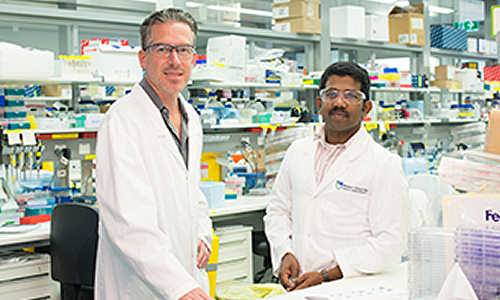
Dr. Axel Kallies (L), Dr. Ajith Vasanthakumar and colleagues have found a signalling molecule could prevent inflammation in fat tissue, reversing symptoms of type 2 diabetes. Photo Credit: Walter and Eliza Hall Institute
Researchers from Melbourne’s Walter and Eliza Hall Institute, with colleagues from the RIKEN Institute, Japan, found they could ‘reverse’ type 2 diabetes in laboratory models by dampening the inflammatory response in fat tissue.
Dr Ajith Vasanthakumar, Dr Axel Kallies and colleagues from the institute discovered that specialised immune cells, called regulatory T cells (Tregs), played a key role in controlling inflammation in fat tissue and maintaining insulin sensitivity. The findings were published in the journal Nature Immunology.
More than 850,000 Australians are estimated to have type 2 diabetes, which is the most common type of diabetes, and its prevalence is rising. The disease is strongly linked with ‘lifestyle’ factors, such as being overweight or having high blood pressure. Long-term complications of type 2 diabetes include kidney, eye and heart disease, and there is no cure.
People with type 2 diabetes have reduced sensitivity to insulin, a hormone that normally triggers uptake of glucose by cells, and their cells no longer respond to insulin appropriately. This decrease in insulin sensitivity is thought to be a result of long-term, low-level inflammation of fat tissue in people who are obese.
Dr Vasanthakumar said Tregs acted as the guardians of the immune system, preventing the immune response from getting out-of-hand and attacking the body’s own tissues. “When Treg numbers are reduced, inflammatory diseases such as diabetes and rheumatoid arthritis can occur,” he said.
Recent studies have shown that fat tissue has its own unique type of Tregs, which disappear from fat tissue during obesity. “The fat tissue of obese people has lower numbers of Tregs than the fat tissue of people in a healthy weight range,” Dr Vasanthakumar said. “Without Tregs, inflammation-causing cell levels increase, and this rise in inflammation can lead to insulin resistance and high blood glucose levels, a classic hallmark of type 2 diabetes.”
The research team discovered a key hormone called IL-33 (interleukin-33) was able to selectively boost Treg populations in fat tissue, effectively halting the development of type 2 diabetes, or even reversing the disease in preclinical models.
“Treating fat tissues with IL-33 restored normal Treg cell levels, which reduced inflammation and decreased blood glucose levels,” Dr Vasanthakumar said. “Treatments that mimic IL-33 could have the potential to reduce obesity-related inflammation and type 2 diabetes.”
Dr Kallies said the research underscored the importance of ‘healthy’ fat tissue in maintaining a healthy body. “We can no longer think of fat tissue simply as energy storage,” Dr Kallies said.
“Fat tissue is increasingly being recognised as a crucial organ that releases hormones and regulates development. Keeping our fat tissue healthy is important for our general wellbeing, and our research highlights the important role it plays in preventing disease.”
The study was funded by the National Health and Medical Research Council, the Australian Research Council, the Sylvia and Charles Viertel Foundation and the Victorian Government.
Story Source:
The above story is based on materials provided by Walter and Eliza Hall Institute.