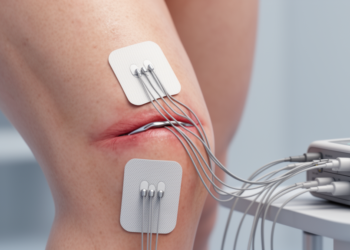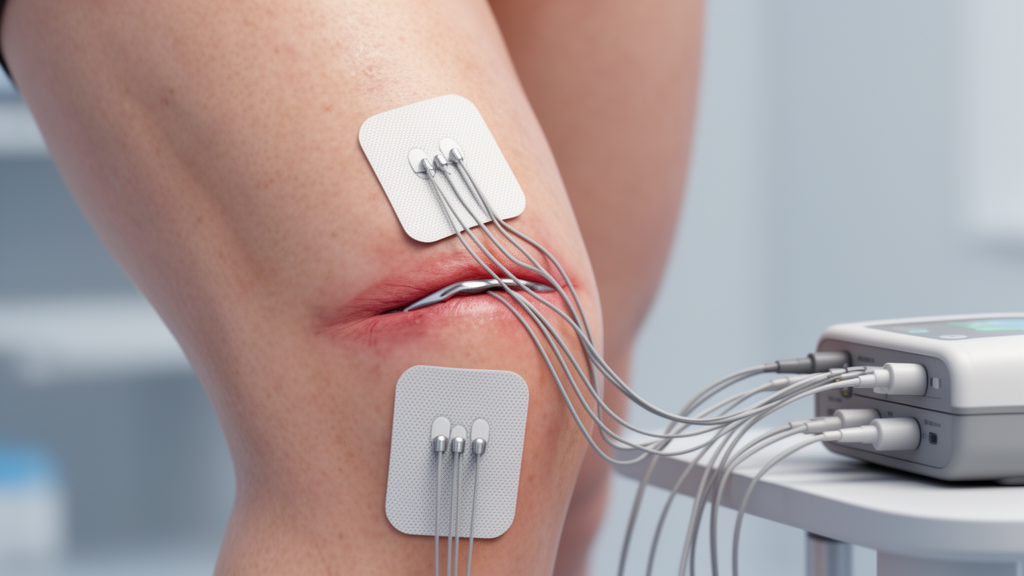
An umbrella review evaluating eleven meta-analyses has found that transcutaneous electrical nerve stimulation significantly reduces acute postoperative pain and decreases opioid consumption in patients undergoing total knee arthroplasty. According to the evidence synthesis, the non-invasive analgesic modality delivered statistically significant reductions in patient-reported pain intensity at both twenty-four and seventy-two hours following surgery. Patients receiving the electrical stimulation therapy also demonstrated marked improvements in early functional rehabilitation metrics, including enhanced knee range of motion and superior Hospital for Special Surgery knee scores. Furthermore, the adjunctive intervention was associated with a measurable reduction in postoperative length of hospital stay and a significantly lower incidence of opioid-related adverse events, particularly postoperative nausea and vomiting. However, the investigators noted that these therapeutic advantages were strictly confined to the early perioperative phase, as pain assessments recorded at two weeks post-surgery demonstrated no statistically significant differences between stimulated and control cohorts.
The clinical motivation behind the comprehensive overview stems from the immense global surgical volume of total knee arthroplasty and the formidable therapeutic challenge posed by acute postoperative pain. Total knee arthroplasty represents a cornerstone orthopedic procedure for patients suffering from severe joint degeneration, advanced osteoarthritis, and inflammatory articular destruction that cause irreversible structural damage. By replacing worn articular cartilage with prosthetic mechanical components, the surgery restores alignment, relieves disabling pain, and substantially improves daily physical functioning. With progressive demographic aging worldwide, epidemiological projections indicate that the annual volume of knee replacement procedures will exceed three million operations globally by 2030, creating substantial healthcare burdens. Despite high surgical success rates and long-term implant survival, severe acute pain after surgery remains a frequent obstacle to early recovery. Suboptimally managed postoperative pain delays early mobilization, elevates the clinical risk of deep thromboembolic events, accelerates periarticular muscle atrophy, and increases the likelihood of persistent chronic post-surgical pain syndromes.
Conventional perioperative pain management protocols after knee reconstruction typically depend upon multimodal pharmaceutical regimens involving systemic opioids, oral nonsteroidal anti-inflammatory drugs, and regional peripheral nerve blocks. Although systemic opioids remain potent analgesics, their administration carries substantial risks of dose-dependent respiratory depression, deep sedation, gastrointestinal hypomotility, constipation, acute nausea, and long-term dependency or misuse. Nonsteroidal anti-inflammatory agents introduce competing clinical hazards, including gastrointestinal ulceration and hemorrhage, renal impairment, and adverse cardiovascular events, while regional nerve blockade can induce motor weakness that heightens patient fall risks during early ambulation. These clinical drawbacks have stimulated extensive interest in non-pharmacological adjunctive modalities capable of mitigating pain intensity while simultaneously curtailing systemic opioid requirements. Transcutaneous electrical nerve stimulation represents a non-invasive, inexpensive, and readily accessible physical modality that delivers mild, low-frequency electrical currents across the skin surface via surface electrodes, thereby engaging sensory neurobiological pathways without introducing pharmacologic systemic toxicities.
To establish definitive pooled evidence regarding the clinical efficacy of this physical therapy modality, the research team registered their systematic umbrella review protocol on the Prospective Register of Systematic Reviews under accession number CRD420251126630. The authors conducted systematic literature queries across four major electronic databases, including PubMed/MEDLINE, Embase, the Cochrane Library, and Web of Science, identifying eligible systematic reviews and meta-analyses published through September 2025. Following established methodological standards set forth by the Cochrane Handbook for umbrella reviews and the PRISMA reporting guidelines, the preliminary search captured forty-two candidate systematic reviews. After removing eleven duplicate records, thirty-one unique citations underwent title and abstract screening, leading to the exclusion of nine ineligible publications. The investigators retrieved and appraised twenty-two full-text publications, ultimately eliminating eleven studies that failed eligibility criteria and retaining eleven high-relevance meta-analyses for quantitative synthesis and critical appraisal.
Strict inclusion criteria dictated that eligible reviews must adhere to PRISMA reporting standards, incorporate meta-analyses containing at least two primary randomized controlled trials per outcome, and investigate adult patients undergoing primary unilateral or bilateral total knee replacement for end-stage joint pathologies. The protocol specifically required that meta-analyses evaluate non-invasive transcutaneous electrical currents against conventional postoperative analgesic controls across predefined outcomes, including pain scores, opioid requirements, range of motion, functional scores, hospital stay duration, and adverse complications. To maintain clinical and physical homogeneity, the review systematically excluded narrative summaries, clinical trial protocols, letters, non-English publications, and alternative electrical interventions. Excluded modalities encompassed neuromuscular electrical stimulation, which utilizes higher-intensity motor currents for muscle strengthening rather than sensory pain modulation; invasive peripheral nerve stimulation requiring surgical electrode placement adjacent to peripheral nerve trunks; and electroacupuncture, which relies upon percutaneous needle insertion into anatomical acupoints rather than cutaneous electrode pads.
Recognizing that overlapping primary randomized trials across different meta-analyses could artificially inflate sample sizes and distort pooled effect estimates, the researchers evaluated study overlap using the Graphical Representation of Overlap for Overviews tool. By calculating the Corrected Covered Area, the software categorized primary trial duplication into slight, moderate, high, or very high overlap categories. Predetermined decision rules established that Cochrane reviews took analytical precedence, followed by non-Cochrane meta-analyses exhibiting superior AMSTAR 2 methodological scores or larger trial enrollments when high overlap occurred. Across all evaluated clinical outcomes, primary trial overlap remained beneath fifteen percent, confirming that most syntheses maintained slight or moderate overlap. For statistical synthesis, the researchers evaluated study heterogeneity using Cochran’s Q test and the I-squared statistic, interpreting values below twenty-five percent as low heterogeneity and values exceeding seventy-five percent as substantial heterogeneity. Fixed-effect models were applied when I-squared fell below fifty percent with non-significant Q tests, whereas random-effects models addressed substantial between-study variance.
Across the seven meta-analyses reporting postoperative pain intensity, quantitative pooling revealed statistically significant early analgesia in patients receiving transcutaneous electrical nerve stimulation compared with control regimens. At twenty-four hours after surgery, the weighted mean difference was minus 0.42 points on standard pain scales, with a ninety-five percent confidence interval spanning minus 0.59 to minus 0.25, demonstrating strong statistical significance at P less than 0.00001 with zero percent heterogeneity. At seventy-two hours postoperatively, the analgesic advantage expanded, yielding a mean difference of minus 0.84 points with a ninety-five percent confidence interval from minus 1.17 to minus 0.52, maintaining identical statistical significance and zero percent heterogeneity. However, evaluations conducted at two weeks after surgery demonstrated no statistically significant difference between treatment arms, showing a mean difference of 0.97 points, a wide confidence interval from minus 0.66 to 2.60, a non-significant P value of 0.24, and substantial heterogeneity of ninety-one percent, reflecting post-discharge protocol cessation, varied rehabilitation, and changing pain biology.
The review identified a clinically meaningful reduction in overall postoperative opioid requirements among patients allocated to adjunctive electrical stimulation therapy. Pooling data from four meta-analyses, the standardized mean difference in opioid consumption was minus 0.58, with a ninety-five percent confidence interval between minus 1.06 and minus 0.11, achieving statistical significance at P equals 0.02 alongside moderate heterogeneity of fifty-three percent. This opioid-sparing effect corresponded directly with reduced pharmacological side effects during inpatient recovery. Evaluating adverse events reported across two constituent meta-analyses, the authors identified statistically significant reductions in postoperative nausea and vomiting among treated individuals. One included meta-analysis documented a risk difference of minus 0.0980 with a ninety-five percent confidence interval between minus 0.180 and minus 0.016 at P equals 0.02, while a second review reported an odds ratio of 0.300 with a ninety-five percent confidence interval of 0.20 to 0.45 at P less than 0.00001, both demonstrating zero percent heterogeneity.
Early physical and functional recovery metrics showed parallel improvements among surgical patients managed with transcutaneous electrical nerve stimulation. Functional mobility synthesized from two meta-analyses revealed a statistically significant increase in active knee range of motion, with a standardized mean difference of 0.40, a ninety-five percent confidence interval of 0.11 to 0.68, a P value of 0.006, and zero percent heterogeneity. Joint-specific function evaluated via the Hospital for Special Surgery score across two meta-analyses demonstrated a pooled mean increase of 4.18 points in favor of electrical stimulation, supported by a ninety-five percent confidence interval of 2.91 to 5.45 and P less than 0.00001 with zero percent heterogeneity. Because this numerical gain exceeds established minimal clinically important difference thresholds, it indicates tangible recovery in joint stability and mobility. Additionally, length of hospital stay synthesized from two meta-analyses was significantly shortened in the stimulation cohorts, displaying a standardized mean difference of minus 0.20, a confidence interval of minus 0.38 to minus 0.03, P equals 0.02, and zero percent heterogeneity.
The authors contextualized these clinical outcomes within established neurophysiological pain modulation pathways documented in recent physiological literature. Classical gate control theory dictates that small-diameter unmyelinated C and finely myelinated A-delta nerve fibers convey ascending nociceptive signals, whereas stimulation of large-diameter cutaneous A-beta sensory afferents inhibits pain transmission within the dorsal horn of the spinal cord. Non-invasive electrical stimulation selectively activates cutaneous A-beta fibers, augmenting dorsal horn segmental gating mechanisms to block ascending nociceptive traffic toward higher cerebral centers. Furthermore, neuroimaging and biochemical investigations indicate that cutaneous electrical stimulation modulates central nervous system structures, including the lateral prefrontal cortex, anterior cingulate cortex, thalamus, amygdala, and hippocampal structures, while altering neurotransmitter concentrations of norepinephrine, serotonin, dopamine, and acetylcholine. Stimulation also promotes central releases of endogenous beta-endorphins and enkephalins that bind mu-opioid receptors, explaining reduced systemic opioid demands, while downregulating pro-inflammatory cytokines like tumor necrosis factor-alpha and interleukin-1-beta and promoting anti-inflammatory interleukin-10 within periarticular synovial tissues.
Despite positive clinical signals across acute postoperative metrics, critical appraisal highlighted substantial methodological limitations that require cautious interpretation by orthopedic surgeons and clinical policymakers. Methodological assessment conducted with the AMSTAR 2 critical appraisal tool revealed notable quality dispersion across the eleven meta-analyses: five reviews achieved high methodological ratings, two were appraised as moderate, and four were classified as low quality due to reporting deficiencies. Furthermore, certainty of evidence evaluated through the GRADE framework remained low to very low for primary pain relief, low to very low for range of motion, very low for Hospital for Special Surgery functional scores, and moderate to very low for opioid consumption. The authors noted that downgrades stemmed primarily from high risks of methodological bias, inadequate patient and assessor blinding, small sample sizes in constituent primary trials, and potential publication bias across published literature.
Geographical concentration and technical variability present additional constraints on the generalizability of the pooled findings across global clinical settings. Seven of the eleven analyzed meta-analyses originated from corresponding author research groups based in China, with the remaining four publications derived from researchers in the United States, Belgium, Italy, and Saudi Arabia. This geographic clustering raises questions regarding international transferability given regional divergences in perioperative surgical workflows, patient discharge thresholds, and post-discharge physical therapy regimens. Furthermore, the included trials exhibited extensive variability in stimulation parameters, including differing pulse frequencies, stimulation intensities, pad placements, daily treatment durations, and timing of device initiation. The literature also lacked standardized reporting of device-related adverse reactions, provided no longitudinal tracking beyond fourteen days, and omitted health economic data regarding device acquisition, staff training expenses, and potential inpatient cost savings.
In their concluding synthesis, the investigators underscored that transcutaneous electrical nerve stimulation represents an effective, safe, and biologically plausible adjunctive modality for acute pain relief following total knee replacement. The therapy delivers clear clinical utility during the initial seventy-two postoperative hours by reducing pain intensity, blunting opioid consumption, decreasing postoperative nausea, improving early joint mobility, and modestly accelerating hospital discharge. To optimize clinical translation, the authors recommend that future prospective research focus on establishing standardized, dose-responsive stimulation protocols, determining optimal frequency and intensity thresholds to produce comfortable paresthesias, and executing rigorous health economic evaluations within structured enhanced recovery after surgery pathways.
Subject of Research: Transcutaneous electrical nerve stimulation as an adjunctive therapy for acute pain and functional recovery following total knee arthroplasty
Article Title: The efficacy of transcutaneous electrical nerve stimulation as an adjunctive therapy for perioperative pain management after total knee arthroplasty: an umbrella review
Article References: Huang, M., Tang, P., Wen, T., Li, Y., Lu, B., Yang, X., Xiao, W., & Zhang, K. (2026). The efficacy of transcutaneous electrical nerve stimulation as an adjunctive therapy for perioperative pain management after total knee arthroplasty: an umbrella review. Journal of Orthopaedics and Traumatology, 27(1), Article 62. https://doi.org/10.1186/s10195-026-00957-z
Image Credits: AI Generated
DOI: 10.1186/s10195-026-00957-z
Keywords: transcutaneous electrical nerve stimulation, total knee arthroplasty, postoperative pain management, umbrella review, meta-analysis, opioid consumption, range of motion, Hospital for Special Surgery score, length of hospital stay, multimodal analgesia, AMSTAR 2, GRADE framework, gate control theory, endogenous opioids, nausea and vomiting, enhanced recovery after surgery, orthopedic rehabilitation
News Source: Ophelia Keating. (November 18, 2026). Electrical Nerve Stimulation Reduces Acute Postoperative Pain Following Knee Replacement. Scienmag.