

• HOME
  • NEWS
  • EXPLORE
    • CAREER
      • Companies
      • Jobs
    • EVENTS
    • iGEM
      • News
      • Team
    • PHOTOS
    • VIDEO
    • WIKI
  • BLOG
  • COMMUNITY
    • FACEBOOK
    • INSTAGRAM
    • TWITTER
Saturday, February 7, 2026
BIOENGINEER.ORG
No Result
View All Result
  • Login
  • HOME
  • NEWS
  • EXPLORE
    • CAREER
      • Companies
      • Jobs
        • Lecturer
        • PhD Studentship
        • Postdoc
        • Research Assistant
    • EVENTS
    • iGEM
      • News
      • Team
    • PHOTOS
    • VIDEO
    • WIKI
  • BLOG
  • COMMUNITY
    • FACEBOOK
    • INSTAGRAM
    • TWITTER
  • HOME
  • NEWS
  • EXPLORE
    • CAREER
      • Companies
      • Jobs
        • Lecturer
        • PhD Studentship
        • Postdoc
        • Research Assistant
    • EVENTS
    • iGEM
      • News
      • Team
    • PHOTOS
    • VIDEO
    • WIKI
  • BLOG
  • COMMUNITY
    • FACEBOOK
    • INSTAGRAM
    • TWITTER
No Result
View All Result
Bioengineer.org
No Result
View All Result
Home Headlines

A visual database of human plasma compounds

Bioengineer.org by Bioengineer.org
January 25, 2018
in Headlines, Health, Science News
Reading Time: 2 mins read
0
Share on FacebookShare on TwitterShare on LinkedinShare on RedditShare on Telegram
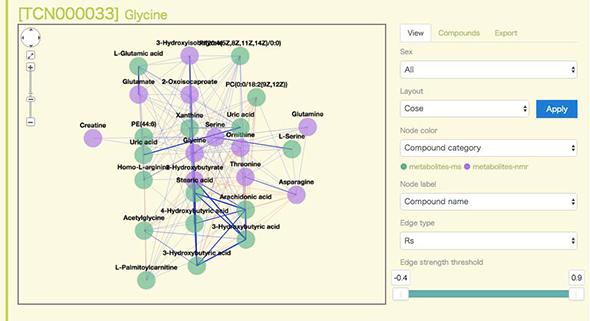
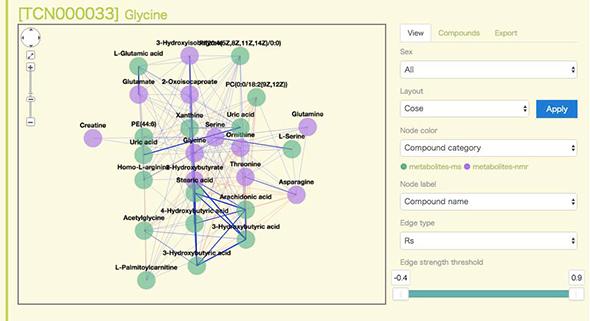
IMAGE

Credit: Tohoku Medical Megabank Organization

Researchers in Japan have created a database of metabolites from blood samples collected from over 5,000 Japanese volunteers, making it freely available online as a valuable resource for researchers around the world.

Metabolites and proteins control many of the processes inside our bodies, and also inform the interaction between our cells and their surroundings. Understanding these compounds and how they relate to each other more, could help researchers to evaluate the health state of people and develop new personalised treatments for various diseases.

The database, which bioinformatics scientist Shu Tadaka from Tohoku University and his colleagues called jMorp, contains information about 306 metabolites and 256 common proteins found in humans. This includes their frequency, concentration, and how often they appeared in males or females and at what age. The database is unique in that, instead of just displaying raw data, it offers visitors a chance to see how the different metabolites correlate to each other graphically, paving the way for further studies to identify how these metabolites and proteins relate to each other.

"The information in jMorp is obtained from statistical data created by aggregating individual data," says Tadaka. "An independent committee has carefully considered all ethical issues before allowing us access to this data."

Similar databases cover other countries or regions, such as the United Kingdom and the Republic of Ireland, but some have limitations due to inconsistent data collection or small sample size. The large number of healthy individuals who contributed samples to jMorp makes it particularly useful. The researchers also collected and analysed data using the same method and at the same institute, which minimizes measurement errors. In addition, they took extra measures to exclude any low-quality samples and to ensure quality control throughout the processes of collecting, storing and analysing the plasma samples. These make jMorp especially reliable as a resource for scientists, especially biochemists and medical researchers.

To make it relevant and useful to other researchers, the Japanese team have setup jMorp in a user-friendly format that allows visitors to reach the data they need easily, as well as pull up comparisons and relationships between different compounds displayed visually. Users can search for the type of compound they are looking for either by name or specifications. The summary of the data can be downloaded and correlation graphs can be saved as image files.

The database is an ongoing effort and the researchers produce updated annual versions as they collect and analyse more samples. They also plan to offer more insight about the metabolites and proteins they document by applying new methods of analysis.

###

Media Contact

Fuji Nagami
[email protected]
@TohokuUniPR

http://www.tohoku.ac.jp/en/

Original Source

https://www.tohoku.ac.jp/en/press/database_human_plasma_compounds.html http://dx.doi.org/10.1093/nar/gkx978
Share12Tweet8Share2ShareShareShare2

Related Posts

Personalized Guide to Understanding and Reducing Chemicals

February 7, 2026

Inflammasome Protein ASC Drives Pancreatic Cancer Metabolism

February 7, 2026

Phage-Antibiotic Combo Beats Resistant Peritoneal Infection

February 7, 2026

Boosting Remote Healthcare: Stepped-Wedge Trial Insights

February 7, 2026
Please login to join discussion

POPULAR NEWS

  • Robotic Ureteral Reconstruction: A Novel Approach

    Robotic Ureteral Reconstruction: A Novel Approach

    82 shares
    Share 33 Tweet 21
  • Digital Privacy: Health Data Control in Incarceration

    63 shares
    Share 25 Tweet 16
  • Study Reveals Lipid Accumulation in ME/CFS Cells

    57 shares
    Share 23 Tweet 14
  • Breakthrough in RNA Research Accelerates Medical Innovations Timeline

    53 shares
    Share 21 Tweet 13

About

We bring you the latest biotechnology news from best research centers and universities around the world. Check our website.

Follow us

Recent News

Personalized Guide to Understanding and Reducing Chemicals

Inflammasome Protein ASC Drives Pancreatic Cancer Metabolism

Phage-Antibiotic Combo Beats Resistant Peritoneal Infection

Subscribe to Blog via Email

Enter your email address to subscribe to this blog and receive notifications of new posts by email.

Join 73 other subscribers
  • Contact Us

Bioengineer.org © Copyright 2023 All Rights Reserved.

Welcome Back!

Login to your account below

Forgotten Password?

Retrieve your password

Please enter your username or email address to reset your password.

Log In
No Result
View All Result
  • Homepages
    • Home Page 1
    • Home Page 2
  • News
  • National
  • Business
  • Health
  • Lifestyle
  • Science

Bioengineer.org © Copyright 2023 All Rights Reserved.
