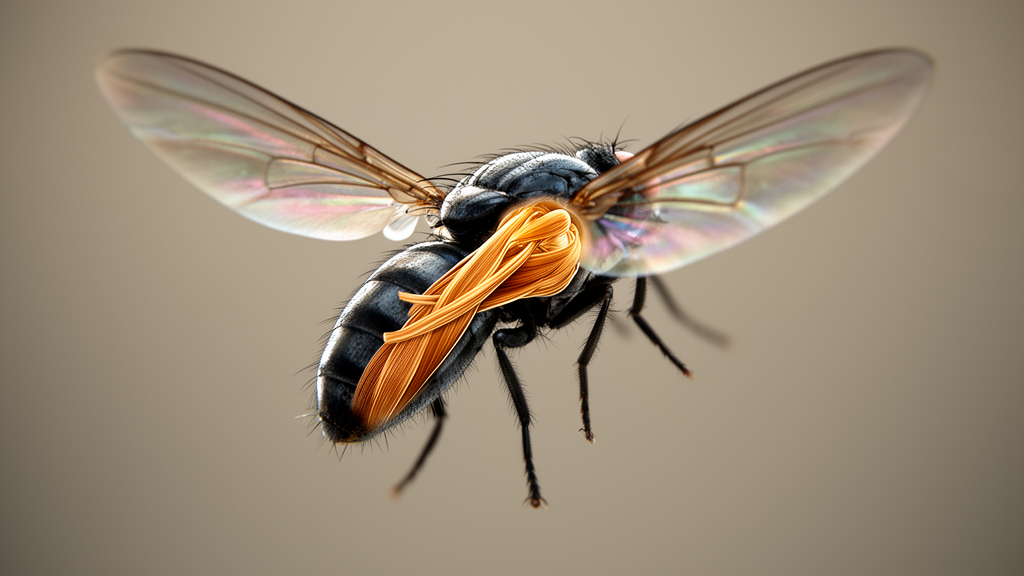
Flapping flight is inherently unstable and requires fruit flies, specifically Drosophila, to fine-tune their wing motions on a timescale of milliseconds. While pioneering investigations established that direct steering muscles attached to the wing hinge drive these rapid flight reflexes, recent connectome data revealed that indirect steering muscles, or tension muscles that alter thorax mechanics, receive shared synaptic inputs from sensory systems. A new study demonstrates that these indirect tergopleural muscles contribute substantially to flight stabilization, specifically when flies encounter large pitch perturbations.
The researchers found that fruit flies switch their corrective flight mechanisms depending on the magnitude of the disturbance. During small perturbations measuring less than 1,000 degrees per second, flies modulate their wing stroke amplitude to generate lift-based corrective torques, matching previously documented flight responses. For larger perturbations exceeding this threshold, Drosophila engage an additional degree of freedom by altering their wing pitch angle. This behavioral shift allows the insects to recruit both lift and drag forces to execute rapid recovery maneuvers.
Quasi-steady aerodynamic simulations carried out by the team revealed that engaging the wing pitch angle minimizes power consumption during these corrective actions. This energy-saving dynamic operates analogously to how certain mammals, including humans, adjust their steady-state gaits in a near energy-optimal manner. The findings indicate that fruit flies rely on specialized reflex strategy selection during time-critical behaviors to maintain stable flight without expending unnecessary aerodynamic power.
To uncover the underlying neural and physical mechanics, the researchers employed optogenetics alongside a control theory framework. Their analysis demonstrated that the tergopleural muscle is activated by a proportional gain component within a nonlinear proportional-integral controller, which dictates the wing pitch angle during large perturbations. Furthermore, the team developed a simplified torsional spring model of the wing hinge, which captures observed pitch dynamics by showing that the tergopleural muscle functions to adjust the rest angle of the wing.
Together, these findings highlight the vital contribution of indirect tension muscles in insect flight control, expanding beyond traditional models focused exclusively on direct hinge muscles. By demonstrating how sensory inputs drive the tergopleural muscle to adjust wing hinge mechanics under intense flight disturbances, the research provides clear evidence of multi-tiered reflex strategies in natural flapping systems.
Subject of Research: Role of indirect steering muscles in insect flight stabilization
Article Title: An indirect wing steering muscle stabilizes flight by regulating wing pitch angle in Drosophila
Article References: Teoh, H. K., Biswas, D., Li, H., Leung, A., Ludlow, B. K., Whitehead, S. C., Ehrhardt, E., Dickinson, M., Beatus, T., Cowan, N. J., & Cohen, I. (2026). An indirect wing steering muscle stabilizes flight by regulating wing pitch angle in Drosophila. PLOS Biology, 24(11), e3003565. https://doi.org/10.1371/journal.pbio.3003565
Image Credits: AI Generated
DOI: 10.1371/journal.pbio.3003565
Keywords: Drosophila, tergopleural muscle, indirect steering muscles, wing pitch angle, flight stabilization, flapping flight, wing stroke amplitude, pitch perturbations, aerodynamic simulations, optogenetics, control theory, proportional-integral controller, torsional spring model, wing hinge mechanics, power consumption, reflex strategy selection
News Source: Drew Townsend. (November 18, 2026). Indirect Steering Muscles Stabilize Fruit Fly Flight by Adjusting Wing Pitch. Scienmag.