• HOME
  • NEWS
  • EXPLORE
    • CAREER
      • Companies
      • Jobs
    • EVENTS
    • iGEM
      • News
      • Team
    • PHOTOS
    • VIDEO
    • WIKI
  • BLOG
  • COMMUNITY
    • FACEBOOK
    • INSTAGRAM
    • TWITTER
Saturday, February 7, 2026
BIOENGINEER.ORG
No Result
View All Result
  • Login
  • HOME
  • NEWS
  • EXPLORE
    • CAREER
      • Companies
      • Jobs
        • Lecturer
        • PhD Studentship
        • Postdoc
        • Research Assistant
    • EVENTS
    • iGEM
      • News
      • Team
    • PHOTOS
    • VIDEO
    • WIKI
  • BLOG
  • COMMUNITY
    • FACEBOOK
    • INSTAGRAM
    • TWITTER
  • HOME
  • NEWS
  • EXPLORE
    • CAREER
      • Companies
      • Jobs
        • Lecturer
        • PhD Studentship
        • Postdoc
        • Research Assistant
    • EVENTS
    • iGEM
      • News
      • Team
    • PHOTOS
    • VIDEO
    • WIKI
  • BLOG
  • COMMUNITY
    • FACEBOOK
    • INSTAGRAM
    • TWITTER
No Result
View All Result
Bioengineer.org
No Result
View All Result
Home NEWS Science News Biology

Pythons and boas shed new light on reptile evolution

Bioengineer by Bioengineer
January 25, 2018
in Biology, Science News
Reading Time: 2 mins read
0
Share on FacebookShare on TwitterShare on LinkedinShare on RedditShare on Telegram
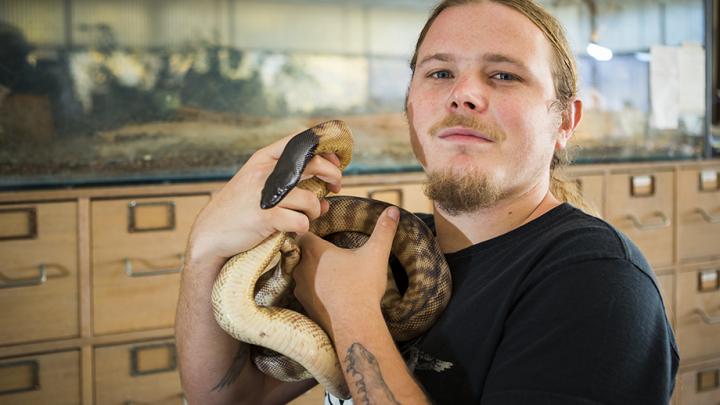
IMAGE

Credit: Stuart Hay, ANU

A new study into pythons and boas has for the first time found the two groups of snakes evolved independently to share similar traits, shedding new light on how the reptiles evolved.

Pythons and boas are two families that include the largest snakes in the world, like the reticulated python and the anaconda boa, which have been known to grow close to eight meters in length.

The Australian National University (ANU) study found that by living in the same habitat, pythons and boas evolved independently to look similar. This happened at least five times in different habitats. Aquatic pythons look like aquatic boas, burrowing pythons look like borrowing boas and tree-dwelling pythons look like tree-dwelling boas.

Lead researcher Damien Esquerre said the study found pythons and boas were an important example of convergent evolution in reptiles. Convergent evolution is where species adapt to the same conditions and evolve similar traits.

"The finding of such a strong case of convergent evolution demonstrates the power of natural selection and adaptation in living organisms," said Mr Esquerre from the ANU Research School of Biology.

"If we see that different groups evolve the same things independently when they face the same challenges, we can find predictability in evolution."

Other famous examples of convergent evolution are sharks and dolphins, which are not related but have evolved similar body plans. Similarly, the extinct Tasmanian Tiger, a marsupial mammal, and the wolf, a placental mammal, evolved similar body plans.

Although they look the similar and both constrict their prey, the pythons and boas last shared a common ancestor 70 million years ago in the age of the dinosaurs.

The research focused on the head shape of close to 2,000 specimens in museum collections in Australia and America.

Mr Esquerre said not all evolution was driven by natural selection, but examples such as pythons and boas reinforce its importance in shaping biological diversity.

"By having greater understanding of the evolution of pythons and boas, researchers can now have better ideas of what extinct fossil snakes were doing before they disappeared," he said.

The research has been published in Ecology Letters.

###

Media Contact

Damien Esquerre
[email protected]
61-451-988-230
@ANUmedia

http://www.anu.edu.au/media

Share12Tweet8Share2ShareShareShare2

Related Posts

Inflammasome Protein ASC Drives Pancreatic Cancer Metabolism

February 7, 2026

Phage-Antibiotic Combo Beats Resistant Peritoneal Infection

February 7, 2026

Boosting Remote Healthcare: Stepped-Wedge Trial Insights

February 7, 2026

Barriers and Boosters of Seniors’ Physical Activity in Karachi

February 7, 2026
Please login to join discussion

POPULAR NEWS

  • Robotic Ureteral Reconstruction: A Novel Approach

    Robotic Ureteral Reconstruction: A Novel Approach

    82 shares
    Share 33 Tweet 21
  • Digital Privacy: Health Data Control in Incarceration

    63 shares
    Share 25 Tweet 16
  • Study Reveals Lipid Accumulation in ME/CFS Cells

    57 shares
    Share 23 Tweet 14
  • Breakthrough in RNA Research Accelerates Medical Innovations Timeline

    53 shares
    Share 21 Tweet 13

About

We bring you the latest biotechnology news from best research centers and universities around the world. Check our website.

Follow us

Recent News

Inflammasome Protein ASC Drives Pancreatic Cancer Metabolism

Phage-Antibiotic Combo Beats Resistant Peritoneal Infection

Boosting Remote Healthcare: Stepped-Wedge Trial Insights

Subscribe to Blog via Email

Enter your email address to subscribe to this blog and receive notifications of new posts by email.

Join 73 other subscribers
  • Contact Us

Bioengineer.org © Copyright 2023 All Rights Reserved.

Welcome Back!

Login to your account below

Forgotten Password?

Retrieve your password

Please enter your username or email address to reset your password.

Log In
No Result
View All Result
  • Homepages
    • Home Page 1
    • Home Page 2
  • News
  • National
  • Business
  • Health
  • Lifestyle
  • Science

Bioengineer.org © Copyright 2023 All Rights Reserved.