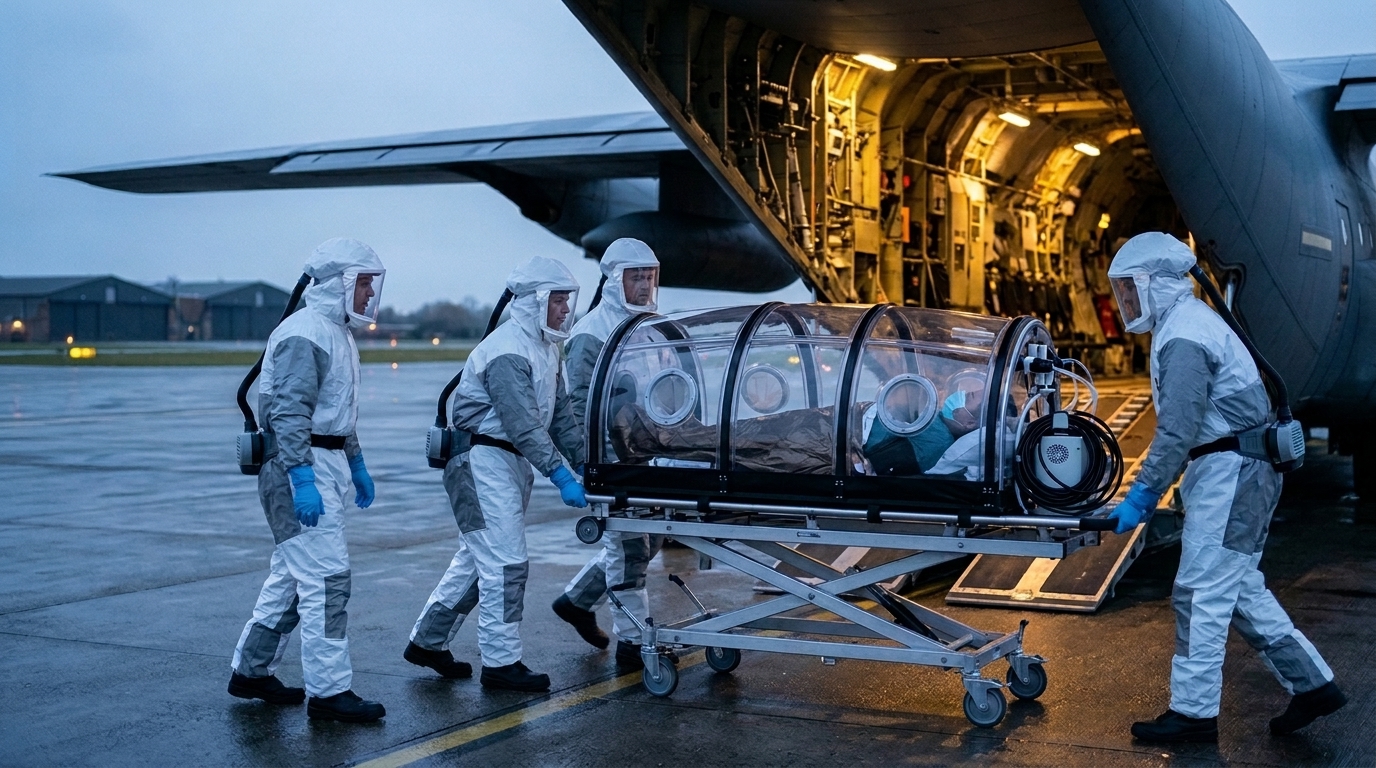
A full-scale, real-time international simulation exercise testing cross-border medical evacuation pathways for high-consequence infectious diseases successfully achieved or partially achieved all eight of its high-level objectives when measured against predetermined key performance indicators. The three-day operational drill, named SIMEX Volare, evaluated a collaborative emergency care arrangement designed to transfer patients diagnosed with high-consequence infections from Ireland to Germany using specialized Norwegian air ambulance services.
High-consequence infectious diseases present severe clinical challenges characterized by elevated mortality rates and limited treatment options, necessitating an urgent, highly coordinated public health response alongside sophisticated high-level isolation unit care. Because Ireland currently lacks high-level isolation capacity, the health systems of Ireland, Norway, and Germany established an agreement to ensure patients requiring such interventions can be evacuated safely across international borders. Although structured around formal cross-border agreements and European Union coordination mechanisms, the operational pathways had never previously been exercised under real-world circumstances.
To address this operational untestedness, an international strategic exercise planning group devised SIMEX Volare to test functional pathways and identify structural improvements in a secure environment. The exercise was structured around the European Centre for Disease Prevention and Control simulation exercise cycle while adhering to national and European guidance. Spanning three consecutive days, the live, multi-service, and cross-agency simulation convened more than two hundred stakeholder participants across multiple jurisdictions to test multi-country interoperability across several operational domains.
Designated exercise evaluators appraised the performance of the medical evacuation framework against predefined key performance indicators. These evaluation domains focused specifically on international stakeholder activation, communication channels, and cross-agency coordination throughout the transfer timeline. Observers noted that executing a large-scale international exercise demanded substantial resources, but the initiative proved fully feasible through sustained cross-jurisdictional engagement and collaborative alignment.
Intense cross-border planning preceding the simulation was vital for establishing working relationships among international agencies, clarifying governance structures, and developing harmonized guidance, operational pathways, and formal procedures. Testing these mechanisms under live conditions allowed participants to observe systemic handoffs that cannot be fully replicated through tabletop exercises alone, verifying that international activation pathways could function cohesively across disparate administrative systems.
Despite the overall achievement of the high-level objectives, the live simulation uncovered critical operational disparities and service limitations that required formal remediation. Evaluators documented notable discrepancies in high-level personal protective equipment provision across different participating services. In addition, the exercise revealed an absence of continuous twenty-four-hour coverage for essential supporting services, including laboratory diagnostics, specialized hazardous waste management, and occupational health monitoring.
The exercise further identified procedural vulnerabilities in end-to-end transport coordination and environmental safety protocols. Specifically, the evaluation highlighted the lack of an agreed end-to-end transport protocol and pointed to the absence of a comprehensive waste-water management protocol as key vulnerabilities requiring corrective action. Addressing these procedural gaps was identified as essential to prevent potential containment failures and logistical disruptions during genuine cross-border evacuations.
Following the completion of SIMEX Volare, participating authorities initiated strengthened governance frameworks and operational response arrangements to reinforce national and international preparedness. These subsequent actions include the development of a managed clinical network approach, targeted enhancements to the operational capacity of key national services, and concrete plans for a coordinated national training and simulation programme for high-consequence infectious diseases.
The outcomes of SIMEX Volare provided transferable insights regarding organizational and international interoperability, offering practical guidance for other simulation programmes addressing high-consequence threats. To maintain optimal readiness against high-stakes cross-border pathogens and support wider health security across Europe, the authors emphasize that partner jurisdictions should routinely integrate live international simulation exercises into their defense strategies.
Subject of Research: Evaluation of a cross-border medical evacuation simulation for high-consequence infectious diseases
Article Title: Learning from an innovative, live, international simulation exercise comprising a medical evacuation system for high-consequence infectious diseases: SIMEX Volare
Article References: Barry, T., Kelly, C., Morley, D., Kelly, C., Long, D., Browne, C., Quinlan, R., Lawlor, B., Menzies, D., Höglund-Braun, H., Stensvag, V., Salmon, J., Treitane, P. M., & Boland, M. (2026). Learning from an innovative, live, international simulation exercise comprising a medical evacuation system for high-consequence infectious diseases: SIMEX Volare. Advances in Simulation. https://doi.org/10.1186/s41077-026-00504-0
Image Credits: AI Generated
DOI: 10.1186/s41077-026-00504-0
Keywords: SIMEX Volare, high-consequence infectious diseases, medical evacuation, simulation exercise, international interoperability, air ambulance, high-level isolation, cross-border healthcare, public health preparedness, European Centre for Disease Prevention and Control, personal protective equipment, waste management, laboratory diagnostics, occupational health, emergency response, managed clinical network, cross-agency coordination
News Source: Kristina Jarvis. (November 18, 2026). European Simulation Validates Cross-Border High-Consequence Infection Evacuation System. Scienmag.