In a randomized, sham-controlled crossover study investigating non-invasive brain stimulation, researchers found that transcranial electrical stimulation using waveforms with the aperiodic 1/f component removed significantly increased resting-state alpha power compared with sham stimulation. In contrast, personalized stimulation that preserved each participant’s natural 1/f spectral profile produced no statistically significant difference in alpha oscillations when compared to the sham condition. The investigation evaluated twenty healthy young adult participants whose complete datasets were included in the final analysis, drawn from an initial cohort of twenty-one recruited individuals.
The trial addressed unresolved mechanistic questions surrounding personalized transcranial electrical stimulation, an emerging approach that applies complex stimulus waveforms derived from individual neural dynamics. Earlier investigations demonstrated that tailoring stimulus waveforms to an individual’s neural dynamics can increase motor cortex excitability and enhance visuospatial attention. However, standard transcranial alternating current stimulation traditionally applies a sinusoidal waveform at a fixed, constant frequency to entrain neural oscillations. Human electroencephalography signals are composed of two distinct elements: periodic components corresponding to rhythmic neural oscillations and aperiodic components represented by the 1/f spectral component.
To clarify how these distinct spectral features shape neuromodulation outcomes, the researchers tested whether reproducing an individual’s resting-state electroencephalography spectrum, including its 1/f component, would modulate periodic and aperiodic activity more effectively than stimulation lacking the 1/f component. Participants were administered three separate experimental conditions: individual spectrum-characteristic stimulation, aperiodic component-removed stimulation, and an inactive sham stimulation control. The individual spectrum-characteristic stimulation condition directly reproduced each participant’s electroencephalographic characteristics recorded during an eyes-closed resting state. The aperiodic component-removed stimulation condition utilized a waveform from which the underlying 1/f aperiodic component had been mathematically filtered out.
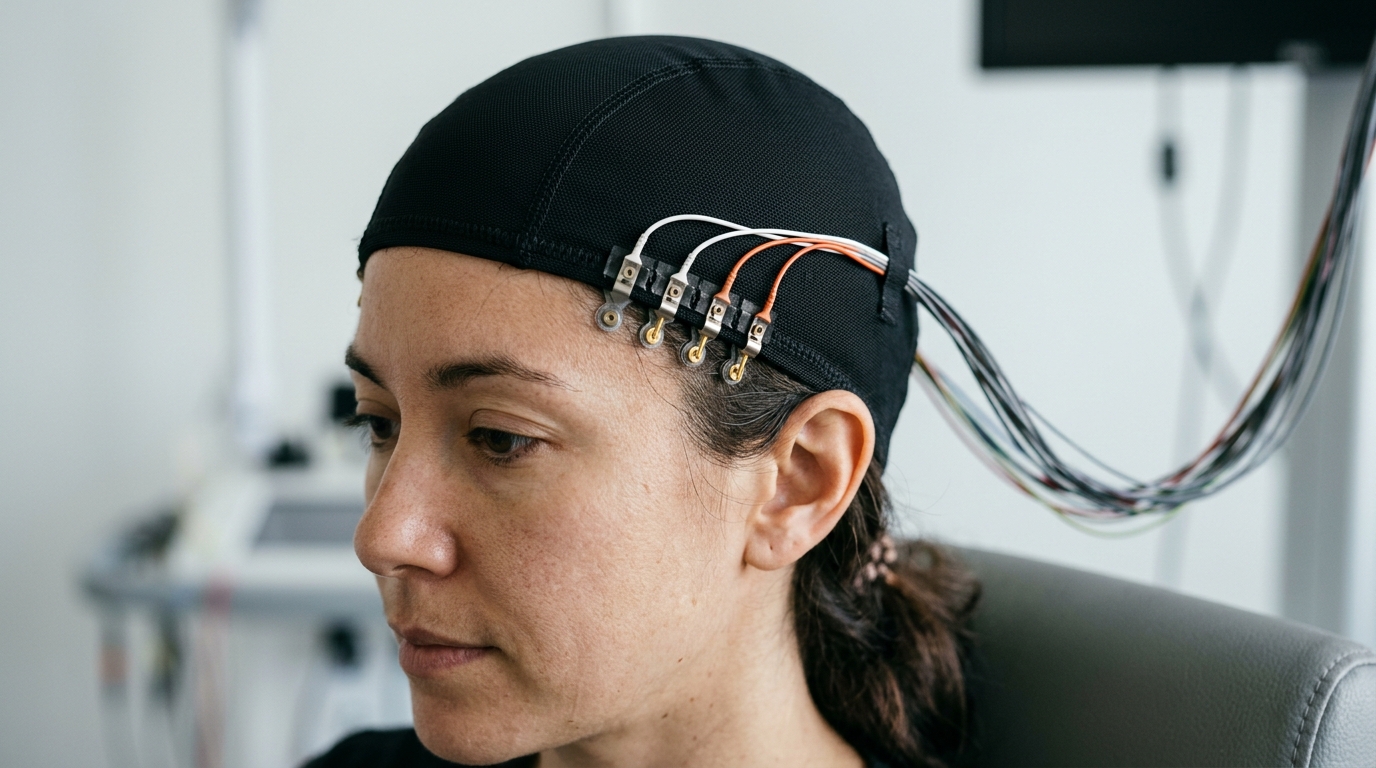
For both active personalized stimulation protocols, the prominent periodic spectral components fell within the alpha frequency range. Each experimental condition delivered non-invasive electrical stimulation across a continuous duration of twenty minutes. To assess the immediate electrophysiological consequences of each intervention, resting-state electroencephalography was systematically recorded immediately before and following each twenty-minute stimulation session.
From these pre- and post-intervention electroencephalography recordings, the investigative team evaluated changes across three specific neurophysiological parameters: alpha power, the aperiodic exponent, and the aperiodic offset. To rigorously determine the effects of each stimulation condition, the researchers analyzed the electrophysiological data using generalized linear mixed models, incorporating post hoc contrast comparisons adjusted with Holm–Bonferroni corrections to control for multiple testing.
The statistical analysis revealed that while aperiodic component-removed stimulation elicited a significant increase in alpha power relative to the sham intervention, a direct comparison between the two active personalized waveforms—aperiodic component-removed stimulation and individual spectrum-characteristic stimulation—did not reach statistical significance. Furthermore, neither the stimulation protocol containing the 1/f component nor the waveform with the aperiodic component removed produced any statistically significant alterations in either the aperiodic exponent or the aperiodic offset when compared against the sham control condition.
The experimental results ran contrary to the investigators’ original hypothesis, showing that removing rather than preserving the 1/f component enhanced alpha oscillations relative to sham. Although the two personalized stimulation protocols did not significantly differ from each other in direct comparison, the authors concluded that the spectral composition of personalized electrical stimulation waveforms, specifically the presence or omission of the 1/f component, represents a critical parameter warranting future systematic research. The researchers noted that these observations establish an empirical foundation for refining and optimizing personalized waveform parameters, which may eventually support the development of targeted neuromodulation strategies for neuroengineering and rehabilitation.
Subject of Research: Effects of the 1/f component in personalized transcranial electrical stimulation waveforms on neural oscillations
Article Title: The influence of the 1/f component in non-invasive transcranial electrical stimulation waveforms on neural oscillations
Article References: Nakazono, H., Kimura, K., Takeda, A., Yamada, E., Mitsutake, T., Taniguchi, T., & Ogata, K. (2026). The influence of the 1/f component in non-invasive transcranial electrical stimulation waveforms on neural oscillations. Journal of NeuroEngineering and Rehabilitation. https://doi.org/10.1186/s12984-026-02228-8
Image Credits: AI Generated
DOI: 10.1186/s12984-026-02228-8
Keywords: transcranial electrical stimulation, neural oscillations, 1/f component, aperiodic component, alpha power, individual spectrum-characteristic stimulation, aperiodic component-removed stimulation, electroencephalography, resting-state EEG, aperiodic exponent, aperiodic offset, sham-controlled trial, crossover study, motor cortex excitability, visuospatial attention, generalized linear mixed models, neuromodulation
News Source: Ophelia Keating. (November 18, 2026). Removing 1/f Component From Transcranial Electrical Stimulation Increases Alpha Power. Scienmag.