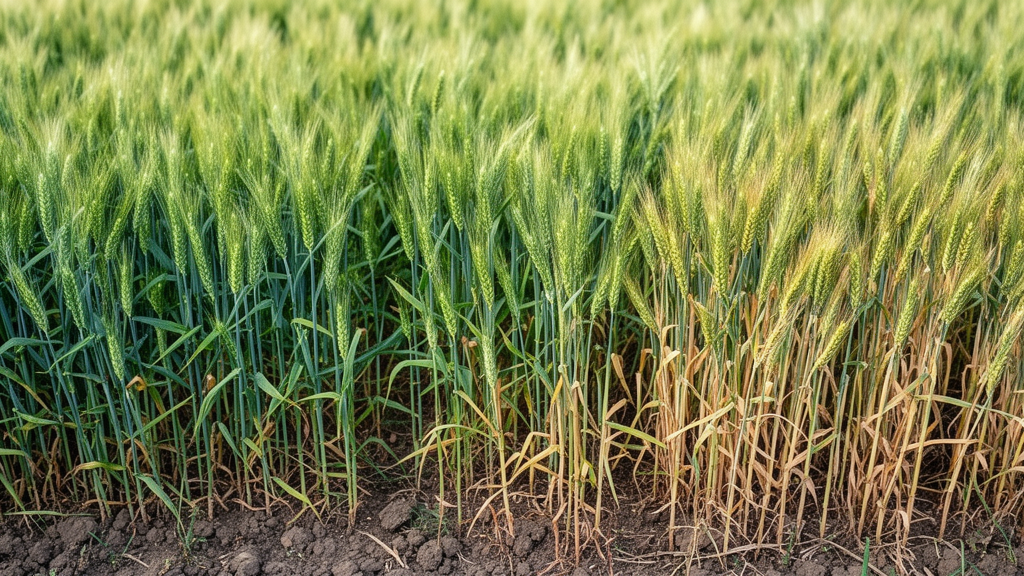
Agricultural resilience under climate change is routinely evaluated through harvest biomass and yield stability, yet maintaining crop productivity under environmental stress does not guarantee that harvested seeds retain their nutritional quality. A comprehensive narrative review published in Frontiers in Nutrition synthesizes evidence across plant physiology, agronomy, and human nutrition to demonstrate that climate stresses alter seed composition in ways that cannot be captured by yield metrics alone. Rising temperatures, drought episodes, soil salinization, and elevated atmospheric carbon dioxide influence root nutrient uptake, assimilate partitioning, and seed filling, producing nutritional shifts that vary across crop species, genotypes, and growing environments. The authors emphasize that mineral concentration alone fails to reflect nutritional value because dietary utilization depends on mineral release and interactions with binding compounds within the seed matrix. In particular, phytic acid serves as the primary storage depot for phosphorus in mature seeds but simultaneously acts as an inhibitor of iron and zinc accessibility in plant-based human diets. Addressing this tension requires moving beyond traditional efforts aimed strictly at minimizing phytic acid toward achieving an optimal balance that protects seed vigor while safeguarding human micronutrient delivery.
The biochemical behavior of phytic acid, formally identified as myo-inositol-1,2,3,4,5,6-hexakisphosphate or InsP₆, underpins its dual role in agricultural systems and human nutrition. The molecule features a six-membered myo-inositol carbon ring in which every hydroxyl group is esterified with an acidic phosphate group. These phosphate groups undergo progressive deprotonation as environmental pH shifts toward neutral and alkaline conditions, creating a high negative charge density that binds divalent and trivalent mineral cations. In plant tissues and food matrices, deprotonated phytic acid forms phytate complexes with mineral cations including calcium, magnesium, zinc, and iron. Complexes formed with iron and aluminum exhibit notable insolubility and strong resistance to enzymatic hydrolysis compared with calcium and magnesium associations. Within developing seeds, phytic acid synthesis proceeds predominantly through a lipid-independent pathway wherein glucose-6-phosphate is converted to myo-inositol-3-phosphate by myo-inositol-3-phosphate synthase, followed by sequential phosphorylation steps completed by inositol-pentakisphosphate 2-kinase. Once formed, InsP₆ is transported into protein storage vacuoles via ABCC-subfamily transporters and deposited within electron-dense globoid structures. During subsequent seed germination, endogenous phytases hydrolyze phytate to mobilize inorganic phosphate and sequestered cations for developing seedlings.
Anatomical localization of phytic acid across seed structures varies sharply among botanical families, fundamentally altering how processing impacts mineral retention. In major cereal grains such as wheat and rice, phytate accumulation is concentrated within peripheral seed envelopes. Approximately eighty-seven percent of wheat seed phytate resides in the aleurone layer, while roughly eighty percent of rice phytate is localized within the pericarp and aleurone tissues. Maize departs markedly from this cereal pattern, depositing an estimated eighty-eight to ninety-five percent of its seed phytate in the embryo, particularly within the scutellum. Conversely, in grain legumes such as soybean, common bean, and field pea, more than ninety-five percent of seed phytic acid is concentrated within the cotyledons inside vacuolar globoids. Distinct patterns also appear in pseudocereals like quinoa, where the central starch-storing perisperm is surrounded by an embryo and endosperm that house the mineral-binding globoids. Because mechanical milling and dehulling preferentially abrade outer seed layers, processing removes both phytate and peripheral iron and zinc reserves in wheat and rice, whereas legume cotyledons retain their phytate and mineral complexes throughout standard physical preparation.
Atmospheric changes and climatic warming exert divergent impacts on grain mineral density and absolute nutrient accumulation. Free-air carbon dioxide enrichment experiments examining wheat grown under concentrations of 550 to 584 parts per million demonstrated average reductions of approximately nine percent in grain zinc and five percent in grain iron compared with ambient atmospheric conditions. Demographic projections indicate that atmospheric carbon dioxide levels approaching 550 parts per million could place an additional 175 million people at risk of zinc deficiency by 2050, alongside potential reductions exceeding four percent in dietary iron availability for roughly 1.4 billion women and young children in anemia-prevalent regions. In soybean, elevated carbon dioxide has been documented to elevate phytic acid concentration by 8.1 percent while depressing seed iron and zinc concentrations by 28.1 percent and 25.9 percent, respectively. Temperature stress during reproductive development accelerates plant senescence and truncates the seed-filling window, altering mature seed composition. Experiments conducted under field-based temperature and carbon dioxide enrichment revealed that grain phytic acid rose by 18.1 percent in rice but fell by 3.5 percent in wheat, highlighting contrasting cereal pathways under identical environmental treatments.
Water limitation and elevated temperatures frequently co-occur during reproductive growth stages, compounding nutritional losses in legume crops. In lentil trials subjected to drought during seed development, seed iron concentrations dropped by 21 to 35 percent and zinc declined by 26 to 48 percent, with the most severe depreciations observed in drought-sensitive genotypes. Across eleven lentil genotypes air-dried at 40 degrees Celsius, phytic acid concentration rose from 6.7 to 8.8 milligrams per gram alongside significant increases in zinc concentration, while mean iron concentration remained stable. When heat and moisture deficit occurred concurrently in lentil evaluations, nutritional declines were intensified, producing recorded losses of 30.4 percent in iron and 35.6 percent in zinc compared with individual heat stress losses of 18.4 percent and 22.2 percent. In contrast, water deficits in wheat have been associated with increased grain iron and zinc concentrations, demonstrating that mineral responses cannot be extrapolated universally across plant architectures. Evidence regarding salinity stress remains largely restricted to vegetative and germinating tissues, although halophytic quinoa exhibited increases in seed iron of 3 to 77 percent and zinc of 8 to 33 percent depending on salt composition and intensity.
Multi-environment field trials illustrate that genotypic factors and environmental conditions interact significantly to shape mature seed composition. An evaluation of sixteen lentil cultivars across six distinct geographical locations confirmed significant effects of genotype, environment, and genotype-by-environment interactions on phytic acid, iron, and zinc concentrations. Similar environmental dependencies emerged from trials of forty-six durum wheat cultivars evaluated under variable irrigation regimes, where environmental factors accounted for approximately forty-six percent of the observed variance in phytic acid concentration while genotype-by-environment interactions heavily governed grain iron accumulation. Genetic investigations in chickpea linked allelic variation in the 5-prime untranslated region of the CaIMP gene, encoding myo-inositol monophosphatase, with elevated seed phytic acid and drought tolerance across consecutive seasons, though researchers caution that broad participation in myo-inositol metabolism precludes inferring a direct causal role for phytic acid accumulation. Because environmental stress alters seed dry-matter accumulation independently of mineral loading, reported increases in nutrient concentration may simply reflect seed shrinkage rather than elevated physiological deposition.
The nutritional consequence of phytic acid intake depends directly on its relative stoichiometric abundance compared with target mineral cations. Human isotope absorption studies have established dose-dependent inhibitions of mineral uptake by phytic acid, with one human trial demonstrating a reduction in zinc absorption from 22 percent in meals without added phytate down to 6 percent when 250 milligrams of phytate-phosphorus was introduced. Stoichiometric molar ratios serve as predictive screening indicators for dietary inhibition, wherein phytic acid to zinc molar ratios below 5, between 5 and 15, and above 15 generally correspond to high, moderate, and low zinc bioavailability, respectively. For iron, a molar ratio below 0.4 has been suggested to support adequate non-heme iron absorption, although this threshold carries substantial uncertainty because iron uptake is highly responsive to dietary enhancers like ascorbic acid and inhibitors like dietary polyphenols. Predictive mathematical models incorporating dietary zinc and phytic acid concentrations have accounted for approximately eighty-two percent of observed variance in human zinc absorption. Nevertheless, molar ratios derived from raw seeds provide only preliminary screening metrics because food preparation, intestinal digestion, and consumer health status govern actual systemic absorption.
Past biofortification efforts focused primarily on developing low-phytic-acid mutants, yet severe depletion of phytic acid frequently compromises plant agronomic fitness. Because InsP₆ serves as an indispensable reservoir of phosphorus and mineral cations for seedling establishment, indiscriminate disruption of inositol-phosphate pathways can impair germination, emergence, and final grain yield. In field pea, low-phytate lines exhibiting sixty percent lower phytate-phosphorus experienced reduced seed weight, lower seed yields, and diminished germination following accelerated aging and cold stress treatments. In wheat, downregulating TaIPK1 through RNA interference reduced grain phytic acid by 28 to 56 percent and elevated iron and zinc, but reduced the number of grains per spikelet. Similarly, while higher-order CRISPR-Cas9 mutations targeting GmIPK1 and GmMRP5 in soybean reduced seed phytic acid by 33.1 to 43.3 percent, they caused impaired germination and significant yield penalties. Conversely, single-gene CRISPR knockouts of GmIPK1b or GmIPK1c achieved moderate phytic acid reductions of 12.3 and 17.8 percent while preserving wild-type yield, seedling emergence, and seed weight, illustrating that targeted, moderate interventions can avoid developmental damage.
Rather than pursuing maximal phytate depletion, the review advocates for an optimal phytic acid-mineral balance defined as a context-dependent functional range where adequate micronutrient density coexists with uncompromised crop performance. To quantify nutritional performance accurately under environmental stress, researchers must distinguish mineral concentration from total mineral content per individual seed and overall mineral yield per hectare. Mineral yield per hectare combines seed biomass with nutrient concentration, preventing the misleading selection of shriveled, low-yielding seeds that exhibit artificially elevated mineral concentrations due to diminished starch accumulation. Furthermore, the authors propose bioaccessible mineral yield as an exploratory crop-to-food metric that multiplies edible mineral yield per hectare by the bioaccessible mineral fraction released during standardized in vitro gastrointestinal digestion protocols such as INFOGEST. When food preparation alters mass or leaches nutrients, true mineral retention and processing yields must be factored into the equation. While bioaccessible mineral yield enables standardized comparisons across genotypes and agronomic treatments, it represents potential digestive release rather than true systemic absorption in living humans.
Agronomic management and post-harvest food processing operate as complementary tools alongside plant breeding to optimize the seed-to-consumption pathway. Soil and foliar zinc fertilization can substantially increase grain zinc accumulation without triggering proportional increases in seed phytic acid, directly lowering unfavorable phytic acid to zinc molar ratios. In contrast, agronomic biofortification of iron remains variable due to complex soil chemistry and tightly regulated plant translocation pathways. Soil phosphorus management must also be calibrated carefully, as surplus phosphorus fertilization has been documented to increase seed phytic acid while depressing iron and zinc concentrations across rice, durum wheat, and sweet corn. Beyond the farm gate, biological processing techniques can mitigate residual phytate constraints without imposing genetic burdens on the crop. Soaking seeds stimulates endogenous phytases and leaches soluble phytate, controlled germination activates seed phosphorus mobilization pathways, and microbial fermentation enhances phytate dephosphorylation through matrix acidification and microbial phytases, thereby converting InsP₆ into lower inositol phosphates that possess significantly weaker mineral-binding properties.
Current scientific understanding remains constrained by methodological disparities, uneven crop representation, and a critical scarcity of multi-environment field data. Much of the available literature that concurrently evaluates mature-seed phytic acid, iron, and zinc under climate-related abiotic stress is restricted to lentil, leaving substantial knowledge gaps across cereals, oilseeds, and pseudocereals. Direct comparisons among existing studies are further hindered by varying analytical methods, including colorimetric assays that fail to distinguish InsP₆ from lower inositol phosphate isomers, as well as inconsistencies in moisture standardization and reporting bases. The authors outline key research priorities, urging investigators to conduct synchronized multi-environment trials that measure mature seed weight, edible yield, total phosphorus, and mineral content alongside standardized digestion assays. Establishing crop-specific functional thresholds and linking genetic traits with customary food processing will determine whether moderate phytate management can preserve seed vigor while reliably delivering bioaccessible micronutrients under increasingly volatile global climates.
Subject of Research: Crop nutritional resilience and phytic acid-mineral interactions under climate change
Article Title: Beyond low phytate: phytic acid–mineral balance as a target for nutritional resilience under climate change
Article References: Choukri, H., Hajib, A., El Harkaoui, S., Idrissi, H. A., Belmaghraoui, W., & Elyacoubi, H. (2026). Beyond low phytate: phytic acid–mineral balance as a target for nutritional resilience under climate change. Frontiers in Nutrition, 13, 2011255. https://doi.org/10.3389/fnut.2026.2011255
Image Credits: AI Generated
DOI: 10.3389/fnut.2026.2011255
Keywords: phytic acid, mineral bioaccessibility, iron deficiency, zinc bioavailability, climate change, drought stress, heat stress, crop nutrition, elevated carbon dioxide, biofortification, molar ratios, plant physiology, seed development, grain legumes, food processing, genotype environment interaction
News Source: Alan Morgan. (November 18, 2026). Crops Face Complex Nutrient Tradeoffs Under Shifting Climate Conditions. Scienmag.