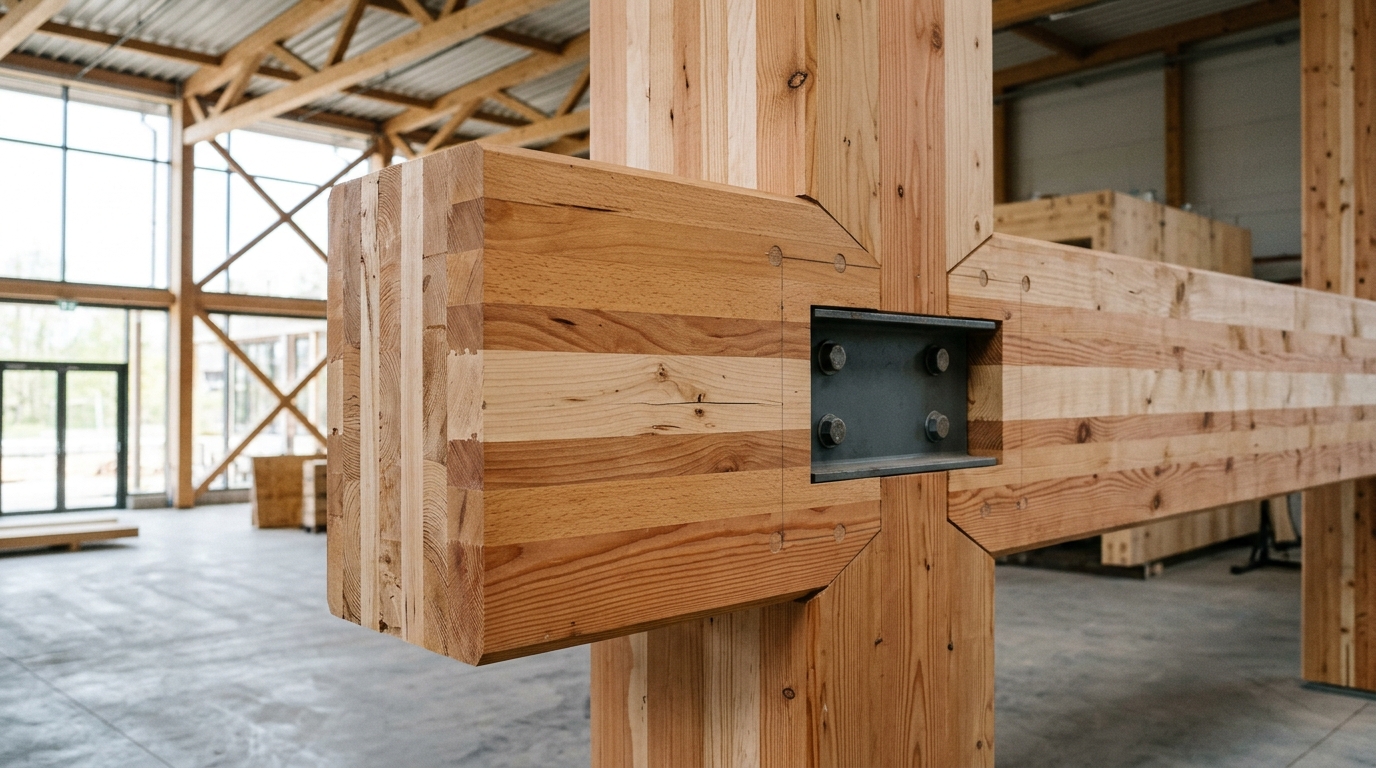
Mass timber has emerged as a cornerstone of modern, low-carbon construction, offering a high-strength, sustainable alternative to traditional concrete and steel. Its rapid rise in popularity, particularly for high-rise buildings and long-span bridges, is largely driven by its mechanical performance and its capacity for carbon sequestration. A recent systematic review of 189 peer-reviewed journal articles has explored the structural characteristics of mass timber products—such as glued laminated timber (GLT), cross-laminated timber (CLT), and laminated veneer lumber (LVL)—and evaluated the potential for expanding the current narrow scope of wood species used in their manufacture. While the industry currently relies heavily on softwoods like spruce and fir due to their predictable manufacturing costs and established processing methods, evidence indicates that hardwoods offer significant untapped mechanical advantages. The study emphasizes that navigating the complexities of these materials, including adhesive bond integrity and long-term hygro-mechanical behavior, remains the primary hurdle for wider structural implementation.
To ensure transparency, the researchers employed a methodology based on evidence-based research synthesis, conducting searches across major databases such as the Web of Science and Scopus. The initial search identified 2,982 potential records, which were refined to 1,907 unique entries after deduplication. A screening process, focused on material properties, excluded over 1,300 papers that did not directly address the mechanical or structural performance of mass timber. By examining studies that spanned diverse experimental conditions and research scopes, the authors sought to compare outcomes without attempting a singular quantitative synthesis of often inconsistent findings. This approach allowed for a granular analysis of how specific species, bonding methods, and protective treatments influence the overall structural efficiency of timber assemblies.
Mass timber products function as engineered wood products (EWP) composed of boards, veneers, or strands bonded through various methods, including adhesives, dowels, and screws. Products like GLT rely on parallel grain orientation to maximize bending strength, while CLT utilizes perpendicular layering to enhance dimensional stability, making it especially effective for load-bearing walls and floors. Emerging products such as parallel strand lumber (PSL) further minimize inherent wood defects like knots through thinner strand processing, leading to high mechanical consistency. The review notes that the integration of computer-aided manufacturing, such as CNC machining, allows for complex structural configurations. However, the reliance on these engineered forms does not eliminate the need for careful consideration of the raw material species, as the inherent properties of the timber dictate the performance limits of the resulting composite element.
A central finding of the review is the dominance of softwoods in the mass timber market. Industry data collected from major European manufacturers show that spruce and fir consistently account for over 90% of GLT and CLT production. The preference for these species is rooted in lower manufacturing costs and existing, highly automated supply chains. Conversely, hardwoods such as beech, oak, and ash demonstrate superior annual increments in mechanical strength and stiffness. The study reveals that hardwoods possess potential for higher structural load capacities and slimmer cross-sections compared to softwood counterparts. Despite these mechanical benefits, the hardwood sector remains fragmented, characterized by smaller mills and significantly higher market prices, which currently discourage their use in standard structural mass timber applications.
Bonding quality remains the most critical barrier to the broader adoption of hardwoods. Because the structural integrity of mass timber depends on the bondline between layers, the interaction between adhesive chemistry and wood anatomy is of paramount concern. Hardwoods, characterized by higher density and lower porosity, restrict adhesive penetration compared to the more porous tracheid structures found in softwoods. This mismatch leads to uneven bondlines and discontinuities that create weak points for crack initiation. The evidence highlights that even when adhesives meet standards for softwoods, they may fail in hardwood configurations. Consequently, research efforts are shifting toward species-specific surface treatments, such as planing and sanding immediately before application, and the development of specialized primer treatments to improve surface wettability and long-term durability.
Hybrid wood systems have emerged as a viable solution to bridge the gap between performance demands and material limitations. By combining hardwood outer layers with softwood cores, engineers can capitalize on the strength-to-weight benefits of dense species while maintaining economic and material efficiency. Experimental data on beech-spruce hybrid CLT panels demonstrate improved strength and reduced deflection compared to homogeneous spruce panels. The review notes that while these hybrids can produce stronger bonds than single-hardwood laminated products, they introduce challenges regarding deformation incompatibility. Different shrinkage and expansion rates between species, induced by environmental humidity fluctuations, can generate internal stresses along bondlines. Future progress in hybrid mass timber relies on identifying species pairings that minimize these internal stresses while maximizing the composite panel’s overall structural life cycle.
Thermal performance of mass timber envelopes is comparable to traditional concrete and brick structures, contributing to significant energy efficiency. Studies comparing the thermal insulation of various envelopes show that while wood density correlates with heat transfer—with higher density wood species typically exhibiting lower insulation effectiveness—the impact is relatively minor in practical building configurations. Airtightness in mass timber structures, particularly those utilizing CLT, helps reduce uncontrolled ventilation, further improving energy consumption benchmarks. Research confirms that when mass timber is used in conjunction with additional insulation materials, such as polyurethanes, thermal resistance can be effectively doubled. While concrete block walls may offer smaller internal temperature fluctuations due to higher thermal mass, mass timber’s ability to shift heating and cooling demands away from peak periods remains a distinct, documented advantage.
Acoustic and vibration performance remains a governed serviceability scenario rather than an ultimate limit state for timber design, due to wood’s relatively low stiffness compared to its strength. The review emphasizes that current standards, particularly those relating to vibration control, are often empirical and lack comprehensive guidance for diverse structural systems. While CLT floors can meet targeted acoustic performance requirements when paired with appropriate floating configurations and suspended ceilings, exposed wood elements such as posts and beams often form acoustic bridges that limit performance at frequencies above 500 Hz. The research stresses that existing acoustic standards for buildings are outdated regarding current CLT structural configurations. There is a documented need for updated design norms that integrate probabilistic formulations to account for the structural uncertainties inherent in timber floor systems.
Seismic performance of mass timber structures has been validated through rigorous, full-scale shaking table tests, demonstrating reliability even under strong seismic motions. Lateral load resisting systems (LLRS) for these structures include braced frames, moment-resisting connections, timber shear walls, and hybrid systems involving concrete cores. For platform-type structures, the performance of the system is heavily dependent on panel-to-panel connections. Research is increasingly focusing on rocking mechanisms, such as post-tensioned shear walls equipped with dissipating devices, to minimize residual drift and ensure post-seismic structural stability. The review notes that while hybrid steel-to-timber or timber-concrete joints are being investigated, these configurations are still in development, necessitating more robust standard design rules that are currently absent in most regional codes.
The durability of mass timber is closely tied to its hygroscopic nature, as swelling and shrinkage induced by moisture fluctuations affect bond-line integrity. Unlike solid wood, mass timber elements exhibit anisotropic behavior, where differential deformations between layers in radial and tangential directions can lead to stress redistribution. Experimental studies show that moisture content variations significantly exacerbate creep—the phenomenon where wood deforms over time under sustained load. The study details that cyclic climate changes produce mechnano-sorptive creep that is roughly 300% greater than under constant conditions. Given these risks, the installation of moisture sensors and the establishment of warning thresholds based on local environmental fluctuations are recommended as critical components of structural health monitoring for long-term safety.
A significant challenge noted in the review is the lack of standardized global grades for mass timber, particularly for GLT. European, Chinese, Japanese, American, and Canadian standards rely on different classification systems that utilize varying characteristic values, design values, and mechanical benchmarks such as bending strength or modulus of elasticity. As a result, there is no direct correspondence between glulam grades across these regional standards, which complicates structural comparisons and restricts the efficiency of global supply chains. The review calls for dedicated studies to establish reliable conversion relationships between these grading systems, arguing that current methods of approximating equivalence based solely on bending strength ignore crucial discrepancies in design stress and stiffness.
Looking ahead, the researchers identify several key areas where structural timber engineering requires further investigation. While laboratory-scale tests provide foundational data, they fail to account for structural-scale variables such as natural defects, including knots, fiber irregularities, and cracks that occur in actual building components. Moreover, the long-term performance of treated mass timber remains largely unknown, particularly regarding how protective chemical or thermal modifications alter the material’s internal microstructure and subsequent creep behavior over decades. The study concludes that moving forward requires a move away from solid-wood research as a proxy; instead, the field must develop specific experimental and simulation frameworks tailored to the unique complexities of engineered mass timber composites to safely push the height and span limits of sustainable building practices.
Subject of Research: Structural engineering and material science of mass timber products.
Article Title: Review of wood species and material characteristics of mass timber for structural applications
Article References: Chen, L., Tamagnone, G., & Wan-Wendner, L. (2026). Review of wood species and material characteristics of mass timber for structural applications. Low-carbon Materials and Green Construction, 4(1), Article 8. https://doi.org/10.1007/s44242-026-00104-1
Image Credits: AI Generated
DOI: 10.1007/s44242-026-00104-1
Keywords: mass timber, glued laminated timber, cross-laminated timber, wood species, structural engineering, hardwood utilization, adhesive bonding, hygro-mechanical behavior, seismic performance, acoustic insulation, thermal performance, creep deformation, composite materials, structural durability, building standards, sustainable construction
News Source: Denise Maddox. (November 18, 2026). Mass Timber Engineering Faces New Frontiers in Wood Species Selection. Scienmag.