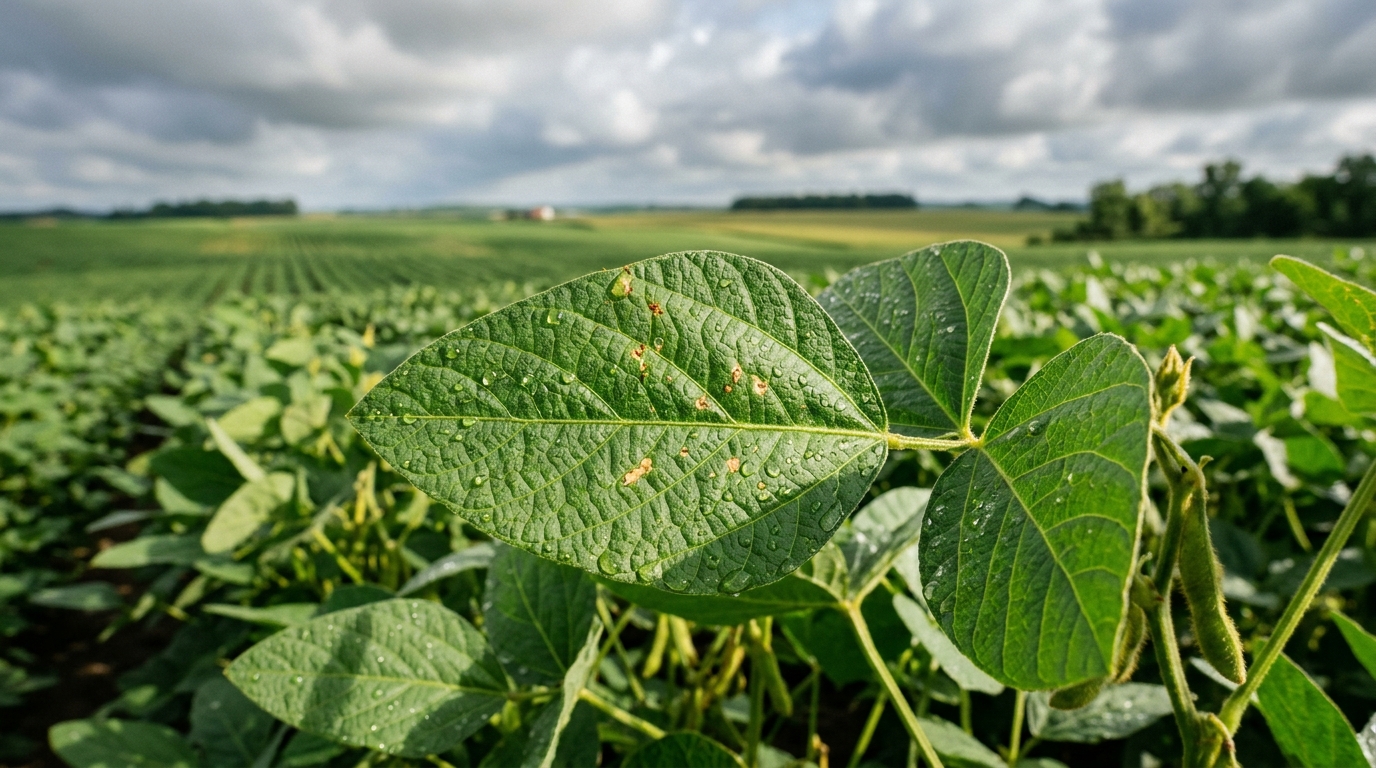
Agricultural production worldwide faces substantial pressure from foliar plant pathologies, with crop diseases causing estimated losses ranging between twenty and forty percent of global harvest yields each year. Pathological symptoms such as interveinal chlorosis, necrotic lesion spots, powdery mildew coatings, and progressive tissue blighting can rapidly propagate across entire agricultural fields if early intervention is not administered. Conventional diagnostic practices rely overwhelmingly on manual, subjective leaf inspections conducted by agricultural experts, an approach that is labor-intensive and difficult to scale across broad farming regions. Although deep learning models and convolutional neural networks have demonstrated high diagnostic accuracy on controlled laboratory datasets, their predictive performance drops sharply when transferred to operational farm settings. To address the persistent performance gap between pristine laboratory benchmarks and unstructured farm environments, researchers have designed and evaluated PALM-Net, a population-aware leaf disease multilinear framework engineered to maintain classification robustness under complex field conditions.
Standard computer vision models frequently falter when moving from standardized benchmark imagery to unconstrained agricultural environments due to intense background noise, erratic natural illumination, shifting camera angles, and morphological variations across plant species. Benchmark collections such as the PlantVillage dataset—comprising 54,305 leaf images across thirty-eight distinct classes and fourteen crop species—are generated in controlled laboratory setups using standardized artificial lighting against uniform white backdrops. Under these idealized testing conditions, advanced vision transformers and hybrid convolutional architectures such as EGWT, ICVT, and RAI-Net routinely achieve classification accuracies surpassing ninety-nine percent. However, when these identical architectures are evaluated on real-world agricultural field imagery, such as the Cassava Leaf Disease Dataset collected from farming plots in Uganda, classification performance deteriorates markedly. For example, EfficientNet-B7 drops from ninety-nine percent on PlantVillage to 84.21 percent on cassava, while ViT-Base plunges from 97.65 percent down to 79.94 percent—an absolute decline of 17.71 percentage points—demonstrating that pristine laboratory efficacy fails to guarantee resilience amid outdoor agricultural complexities.
Analysis of this generalization breakdown identifies three structural constraints embedded within standard deep learning pipelines. First, prevailing convolutional and vision transformer models process and classify individual leaf images in isolation, relying entirely on single-instance pattern matching. Under this isolated training paradigm, a neural network never directly contrasts the statistical distribution of one pathology against another across hundreds of training samples, forcing the model to infer fine-grained class boundaries implicitly. In field datasets where within-class environmental variation caused by fluctuating sunlight, soil textures, weeds, and shadowing frequently exceeds subtle between-class morphological disparities, per-image feature mappings prove insufficient. Second, classical convolutional backbones collapse spatial dimensions through global average pooling prior to classification, condensing three-dimensional feature representations into a single vector. This spatial averaging permanently destroys critical anatomical indicators, such as whether chlorotic patches disperse across the leaf lamina or necrotic lesions progress inward along leaf margins.
The third major structural obstacle involves spectral channel imbalance and numerical instability during multilinear tensor factorizations. Deep convolutional activations typically exhibit pronounced channel dominance, wherein a small subset of channels responding to broad lighting variations or soil backgrounds exhibits high variance while channels encoding faint lesion structures display near-zero variance. When multilinear subspace techniques attempt to factorize such unconditioned representations via alternating least-squares algorithms, the resulting Gram matrices become severely ill-conditioned, with condition numbers spanning from 100,000 to over several million. This ill-conditioning triggers mathematical divergence in tensor decompositions, prompting prior methods to implement post-hoc per-layer fine-tuning to stabilize factor representations. To circumvent these sequential bottlenecks, PALM-Net integrates three interconnected components into a unified end-to-end framework: a Multi-Scale Attentive Leaf Feature Extractor, a Population-Aware Leaf Disease Multilinear Purification module, and a Stable Rank Factorisation Head.
The initial feature extraction stage, termed the Multi-Scale Attentive Leaf Feature Extractor, captures hierarchical disease representations while deliberately avoiding the spatial collapse caused by global average pooling. The backbone employs a transfer-learned ResNet18 network initialized with ImageNet weights, retaining low-level feature extraction capabilities while adapting higher layers to foliar disease patterns. Activations from the final residual block are processed through a Squeeze-and-Excitation channel attention mechanism, which computes channel-wise recalibrations to accentuate lesion-relevant filters while suppressing peripheral background clutter. Subsequently, an Inception block applies parallel convolutional filters of dimensions 1×1, 3×3, and 5×5 alongside a 3×3 max-pooling operation. The 1×1 convolutions resolve fine-grained lesion perimeters, the 3×3 kernels capture intermediate infection patches, and the 5×5 filters capture diffuse foliar patterns. By outputting an unpooled three-dimensional spatial-spectral tensor, the feature extractor preserves the precise anatomical lesion architecture necessary for subsequent population-level multilinear processing.
Following feature extraction, individual image tensors across all training samples are stacked into a fourth-order dataset tensor whose fourth mode indexes the sample population. This tensor enters the Population-Aware Leaf Disease Multilinear Purification module, which operates through two sequential operations: a Spectral Decorrelation Layer and a Cross-Sample Discriminant Projection step. The Spectral Decorrelation Layer applies higher-order whitened singular value decomposition across tensor modes to eliminate inter-channel correlations. This whitening transformation equalizes channel variance, neutralizing the disproportionate influence of dominant environmental features and driving the channel-mode condition number toward unity. With the tensor conditioned, Cross-Sample Discriminant Projection applies multilinear exponential discriminant analysis to maximize inter-class dispersion while minimizing intra-class dispersion. By utilizing an exponential matrix mapping, the projection amplifies separation between visually similar disease pairs while regularizing near-singular scatter matrices, allowing the model to distinguish overlapping visual symptoms directly across the training population.
The conditioned, purified tensor then feeds into the Stable Rank Factorisation Head, which executes a Canonical Polyadic decomposition across the spatial and spectral modes using alternating least squares. Because the prior whitening step guarantees an isotropic channel covariance and a condition number approaching 1.0001, the alternating least-squares algorithm consistently converges within five iterations without encountering rank divergence or requiring iterative fine-tuning. The resulting directional factor vectors capture spatial height trajectories, spatial width profiles, and spectral channel signatures, respectively. Concatenating these factor vectors produces a compact descriptor vector containing 3R elements, which is mapped directly to diagnostic category probabilities through a linear softmax classification head. Theorem proofs confirmed that this multilinear factorization reduces classifier head parameters by more than ninety-five percent relative to standard dense fully connected classification layers, producing an exceptionally compact classification boundary.
Training the entire architecture proceeds under a two-phase protocol designed to maintain structural stability while enabling end-to-end parameter co-adaptation. During the initial five warmup epochs, early convolutional stages of the ResNet18 backbone are frozen at ImageNet weights while deeper layers, attention blocks, Inception filters, factor matrices, and classification parameters undergo initial optimization. At the conclusion of the first epoch, the spectral decorrelation whitening matrices and discriminant projection bases are calculated once from training-split features and subsequently fixed for the remainder of training and evaluation. At epoch six, the earlier backbone layers are unfrozen, and the learning rate is scaled down tenfold to allow joint optimization against a composite objective function. This objective balances diagnostic cross-entropy, multilinear discrimination, environmental variance suppression, and tensor reconstruction compactness, enabling backpropagation gradients to flow through constant projection matrices back into the feature extractor without updating the fixed population statistics.
Empirical evaluation of the framework was performed across three distinct benchmark datasets reflecting laboratory, unconstrained field, and cross-species settings using NVIDIA Tesla V100 graphics processing units under PyTorch. On the controlled PlantVillage benchmark of 54,305 images across thirty-eight classes, PALM-Net achieved a Top-1 accuracy of 99.32 percent with 12.07 million parameters, closely matching hybrid transformer architectures while using forty-seven percent fewer parameters than EGWT. Statistical significance and reproducibility assessments over independent randomized seeds yielded a mean Top-1 accuracy of 98.97 percent with a standard deviation of plus or minus 0.12 percent. A one-sample t-test against the baseline ResNet18 model confirmed statistical significance with a t-statistic of 47.71 and a p-value of 0.013, establishing a 95 percent confidence interval lower bound of 97.89 percent that ensures at least a 2.98 percentage point improvement over baseline.
On the challenging Cassava Leaf Disease Dataset, comprising 26,220 field images across five classes collected in Uganda under variable illumination, soil backdrops, and a 10.4-to-1 class imbalance, PALM-Net recorded an 84.56 percent Top-1 accuracy. This result surpassed competing architectures including EfficientNet-B7 at 84.21 percent, ViT-Base at 79.94 percent, and HOWSVD-TEDA at 78.40 percent, while performing within 0.69 percentage points of GWT, which requires nearly four times more parameters and five times higher computational FLOPs. On the Tomato Disease Dataset comprising 22,930 images across ten classes, the model achieved 97.44 percent Top-1 and 99.82 percent Top-5 accuracy. Across all benchmarks, the classifier head required only 4,661 to 6,846 parameters, representing up to an 818-fold compression compared to prior tensor subspace heads. These experimental findings demonstrate that combining pre-pooling lesion geometry preservation with population-level multilinear decorrelation establishes a computationally compact, field-robust architecture for automated crop disease diagnosis.
Subject of Research: Multilinear deep learning architecture for agricultural plant disease detection
Article Title: PALM-Net: Population-aware leaf disease multilinear network for robust plant disease detection
Article References: Lee, J.-H., Singh, V., Marathe, N., Kumar Jain, M., & Singh Rathore, B. (2026). PALM-Net: Population-aware leaf disease multilinear network for robust plant disease detection. Journal of King Saud University Computer and Information Sciences, 38(10), Article 1023. https://doi.org/10.1007/s44443-026-01373-3
Image Credits: AI Generated
DOI: 10.1007/s44443-026-01373-3
Keywords: PALM-Net, plant disease detection, multilinear learning, tensor decomposition, spectral decorrelation, precision agriculture, computer vision, cassava leaf disease, PlantVillage dataset, tomato disease classification, convolutional neural networks, feature extraction, squeeze-and-excitation attention, Inception blocks, discriminant projection, alternating least squares, agricultural technology, deep learning
News Source: Blake Davidson. (November 18, 2026). Multilinear Neural Network Boosts Field Crop Disease Diagnosis Across Variable Environments. Scienmag.