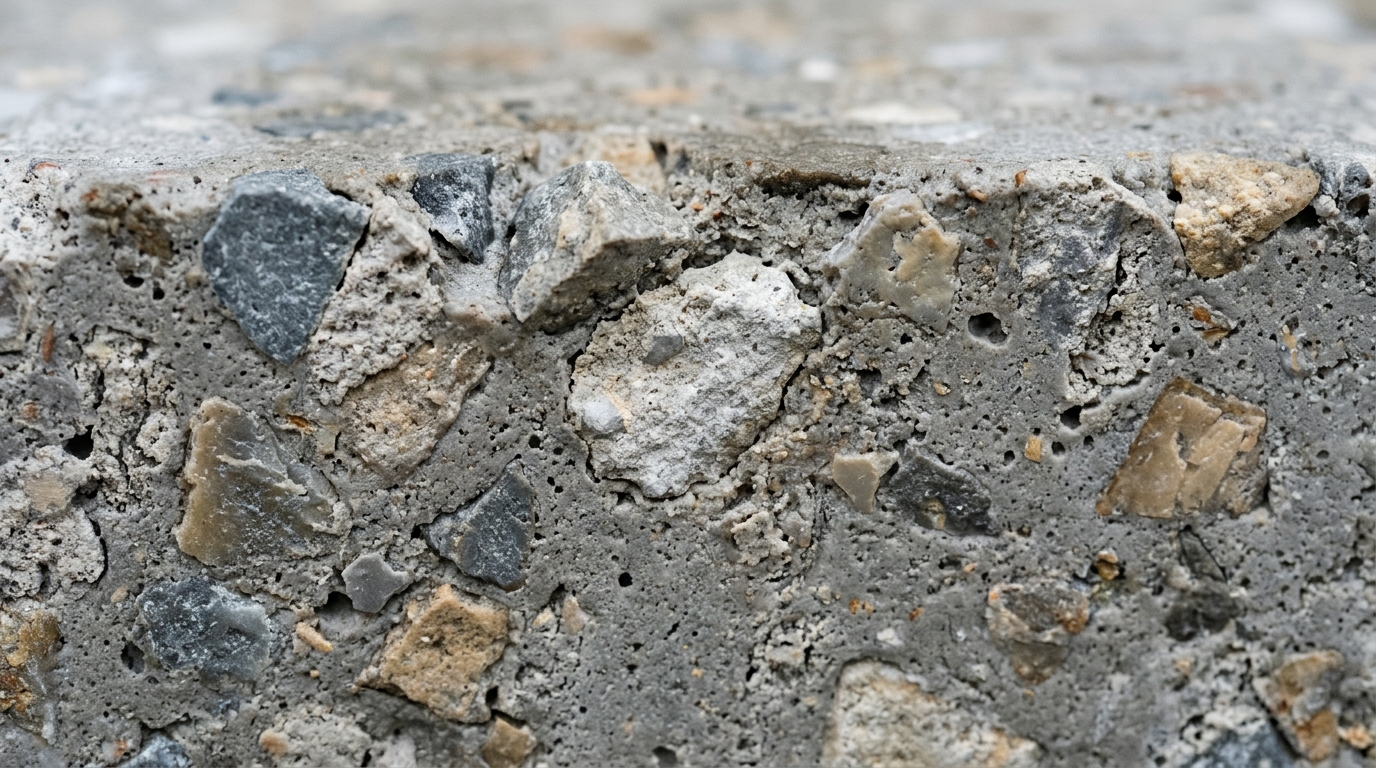
The global construction industry remains one of the most energy-intensive sectors worldwide, primarily driven by the massive production of concrete and cement-based materials. In 2019, European Union countries produced approximately 1.2 billion tons of concrete, necessitating the extraction of 2.55 billion tons of aggregates, nearly half of which were destined for structural concrete. Simultaneously, the industry faces an mounting crisis of waste management; by 2021, construction and demolition waste accounted for 36% of the global waste stream, totaling around 800 million tons annually in the EU-27. To address this environmental strain, the incorporation of recycled concrete aggregates (RCA) has become a primary focus of sustainable development. However, these materials often exhibit reduced durability performance compared to virgin aggregates, largely due to the increased porosity and altered pore structure inherent in the recycled mortar. A critical challenge for modern civil engineering is accurately predicting the long-term degradation of such materials, particularly concerning their exposure to aggressive ions and moisture fluctuations. A recent study has established a sophisticated integrated experimental and numerical framework to address this, leveraging water retention hysteresis modeling to enhance the reliability of durability assessments in recycled concrete.
The research team conducted a rigorous experimental program to characterize both moisture-related transport mechanisms and chloride migration in three distinct cement-based materials: natural aggregate concrete, recycled aggregate concrete with 100% substitution of aggregates, and an equivalent mortar. The experimental design included measurements of bulk density, water absorption, open porosity, and intrinsic water permeability in accordance with standard ASTM and international protocols. A central innovation of the study was the detailed determination of the main drying and wetting water retention curves through the vapor control technique. By maintaining thermodynamic equilibrium in a controlled climatic chamber using various saturated salt solutions, the researchers mapped the saturation degree against suction. This provided the empirical data necessary to calibrate the complex constitutive models that describe how recycled aggregate concrete exchanges moisture with its environment over time.
At the heart of the physics in this study is the theory of porous media, which treats concrete as a multi-phase system comprising liquid water, dissolved air, water vapor, and gaseous air. Water retention curves, which describe the relationship between saturation and suction, are traditionally modeled using the empirical Van Genuchten formulation. However, standard models often ignore the path-dependent nature of hysteresis—the phenomenon where the wetting and drying history of the material dictates its current state. The research team implemented a refined approach using scanning curves to describe the transitions between the boundary drying and wetting curves. These transitions are influenced by physical mechanisms such as the ink-bottle effect caused by irregular pore geometries, the difference between advancing and receding contact angles, and air entrapment during rewetting, which can occupy up to 10% of the pore volume. By incorporating these complexities, the model better captures the real-world performance of materials under fluctuating environmental conditions.
The numerical framework utilizes a multiscale finite element squared (FE2) methodology, which allows for the simulation of coupled water and gas transport, as well as chloride ion diffusion and advection, within saturated and unsaturated porous media. In this multiscale approach, the macroscale structure is meshed, but each individual Gauss point is associated with a mesoscale representative volume element that explicitly depicts the concrete’s internal heterogeneity. This element distinguishes between the newly cast mortar matrix and the adhered mortar on recycled aggregates, while natural aggregates are assumed to be impervious. The FE2 workflow operates through four iterative steps: determining the macroscale boundary conditions, resolving the mesoscale physics, homogenizing the fluxes, and feeding those effective properties back to the macroscale model. This provides a robust computational pathway that relies on fundamental intrinsic material properties rather than relying on structural-level empirical guesses.
Experimental findings highlighted significant structural differences between the materials. As expected, the recycled aggregate concrete was found to be less dense and more porous than the reference natural aggregate concrete, a direct consequence of the less dense adherent mortar found on the recycled components. The equivalent mortar, intended to represent the paste phase of the concrete, was notably more permeable, indicating a more interconnected network of larger pores. Despite these differences, the study confirmed that the Van Genuchten empirical model is highly applicable to recycled aggregate concrete. Analysis of the model parameters indicated that recycled aggregate concrete exhibits a wider pore size distribution, characterized by larger maximum pores and smaller minimum pores. Consequently, the material experiences faster moisture exchange with the environment, saturating and desaturating more rapidly than its natural counterpart under identical boundary conditions.
A critical component of the numerical analysis involved a parametric sensitivity study on the suction increment during simulation. Because the calculation of the saturation degree relies on the gradient of the retention curve, assuming a constant value over large suction increments can introduce substantial numerical errors. The study demonstrated that to maintain accuracy, the maximum sub-increment of suction must be kept strictly equal to or less than 10% of the Van Genuchten air-entry pressure parameter. By establishing this explicit correlation between the numerical sub-stepping and the physical material properties, the research team created a validated protocol for future FE2 simulations. This ensures that the modeled saturation responses remain accurate and physically consistent without forcing the implementation of excessively small global time steps that would render long-term environmental assessments computationally unfeasible.
Further investigation targeted the ‘b’ parameter, a dimensionless fitting variable that governs the curvature and slope of the hysteresis scanning curves. The study revealed that this parameter is not a fixed material constant but evolves based on the moisture history of the concrete. Sensitivity analysis showed that higher values of ‘b’ cause the scanning curves to converge toward the boundary limits more rapidly, while lower values cause the path to remain nearly parallel to the boundary. This is particularly relevant because chloride ingress is deeply coupled with the saturation degree; changes in local water content modify the relative contribution of diffusion versus advection. By evaluating three different approaches—modeling only one boundary, using a mean property, or implementing full hysteresis—the team showed that the choice of ‘b’ significantly influences the modeled distribution of water and, consequently, the long-term prediction of ion ingress.
Temporal simulations covering a decade of exposure illustrated the real-world implications of these findings. In the near-surface zone, where concrete experiences the most intense wetting and drying cycles, variations in chloride content were most pronounced. Simulations confirmed that the higher the water content, the faster the diffusion process, and that the amplitude of water flux dictates advective transport. For the purposes of safety and design, the study concluded that in the absence of highly specific experimental data for the ‘b’ parameter, choosing a higher value acts as a conservative design constraint, as it leads to an overestimation of chloride concentration. This design methodology ensures that engineering teams can mitigate potential degradation risks even when the historical moisture profile of a structure remains partially uncertain.
Perhaps the most significant industrial takeaway of the study concerns the long-term convergence of the results over multi-year periods. When examining the mean chloride content over a ten-year exposure cycle, the differences between various hysteresis modeling approaches were found to decrease substantially. While full hysteresis modeling remains an indispensable tool for precision scientific research into durability mechanisms, the study suggests that for many large-scale industrial engineering applications, the model complexity might be simplified without causing a major loss of accuracy. This conclusion offers a pragmatic pathway for engineers, allowing for the balancing of high-level computational efficiency with the necessary precision for structural service-life assessment, provided that the long-term exposure conditions are well-defined.
In conclusion, this research provides a comprehensive and sophisticated integrated framework for assessing the durability of recycled aggregate concrete. By bridging the gap between empirical material testing and multiscale numerical modeling, the team demonstrated how microstructural heterogeneity directly informs the macroscopic long-term performance of sustainable infrastructure. The findings serve as a cornerstone for future studies, particularly those aiming to investigate other degradation phenomena like carbonation and freeze-thaw cycles, which are also highly dependent on the transient moisture state. Furthermore, the researchers emphasize that future inquiries must explore how long-term exposure itself potentially modifies the internal microstructure of the concrete. This work marks a vital step toward the broader adoption of recycled concrete, ensuring that as the construction industry transitions toward a circular economy, it does so on a foundation of rigorous scientific understanding and validated engineering models.
Subject of Research: Civil engineering and sustainable material science.
Article Title: Application of a hysteresis model for the water retention curve in recycled aggregates concrete: experimental and numerical FE2 approaches
Article References: Fanara, A., Courard, L., & Collin, F. (2026). Application of a hysteresis model for the water retention curve in recycled aggregates concrete: experimental and numerical FE2 approaches. Low-carbon Materials and Green Construction, 4(1), Article 9. https://doi.org/10.1007/s44242-026-00105-0
Image Credits: AI Generated
DOI: 10.1007/s44242-026-00105-0
Keywords: Recycled Concrete Aggregate, Water Retention Curves, Hysteresis, Chloride Ingress, Finite Element Analysis, Concrete Durability, Sustainable Construction, Multiscale Modeling, Van Genuchten Model, Material Science, Porous Media Theory, Cement-based Materials, Numerical Homogenization, Infrastructure Engineering, Construction Materials
News Source: Denise Maddox. (November 18, 2026). Improving Concrete Durability Predictions with Hysteresis Modeling in Recycled Aggregates. Scienmag.