

• HOME
  • NEWS
  • EXPLORE
    • CAREER
      • Companies
      • Jobs
    • EVENTS
    • iGEM
      • News
      • Team
    • PHOTOS
    • VIDEO
    • WIKI
  • BLOG
  • COMMUNITY
    • FACEBOOK
    • INSTAGRAM
    • TWITTER
Friday, January 16, 2026
BIOENGINEER.ORG
No Result
View All Result
  • Login
  • HOME
  • NEWS
  • EXPLORE
    • CAREER
      • Companies
      • Jobs
        • Lecturer
        • PhD Studentship
        • Postdoc
        • Research Assistant
    • EVENTS
    • iGEM
      • News
      • Team
    • PHOTOS
    • VIDEO
    • WIKI
  • BLOG
  • COMMUNITY
    • FACEBOOK
    • INSTAGRAM
    • TWITTER
  • HOME
  • NEWS
  • EXPLORE
    • CAREER
      • Companies
      • Jobs
        • Lecturer
        • PhD Studentship
        • Postdoc
        • Research Assistant
    • EVENTS
    • iGEM
      • News
      • Team
    • PHOTOS
    • VIDEO
    • WIKI
  • BLOG
  • COMMUNITY
    • FACEBOOK
    • INSTAGRAM
    • TWITTER
No Result
View All Result
Bioengineer.org
No Result
View All Result
Home Headlines

Wearable equipment supports human motion where and when needed

Bioengineer.org by Bioengineer.org
January 25, 2018
in Headlines, Health, Science News
Reading Time: 2 mins read
0
Share on FacebookShare on TwitterShare on LinkedinShare on RedditShare on Telegram
IMAGE

A new model of pneumatic muscle and an active type of assistive equipment incorporating this pneumatic muscle has been developed at Hiroshima University and Daiya Industry Co. Ltd., Japan. This wearable equipment, called the Unplugged Powered Suit (UPS), supports human movement without requiring any electronic devices and tanks because it employs a newly developed pneumatic muscle named Pneumatic Gel Muscle (PGM) as an actuator. The UPS improves the quality of life of not only elderly individuals but also healthy people who enjoy sports activities. The UPS will be displayed at the International Robot Exhibition 2015 in December.

To prevent injury and accidents by aging and muscle fatigue, it is important to provide with safe and easy-to-use assist devices. In traditional assistive equipment, compressors and tanks are necessary to exert sufficient power for supporting human motion. It is also expensive to maintain an assist device.

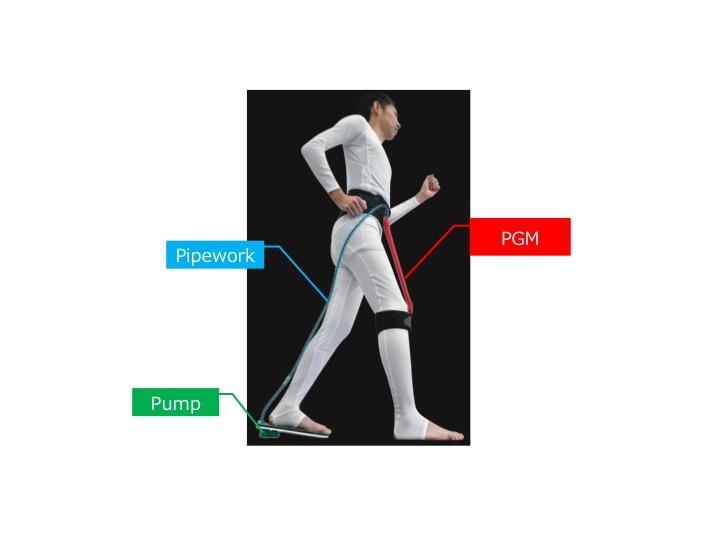
The UPS consists of three parts: PGM (drive part), pump (air pressure for flexing artificial muscle), and pipework (transmission). PGM is characterized as light and flexible, and can exert supportive power by low air pressure. The pump is equipped in the sole, and thus the driving force can be transmitted to PGM by using the human body weight. Overall, the UPS has a very simple structure, is easy to maintain, and is inexpensive.

"For example, PGM covers the articulatio coxae and the pump is equipped on the contralateral sole. This arrangement makes it possible to support human hip movement in the swing phase," said Associate Professor Yuichi Kurita at Hiroshima University.

There are two examples of UPS application. One is to decrease muscle activity during jogging, and the other is to increase the pitch speed. To decrease muscle activation during jogging, PGM in the UPS is equipped along the musculus soleus and the pump is equipped on the ipsilateral toe. To increase the pitch speed, PGM in the UPS is equipped along the greater pectoral muscle and the pump is equipped on the contralateral toe.

"The UPS is designed to support human motion where and when needed. It also does not contain any heavy devices. This means that we can customize the UPS to the user's particular needs such as muscle strength for athletes and rehabilitation. In the future, we can develop smarter assistive suits including wearable actuators and sensors by using our technique," said Dr. Kurita.

###

PHOTO OPPORTUNITY: You can film/photograph or try on the Unplugged Powered Suit (UPS) during the International Robot Exhibition 2015 from December 2nd to December 5th. Any reporters interested in this photo opportunity are asked to contact Norifumi Miyokawa at '[email protected]'

Share14Tweet7Share2ShareShareShare1

Related Posts

blank

Motivational Factors Influencing Generative AI Adoption

January 16, 2026

Advancements in Addiction Medicine Education Consultations

January 16, 2026

Empowering Seniors: Community-Based Approach to Aging

January 16, 2026

CTRP9 Enhances Heart Failure by Modulating Lipid Metabolism

January 16, 2026
Please login to join discussion

POPULAR NEWS

  • Enhancing Spiritual Care Education in Nursing Programs

    155 shares
    Share 62 Tweet 39
  • PTSD, Depression, Anxiety in Childhood Cancer Survivors, Parents

    147 shares
    Share 59 Tweet 37
  • Robotic Ureteral Reconstruction: A Novel Approach

    76 shares
    Share 30 Tweet 19
  • Study Reveals Lipid Accumulation in ME/CFS Cells

    53 shares
    Share 21 Tweet 13

About

We bring you the latest biotechnology news from best research centers and universities around the world. Check our website.

Follow us

Recent News

Motivational Factors Influencing Generative AI Adoption

Advancements in Addiction Medicine Education Consultations

Empowering Seniors: Community-Based Approach to Aging

Subscribe to Blog via Email

Enter your email address to subscribe to this blog and receive notifications of new posts by email.

Join 71 other subscribers
  • Contact Us

Bioengineer.org © Copyright 2023 All Rights Reserved.

Welcome Back!

Login to your account below

Forgotten Password?

Retrieve your password

Please enter your username or email address to reset your password.

Log In
No Result
View All Result
  • Homepages
    • Home Page 1
    • Home Page 2
  • News
  • National
  • Business
  • Health
  • Lifestyle
  • Science

Bioengineer.org © Copyright 2023 All Rights Reserved.
