In a prospective multicenter real-world study of patients undergoing combined cataract extraction and bio-reinforced cyclodialysis, implanting two allogeneic scleral spacers achieved numerically greater intraocular pressure reduction at one year than implanting a single spacer, although this association weakened considerably after accounting for enrolling surgical centers. The research evaluated two hundred sixty eyes across nine centers in the CREST study, recording an unadjusted between-group difference of 2.5 millimeters of mercury favoring two spacers. That statistical advantage persisted across multiple patient-level adjustments, including multivariable regression, propensity score matching, and doubly robust overlap weighting, which each showed an approximate two-millimeter difference. However, because spacer count was selected by surgeons rather than randomized, treatment was heavily clustered by center. When accounting for enrolling site, the estimated difference attenuated to 0.9 millimeters of mercury, indicating that institutional practice patterns significantly influenced the observed outcomes.
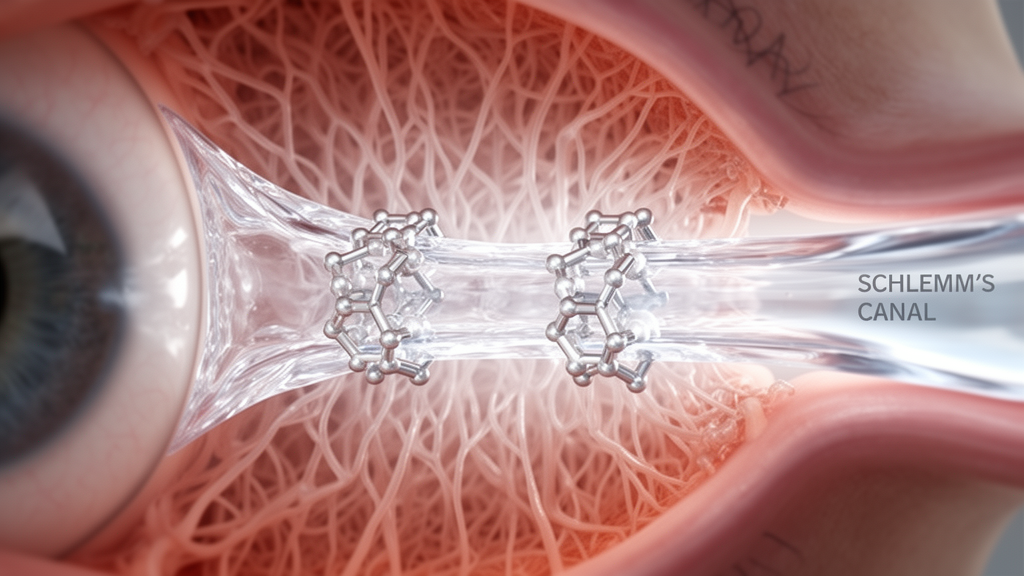
Managing open-angle glaucoma often requires individualizing therapeutic intensity, yet many angle-based surgical procedures deliver a fixed, binary intervention. Trabecular micro-bypass approaches target Schlemm’s canal to enhance conventional outflow, but their pressure-lowering capacity is physiologically constrained by downstream episcleral venous pressure, which imposes a functional lower limit estimated near 16 millimeters of mercury. Conversely, the unconventional uveoscleral pathway accounts for approximately thirty-five to fifty percent of aqueous humor drainage in healthy eyes and functions relatively independent of pressure within physiological ranges. By creating a direct communication between the anterior chamber and supraciliary space, bio-reinforced cyclodialysis targets this alternative drainage route. The surgical approach deploys biocompatible, acellular scleral allograft tissue to maintain cleft patency and foster outflow without disturbing the bulbar conjunctiva or Tenon’s capsule, preserving conjunctival tissue for potential future filtration surgeries should subsequent interventions be needed.
The study evaluated twelve-month outcomes from cohort one of the prospective, multicenter CREST registry, registered under identifier NCT05506423. The analysis focused on two hundred sixty eyes across one hundred eighty-seven patients with open-angle glaucoma who underwent bio-reinforced cyclodialysis combined with phacoemulsification cataract surgery and reached the twelve-month examination. Among these eyes, one hundred forty-six received one spacer and one hundred fourteen received two spacers, with seventy-three patients contributing bilateral surgeries accounting for one hundred forty-six eyes. Following real-world design principles, the protocol imposed no preoperative medication washouts and no fixed postoperative treatment schedules, leaving medication adjustments and the selection of spacer count entirely to surgeon discretion. Baseline clinical profiles were broadly comparable, with mean patient ages of 72.3 years in the single-spacer group and 72.4 years in the dual-spacer group, and female proportions of 50.0 percent and 56.1 percent, respectively.
Surgeons performed bio-reinforced cyclodialysis through an ab interno technique under gonioscopic visualization, maintaining the anterior chamber with viscoelastic material while fashioning a controlled cyclodialysis cleft within the nasal angle. Using the AlloFlo Uveo delivery system, elongated acellular scleral allograft scaffolds measuring five millimeters in length and five hundred micrometers in diameter were deployed into the supraciliary space flush with the iris root. These processed, porous, hydrophilic collagen matrices provide a durable structural pathway for uveoscleral outflow without protruding into the anterior chamber. Following scaffold positioning, residual viscoelastic substance was evacuated through irrigation or irrigation-aspiration, and patients received postoperative topical antibiotic and corticosteroid regimens tailored by each surgeon. The surgical platform enables titrating treatment intensity intraoperatively by adjusting the number of implanted scaffolds, contrasting with conventional angle devices that deliver fixed interventions across diverse disease severities.
To rigorously evaluate the effect of spacer count on intraocular pressure reduction, the study prespecified five complementary analytical approaches for the primary twelve-month endpoint. In addition to an unadjusted comparison using Welch t tests, investigators conducted analysis of covariance adjusting for baseline pressure, followed by multivariable modeling that adjusted for baseline medication burden, age, sex, glaucoma diagnosis, and prior glaucoma procedures. To address selection bias inherent in non-randomized surgical decisions, researchers applied one-to-one nearest-neighbor propensity score matching, generating one hundred three balanced pairs. They also used doubly robust overlap weighting, which preserved all two hundred fifty-two eyes with available twelve-month measurements by weighting each eye according to its counterfactual treatment probability. Across all primary efficacy analyses, intraocular pressure readings taken after any secondary pressure-lowering procedure were censored, ensuring that subsequent surgical interventions did not distort the evaluated outcomes.
Baseline intraocular pressure was modestly higher in the two-spacer group at 18.5 millimeters of mercury compared to 17.8 millimeters of mercury in the single-spacer group, accompanied by slightly higher baseline medication use of 1.5 versus 1.3 drugs. At twelve months, pressure dropped to 14.9 millimeters of mercury in single-spacer eyes, representing a reduction of 2.9 millimeters of mercury or 13.5 percent. In dual-spacer eyes, pressure decreased to 13.0 millimeters of mercury, reflecting a larger reduction of 5.5 millimeters of mercury or 23.6 percent. In unadjusted analysis, this difference in pressure reduction measured 2.5 millimeters of mercury favoring two spacers. Adjusting for baseline pressure yielded an estimated difference of 2.0 millimeters of mercury, identical to the fully adjusted multivariable model. Propensity score matching produced a 2.4-millimeter difference, and overlap weighting demonstrated a 2.0-millimeter difference, showing consistent numerical separation across patient-level models.
Despite apparent consistency across patient-level adjustments, closer examination revealed that treatment choice was heavily clustered within individual surgical sites. A single high-volume center contributed forty-four of the one hundred fourteen dual-spacer eyes, representing 38.6 percent of that group, but only eleven single-spacer eyes, or 7.5 percent. In contrast, three sites implanted single spacers exclusively across sixty-six eyes. Including center in the propensity model placed twenty-seven percent of eyes outside common support, showing that treatment decisions rarely overlapped within sites. When researchers applied a linear mixed-effects model treating site as a random effect, the between-group difference in pressure reduction attenuated to 0.9 millimeters of mercury. When analysis was restricted to the five centers using both strategies, the difference narrowed further to 0.4 millimeters of mercury, indicating that center-level differences largely accounted for the observed pressure reduction gap. Furthermore, because seventy-three patients underwent bilateral cyclodialysis, contributing one hundred forty-six eyes, investigators evaluated the inter-eye correlation of pressure change, identifying a strong correlation coefficient of 0.76. Adjusting for patient random effects alongside baseline pressure and medications yielded a 1.6-millimeter difference favoring two spacers, but combining both patient and site random effects attenuated the difference to 0.7 millimeters of mercury. Researchers also examined whether baseline glaucoma severity influenced outcomes among one hundred thirty-nine eyes with available visual field mean deviation. In a multivariable model adjusted for baseline pressure and site, baseline mean deviation did not predict twelve-month pressure, and no interaction between spacer count and visual field severity was observed. Stratified analyses across mild, moderate, and severe glaucoma strata demonstrated differences close to zero, reflecting the fact that baseline perimetry was largely absent from the highest-enrolling dual-spacer site.
Categorical responder endpoints displayed similar patterns of prominent unadjusted separation that attenuated following site adjustment. In unadjusted evaluations, two-spacer eyes more frequently achieved at least a twenty percent pressure reduction, at 58.6 percent versus 38.3 percent, and at least a thirty percent reduction, at 47.7 percent versus 24.1 percent. Achieving twelve-month pressures of 15 millimeters of mercury or lower occurred in 80.2 percent of dual-spacer eyes versus 59.6 percent of single-spacer eyes. When composite criteria required no medication additions and no secondary procedures, rates dropped in both arms while maintaining unadjusted separation. After adjusting for site, differences for twenty and thirty percent reductions lost statistical significance, while achieving 12 millimeters of mercury or lower remained significantly higher with two spacers. Medication burden decreased similarly in both groups, falling by 0.7 drugs with one spacer and 0.6 drugs with two spacers, while medication-free eyes reached 58.2 percent and 51.4 percent.
Safety findings were favorable and comparable between cohorts over twelve months. Secondary intraocular pressure-lowering interventions were performed in 3.4 percent of single-spacer eyes and 3.5 percent of dual-spacer eyes, with three eyes in each group receiving laser treatments alone and two single-spacer eyes undergoing secondary incisional operations involving a gel stent and a tube shunt. Kaplan-Meier estimates of twelve-month freedom from secondary incisional surgery reached 98.6 percent with one spacer and 99.1 percent with two spacers. Recorded ocular adverse events occurred in 15.1 percent of single-spacer eyes and 8.8 percent of dual-spacer eyes, yielding a site-adjusted odds ratio of 0.72 that showed no statistically significant difference. There were no cases of clinically significant hypotony maculopathy, and no instances of spacer dislodgement, migration, or extrusion were reported. Postoperative hyphemas resolved under conservative management, and transient numeric low pressures resolved spontaneously without causing permanent structural damage.
The authors noted several important constraints that define the limits of clinical inference from this real-world registry analysis. First, spacer number was determined by operating surgeons rather than assigned through randomization, resulting in substantial clustering across sites that prevented clear separation of spacer effects from institutional practices. Second, circumferential cyclodialysis cleft length was not measured independently, meaning scaffold count could reflect broader dimensions of surgical technique rather than spacer dosage alone. Third, all eyes underwent concurrent cataract surgery without a phacoemulsification-only comparator group, precluding estimation of the isolated pressure reduction provided by bio-reinforced cyclodialysis. Additionally, the study protocol lacked day-one and week-one scheduled visits, capturing early postoperative pressure spikes only during unscheduled examinations. The researchers concluded that while biological plausibility and trabecular micro-bypass precedents support the concept of titratable outflow surgery, prospective randomized clinical trials incorporating standardized surgical parameters and anatomical imaging are necessary to establish whether adding a second spacer independently enhances pressure reduction.
Subject of Research: Clinical outcomes of single versus dual allogeneic scleral spacers in bio-reinforced cyclodialysis combined with cataract surgery.
Article Title: Clinical Outcomes of Bio-Interventional Cyclodialysis with One or Multiple Allogeneic Reinforcements: A Multicenter Real-World Evidence Study
Article References: Chaya, C. J., Radcliffe, N. M., Qiu, M., Sieminski, S., Patel, S., Ianchulev, T., Ferreira, G., Shah, M., & Bacharach, J. (2026). Clinical Outcomes of Bio-Interventional Cyclodialysis with One or Multiple Allogeneic Reinforcements: A Multicenter Real-World Evidence Study. Ophthalmology and Therapy. https://doi.org/10.1007/s40123-026-01539-2
Image Credits: AI Generated
DOI: 10.1007/s40123-026-01539-2
Keywords: Glaucoma, Bio-reinforced cyclodialysis, Intraocular pressure, Uveoscleral outflow, Allogeneic scleral spacer, Cataract surgery, Phacoemulsification, CREST study, Real-world evidence, AlloFlo Uveo system, Supraciliary space, Propensity score matching, Overlap weighting, Surgical titratability, Observational study, Open-angle glaucoma, Ocular hypertension, Multicenter clinical study
News Source: Ophelia Keating. (November 18, 2026). Dual Glaucoma Spacers Lower Pressure but Clinic Differences Explain Most Gains. Scienmag.