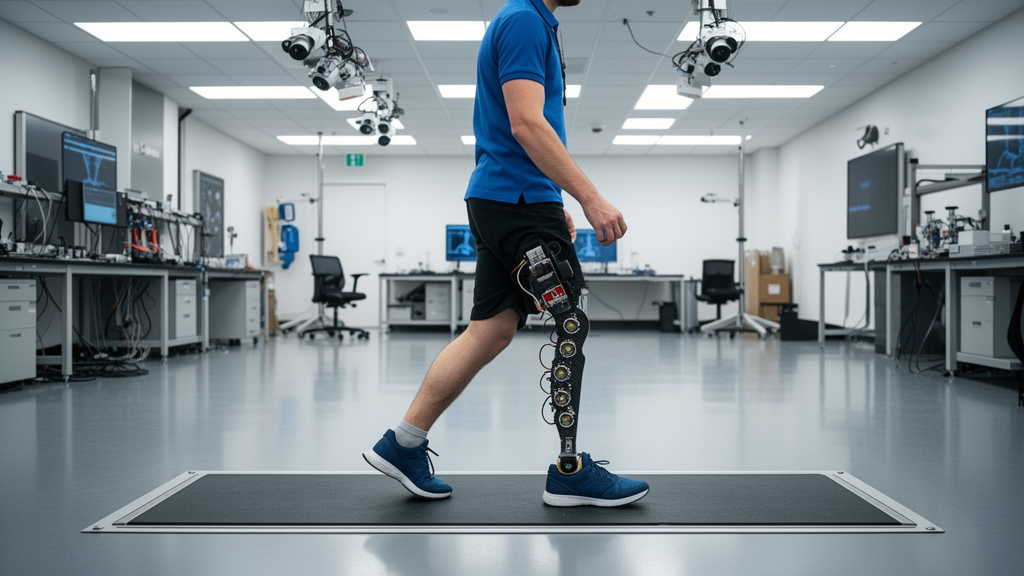
Applying mechanical tendon vibration to the sound limb of adults standing with a prosthetic bypass system alters center of pressure shifts and modulates inter-limb weight distribution, according to a preliminary study published in the Journal of NeuroEngineering and Rehabilitation. The research evaluated whether proprioceptive stimulation can influence standing posture in asymptomatic participants using a prosthetic bypass system that simulates a prosthesis, while identifying its specific impact on overall postural control during quiet standing.
Postural control is frequently impaired following lower-limb amputation because of substantial sensory and motor deficits. These functional deficits commonly lead to asymmetrical weight distribution between the limbs and an increased risk of falls. Mechanical vibration applied to the Achilles tendon or the tibialis anterior tendon can induce predictable postural responses through proprioceptive illusions and may offer therapeutic potential for improving balance. However, the precise effects of such vibration in individuals with reduced mobility and altered proprioception, including prosthetic users, have remained unclear.
To address this uncertainty, the investigators conducted a preliminary study to determine whether tendon vibration affects posture in asymptomatic individuals using a prosthetic bypass system simulating a prosthesis. By employing this bypass model, the team sought to identify the direct impact of tendon vibration on postural control and examine how sensory stimulation interacts with the altered mechanical configuration imposed by the prosthetic device during quiet standing.
The experimental cohort consisted of thirty healthy adult participants, comprising thirteen females and seventeen males. The female participants had a mean age of 28 years (standard deviation 7), a mean body mass of 60 kilograms (standard deviation 7), an average height of 166 centimeters (standard deviation 7), and ten individuals had a right-dominant leg. The male participants had a mean age of 31 years (standard deviation 12), a mean body mass of 73 kilograms (standard deviation 11), an average height of 182 centimeters (standard deviation 7), and twelve individuals had a right-dominant leg.
During testing, participants underwent mechanical vibrations at a frequency of 90 hertz applied to the Achilles tendon and the tibialis anterior tendon on their sound limb. The researchers analyzed center of pressure displacement, center of pressure velocity, and weight distribution on the bypass. Balance responses were examined both with and without the bypass worn across three designated temporal periods: a pre-vibration baseline interval lasting ten seconds, a stimulation interval lasting forty seconds during active vibration, and a post-vibration interval lasting ten seconds after vibration ceased.
The recorded data revealed that wearing the prosthetic bypass preserved the direction of vibration-induced center of pressure shifts, but significantly modulated their magnitude. Specifically, Achilles tendon vibration produced larger postural effects when the bypass was worn compared to standing without it. These findings indicate that while the directional illusion generated by tendon vibration remains consistent, the presence of the bypass alters the overall scale of the body’s compensatory postural adjustments during quiet stance.
Medio-lateral center of pressure shifts depended on the site of stimulation: Achilles tendon vibration shifted the center of pressure toward the bypass limb, whereas tibialis anterior tendon vibration shifted it toward the sound limb, thereby influencing weight distribution between the limbs. The authors concluded that these results provide preliminary evidence that tendon vibration can modulate postural responses and inter-limb loading in healthy participants using a prosthetic bypass. They noted that the findings support further investigation in individuals with lower-limb amputation to evaluate safety, persistence, and effects on load distribution.
Subject of Research: Postural control and limb loading during tendon vibration in a prosthetic-bypass model
Article Title: Effect of tendon vibration on postural control and limb loading during quiet standing in a prosthetic-bypass model
Article References: de Vaulchier, A., Jarrassé, N., & Bachta, W. (2026). Effect of tendon vibration on postural control and limb loading during quiet standing in a prosthetic-bypass model. Journal of NeuroEngineering and Rehabilitation. https://doi.org/10.1186/s12984-026-02195-0
Image Credits: AI Generated
DOI: 10.1186/s12984-026-02195-0
Keywords: tendon vibration, postural control, limb loading, prosthetic bypass, quiet standing, center of pressure, center of pressure velocity, weight distribution, Achilles tendon vibration, tibialis anterior tendon vibration, proprioceptive illusions, lower-limb amputation, sound limb, medio-lateral shifts, sensory deficits, fall risk, inter-limb loading
News Source: Ophelia Keating. (November 18, 2026). Tendon Vibration Modulates Balance and Limb Loading in Prosthetic Bypass Model. Scienmag.