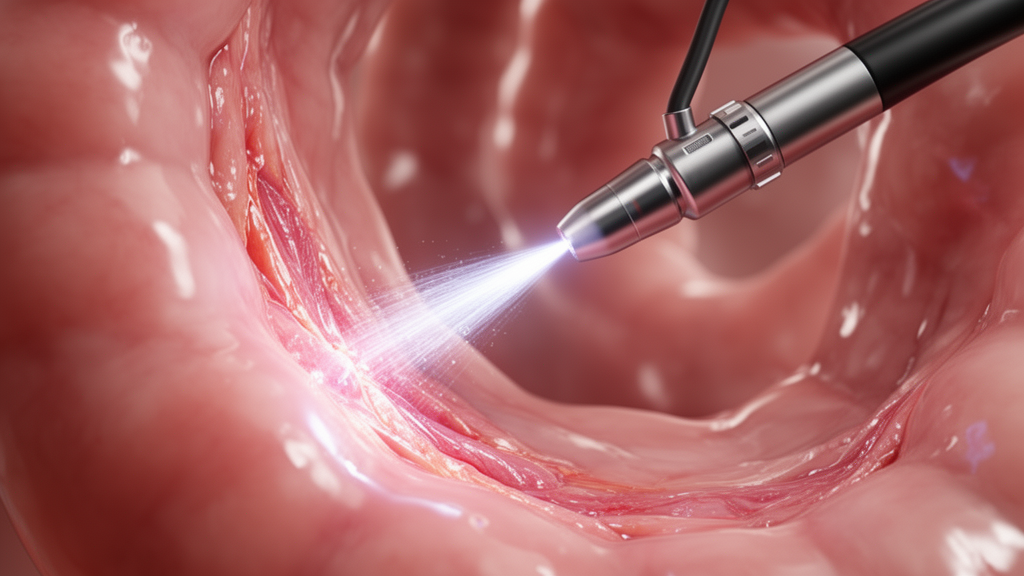
High-power spray coagulation utilized as a knife-based hemostasis strategy significantly improves procedural efficiency during colorectal underwater endoscopic submucosal dissection, according to a retrospective cohort study. In the clinical analysis, this specialized electrocautery approach was associated with nearly fourfold higher odds of completing resections within 60 minutes. While underwater endoscopic submucosal dissection has emerged as a promising alternative for removing colorectal neoplasms, intraoperative bleeding in the fluid environment remains a persistent hurdle. The study demonstrates that knife-based high-power spray coagulation mitigates these interruptions.
In conventional air-filled lumens, spray coagulation electrocautery reliably enhances hemostatic control. However, its effectiveness within an underwater operational field had not been established prior to this investigation. To address this knowledge gap, the study evaluated clinical outcomes of colorectal underwater dissection, assessing whether high-power spray coagulation applied directly through the dissection knife could enhance overall procedural efficiency.
The investigation was conducted as a single-center retrospective cohort study at a tertiary referral medical center, evaluating 56 consecutive patients who underwent underwater endoscopic submucosal dissection for colorectal neoplasms measuring 20 millimeters or larger between January 2024 and October 2025. Among the participants, 30 procedures utilized conventional coagulation settings, specifically Swift coagulation 4.5 or PreciseSECT 4.5. The remaining 26 procedures employed high-power spray coagulation using mode 7 on a VIO3 generator. Procedural efficiency, defined as completing the dissection within 60 minutes, served as the primary clinical outcome.
Univariable and multivariable logistic regression analyses were conducted to determine independent factors associated with timely completion. In multivariable analysis, high-power spray coagulation was independently associated with completing the procedure within 60 minutes, yielding an adjusted odds ratio of 3.99, a 95 percent confidence interval of 1.03 to 15.46, and a P value of 0.045. Conversely, tumor size of 30 millimeters or larger was associated with a reduced likelihood of timely completion, showing an adjusted odds ratio of 0.05, a 95 percent confidence interval of 0.01 to 0.27, and a P value under 0.0001.
The procedural efficiency associated with high-power spray coagulation was accompanied by a lower burden of intraprocedural bleeding requiring device exchanges. In the conventional group, the mean number of bleeding episodes requiring hemostatic forceps exchange was 0.53 with a standard deviation of 0.78. In contrast, the high-power spray cohort recorded a mean of 0.15 episodes with a standard deviation of 0.37, reaching statistical significance with a P value of 0.050.
Both technical approaches achieved high resection efficacy. En bloc resection was accomplished in 100 percent of procedures across both groups, comprising 30 of 30 conventional cases and 26 of 26 high-power spray cases. Histological complete R0 resection was attained in 92.9 percent of cases overall, representing 27 of 30 conventional dissections and 25 of 26 high-power spray dissections, with no significant difference between groups (P = 0.615). Safety profiles were similarly reassuring; intraprocedural microperforations occurred in two patients, representing 3.6 percent overall, with one event in each group, and all were successfully closed endoscopically.
Neither cohort experienced delayed bleeding or delayed perforation following the intervention. The study authors concluded that high-power spray coagulation as a knife-based vessel management strategy during underwater endoscopic submucosal dissection improves procedural efficiency and reduces bleeding episodes requiring forceps exchange. Nevertheless, the investigators emphasized that because these findings originate from a single-center retrospective design, further prospective multicenter studies are warranted to validate the technique before standardizing its integration into clinical underwater dissection practice.
Subject of Research: High-power spray coagulation efficiency in colorectal underwater endoscopic submucosal dissection
Article Title: High-power spray coagulation as knife-based hemostasis improves procedural efficiency in colorectal underwater endoscopic submucosal dissection
Article References: Lee, C.-Y., Toh, D.-E., Shen, C.-S., Chen, M.-Y., & Lee, T.-C. (2026). High-power spray coagulation as knife-based hemostasis improves procedural efficiency in colorectal underwater endoscopic submucosal dissection. International Journal of Colorectal Disease. https://doi.org/10.1007/s00384-026-05250-3
Image Credits: AI Generated
DOI: 10.1007/s00384-026-05250-3
Keywords: underwater endoscopic submucosal dissection, high-power spray coagulation, colorectal neoplasms, procedural efficiency, hemostasis, intraoperative bleeding, hemostatic forceps, en bloc resection, R0 resection, electrocauterization, Swift coagulation, PreciseSECT, VIO3, microperforation, knife-based vessel management, retrospective cohort study
News Source: Ophelia Keating. (November 18, 2026). High-Power Spray Coagulation Boosts Efficiency in Colorectal Underwater Endoscopic Dissection. Scienmag.