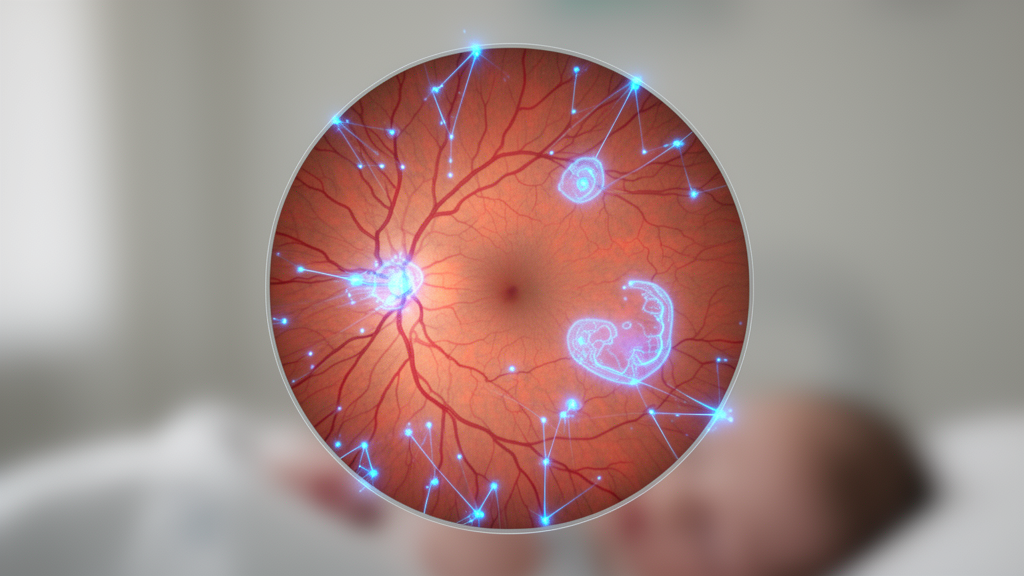
A unified multi-source deep learning framework designed for five-class retinopathy of prematurity image classification achieved an accuracy of 85 percent and an area under the receiver operating characteristic curve of 0.9587 on an augmented test subset, according to a study published in Frontiers in Artificial Intelligence. The research team, based at VIT University in Vellore, India, evaluated the computational architecture on heterogeneous neonatal fundus images to address challenges in automated analysis caused by variable imaging systems. Retinopathy of prematurity is an important retinal disorder affecting premature infants and represents a leading cause of preventable childhood blindness worldwide. Clinical management of the condition relies on timely detection and accurate classification of retinal findings, but automated diagnostic tools frequently struggle with differences in illumination, contrast, glare, and acquisition characteristics across different retinal cameras.
To develop and evaluate their proposed system, the researchers assembled a combined dataset comprising 1,151 neonatal fundus images collected from three publicly available sources. The team partitioned the combined dataset into three distinct portions: a training subset of 803 original images, a validation subset of 175 original images, and a testing subset containing 173 original images. After establishing these initial splits, the researchers applied offline class-wise augmentation independently within each separate subset rather than relying on on-the-fly augmentation techniques during model training. Following this independent offline augmentation procedure, the final dataset contained 1,388 image instances in the training subset, 300 image instances in the validation subset, and 300 image instances in the testing subset.
The framework incorporates a specialized multi-stage preprocessing pipeline engineered to standardize input data and mitigate discrepancies across heterogeneous acquisition devices. The proposed preprocessing pipeline combines adaptive gamma correction with PCAR-CLAHE enhancement. The technical pipeline additionally incorporates glare suppression. Finally, the preprocessing workflow includes image resizing and normalization steps.
For the core classification task, the investigators implemented a DenseNet201 architecture augmented with a Convolutional Block Attention Module. This attention-enhanced deep learning architecture was trained to perform five-class classification across distinct stages and presentations of retinopathy of prematurity.
To support interpretability, the investigators integrated Gradient-weighted Class Activation Mapping into the framework to produce qualitative visual explanations of automated decisions. This visualization technique highlights the specific spatial regions within neonatal fundus images that contribute most heavily to the network predictions for each class.
When evaluated on the 300-image augmented test subset, the unified model achieved an overall accuracy of 85 percent, a sensitivity of 85 percent, and a specificity of 96.25 percent. The area under the receiver operating characteristic curve reached 0.9587, confirming strong discriminative capability across the five evaluated disease classes. The authors concluded that their preprocessing and attention-enhanced framework offers a unified approach for handling heterogeneous neonatal fundus images. However, they emphasized that further investigation of cross-device generalization across independent clinical imaging devices and prospective clinical validation remain necessary before real-world clinical deployment.
Subject of Research: Medical AI and Ophthalmology
Article Title: Unified image preprocessing and attention-enhanced deep learning framework for cross-device multi-stage retinopathy of prematurity classification
Article References: Leema, A. A., Sowmiya, K., Haritha, R., Prasanna Kumar, K. S., & Balakrishnan, P. (2026). Unified image preprocessing and attention-enhanced deep learning framework for cross-device multi-stage retinopathy of prematurity classification. Frontiers in Artificial Intelligence, 9, Article 1956092. https://doi.org/10.3389/frai.2026.1956092
Image Credits: AI Generated
DOI: 10.3389/frai.2026.1956092
Keywords: Retinopathy of Prematurity, Deep Learning, Medical Imaging, Neonatal Screening, Artificial Intelligence, DenseNet201, Attention Mechanism, Grad-CAM, Image Preprocessing, Computer Vision, Clinical Diagnostics, Fundus Photography, Cross-Device Generalization, Explainable AI, Pediatric Ophthalmology
News Source: Blake Davidson. (November 18, 2026). Deep Learning Framework Classifies Retinopathy of Prematurity With 85 Percent Accuracy. Scienmag.