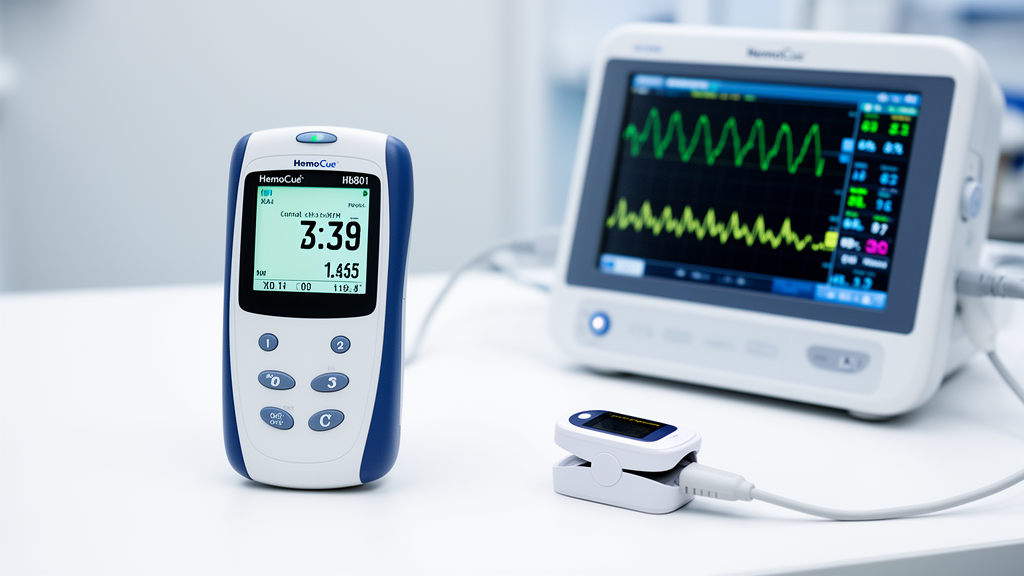
A prospective observational study evaluating perioperative hemoglobin monitoring has determined that while continuous non-invasive pulse hemoglobin monitoring (SpHb, version O) reliably tracks the direction of hemoglobin fluctuations, it lacks the absolute precision necessary to serve as the sole basis for clinical transfusion decisions. In contrast, intermittent point-of-care testing (POCT) using the HemoCue® Hb801 device demonstrated excellent agreement with a clinical laboratory reference standard, confirming its utility for precise bedside assessment. The research highlights the distinct performance characteristics of these two modalities and suggests that a combined, hybrid monitoring strategy may optimize patient care during surgery by utilizing continuous monitoring for early warning while relying on accurate point-of-care testing for confirmatory transfusion management.
Monitoring blood hemoglobin concentration remains a critical component of perioperative anesthetic management, as hemoglobin plays a central role in oxygen delivery to tissues. Reduced hemoglobin levels can disrupt the essential oxygen supply-demand balance, increasing the risk of adverse outcomes including cardiac and pulmonary complications, surgical site infections, and increased mortality rates. Because of these risks, clinicians must balance the goal of minimizing anemia against the potential immunological and infectious risks associated with red blood cell transfusions. Achieving this balance requires accurate, timely measurement of hemoglobin concentrations to guide informed clinical decision-making.
The study was conducted at a single center between May and December 2023, involving 50 adult patients undergoing general anesthesia with invasive arterial pressure monitoring for surgeries anticipated to involve significant blood loss. The research team evaluated two minimally or non-invasive modalities against an automated hematology analyzer as the reference standard. Continuous monitoring was performed using the latest version of pulse Co-oximetry, known as SpHb revision O, while intermittent POCT measurements were performed using the HemoCue® Hb801 device. A total of 281 arterial blood samples were analyzed, with researchers collecting comprehensive physiological and laboratory data to assess the accuracy, proportional bias, and trend-tracking ability of each device under varying clinical conditions.
The performance differences observed between the devices are largely rooted in their underlying measurement technologies. The SpHb system estimates hemoglobin concentration from the pulsatile component of multi-wavelength near-infrared light transmitted through a fingertip. This signal is inherently dependent on skin characteristics, subcutaneous tissue composition, and venous blood interference. In contrast, the automated reference standard utilizes impedance cell counting combined with cyanmethemoglobin spectrophotometry, while the HemoCue® Hb801 device employs direct spectrophotometry of whole blood at an hemoglobin-specific isosbestic point. Because these comparator methods directly analyze the optical properties of blood samples, they remain largely insensitive to the tissue and perfusion variations that complicate non-invasive monitoring.
The results of the analysis showed that the HemoCue® Hb801 device achieved excellent agreement with the reference standard, producing a correlation coefficient of r = 0.979. The measured bias was 0.119 g/dL, with limits of agreement falling between −0.687 and +0.925 g/dL. These metrics indicate that the device provides high accuracy, remaining well within clinically acceptable limits for bedside transfusion decision-making. Conversely, SpHb revision O showed a lower correlation coefficient of r = 0.777. The Bland–Altman analysis for SpHb revealed a bias of 0.348 g/dL and significantly wider limits of agreement, ranging from −2.114 to +2.811 g/dL. Notably, SpHb exhibited a distinct proportional bias, tending to overestimate hemoglobin at lower concentrations and underestimate it at higher concentrations, with values frequently converging toward a central median.
The study also analyzed the impact of peripheral perfusion on SpHb measurement accuracy, specifically assessing the device under low-perfusion conditions where the perfusion index (PI) dropped below 1.4. This threshold is clinically validated as identifying abnormal peripheral perfusion and is commonly used as a cut-off in perioperative settings. The research found that low peripheral perfusion was a common and recurrent issue, affecting 31.3% of all measurements across 64% of the participants. Under these conditions, the proportional bias of the SpHb device was slightly attenuated, but random error or noise increased significantly, rendering measurements more unstable. This fluctuation confirms that SpHb accuracy is strongly influenced by hemodynamic conditions, a factor that clinicians must anticipate during high-bleeding-risk operations.
Despite the lack of absolute accuracy, the polar plot analysis for trend-tracking ability yielded clinically useful observations. Among the 9 cases involving blood loss exceeding 1,000 mL, the research evaluated successive changes in hemoglobin levels between sampling points. SpHb demonstrated an angular bias of −5.8°, which was statistically insignificant, and a four-quadrant concordance rate of 100%. This indicates that the device reliably indicated the correct direction of hemoglobin movement in every observed instance. However, the radial limits of agreement, which assess the ability to quantify the magnitude of that movement, were −36.3° to +24.6°, exceeding the ±30° criterion for acceptability. These results suggest that while SpHb can function effectively as a qualitative early-warning tool, it is not currently sufficient as a standalone quantitative gauge of hemoglobin changes.
The study further addressed the threshold of clinical acceptability for hemoglobin monitors, arguing that bias and precision metrics alone are insufficient without context regarding the specific transfusion decision window. Most transfusion decisions occur within a hemoglobin concentration range of 6–10 g/dL. With observed limits of agreement as wide as ±2.5 g/dL, the SpHb device could potentially cause a clinician to withhold a necessary transfusion for a truly anemic patient or, conversely, prompt an unnecessary transfusion for a patient with stable levels. Given that the measured error band is wider than the standard 1–2 g/dL clinical decision window, the authors suggest that a device must exhibit limits of agreement within approximately ±1 g/dL to be considered reliable for making standalone transfusion decisions.
Integrating these findings, the research team proposes a hybrid perioperative strategy. Continuous, non-invasive SpHb monitoring serves as an early-warning signal, alerting the anesthesiologist to downward trends in hemoglobin that might otherwise go unnoticed between intermittent laboratory checks. When SpHb signals a significant trend, the clinician can then perform a rapid HemoCue® measurement to obtain the precise hemoglobin value required for a clinical decision. Because the HemoCue® system requires only approximately 10 microliters of arterial blood per measurement, it can be utilized repeatedly throughout the surgery without contributing to iatrogenic anemia, ensuring that patients receive timely care during evolving hemorrhage while avoiding unnecessary blood exposure.
The study includes several identified limitations that warrant consideration for future research. It was a single-center trial with 50 patients, and the mean preoperative hemoglobin concentration of 12.5 g/dL meant there were relatively few cases below the common 8 g/dL transfusion threshold. Therefore, additional, larger-scale multi-center studies are required to confirm these performance characteristics at extremely low hemoglobin levels. Furthermore, while the trend-tracking analysis provided significant insight into directional accuracy, the number of successful pairs after applying the exclusion-zone filter resulted in uncertainty regarding the radial limits of agreement. Future investigations should also model the perfusion index as a continuous modifier of error, rather than as a single binary threshold, to gain a more nuanced understanding of how hemodynamic fluctuations specifically degrade non-invasive measurement precision.
In conclusion, the prospective observational data confirms that while HemoCue® Hb801 provides highly accurate arterial hemoglobin measurement, SpHb revision O is best utilized for its ability to track the direction of hemoglobin trends rather than for absolute estimation. By adopting a hybrid management approach that leverages the continuous monitoring capabilities of pulse Co-oximetry for early warning alongside the confirmed precision of point-of-care testing, clinicians may better balance the competing risks of anemia and unnecessary transfusion. This combined approach, provided an arterial line is available to facilitate reliable arterial blood sampling, offers a robust framework for improving patient safety and decision-making precision in high-bleeding-risk surgical procedures.
Subject of Research: Evaluation of continuous pulse hemoglobin monitoring and point-of-care testing accuracy in perioperative surgical settings.
Article Title: Accuracy of minimally invasive hemoglobin monitoring in the perioperative period: transcutaneous hemoglobin monitoring and point-of-care testing devices: prospective observational study
Article References: Sakimura, S., Oya, K., Sakaguchi, Y., & Yamaura, K. (2026). Accuracy of minimally invasive hemoglobin monitoring in the perioperative period: transcutaneous hemoglobin monitoring and point-of-care testing devices: prospective observational study. Journal of Clinical Monitoring and Computing. https://doi.org/10.1007/s10877-026-01510-3
Image Credits: AI Generated
DOI: 10.1007/s10877-026-01510-3
Keywords: hemoglobin, pulse oximetry, point-of-care testing, surgery, perioperative medicine, anesthesiology, blood transfusion, anemia, patient monitoring, hemodynamics, clinical accuracy, SpHb, HemoCue, medical technology, prospective study
News Source: Ophelia Keating. (November 18, 2026). HemoCue Hb801 Accurately Measures Hemoglobin While SpHb Tracks Trends. Scienmag.