Researchers at the Nelson Mandela African Institution of Science and Technology (NM-AIST) have demonstrated that implementing a two-stage anaerobic digestion system significantly improves both the stability and methane yield when processing kitchen waste compared to traditional single-stage configurations. Over a comprehensive 300-day experimental period conducted at mesophilic temperatures of 37.5 degrees Celsius, the two-stage process achieved a methane content of 69.6 percent with a methane yield of 640.31 liters of methane per kilogram of volatile solids. This contrasts sharply with the performance of the single-stage operation, which yielded only 356 liters of methane per kilogram of volatile solids at a 48 percent methane content. These findings suggest that the two-stage approach effectively mitigates common process instabilities, such as overloading and volatile fatty acid accumulation, which often plague single-stage reactors utilizing heterogeneous feedstocks like kitchen waste.
Anaerobic digestion is a complex biological process occurring in the absence of oxygen, involving four primary stages: hydrolysis, acidogenesis, acetogenesis, and methanogenesis. In the hydrolysis phase, organic matter is broken down into simpler compounds, followed by the acidogenesis stage where acidogens convert these compounds into various higher organic acids including propionic, butyric, and lactic acids, alongside alcohols and ketones. During the subsequent acetogenesis phase, these intermediate products are transformed into acetic acid and hydrogen, which are finally converted into methane and carbon dioxide during the crucial methanogenesis phase. The primary challenge in single-stage systems is that all these stages occur simultaneously within the same reactor, leading to a homogeneous mixture that cannot easily separate the distinct microbial requirements for each stage, often resulting in lower efficiency.
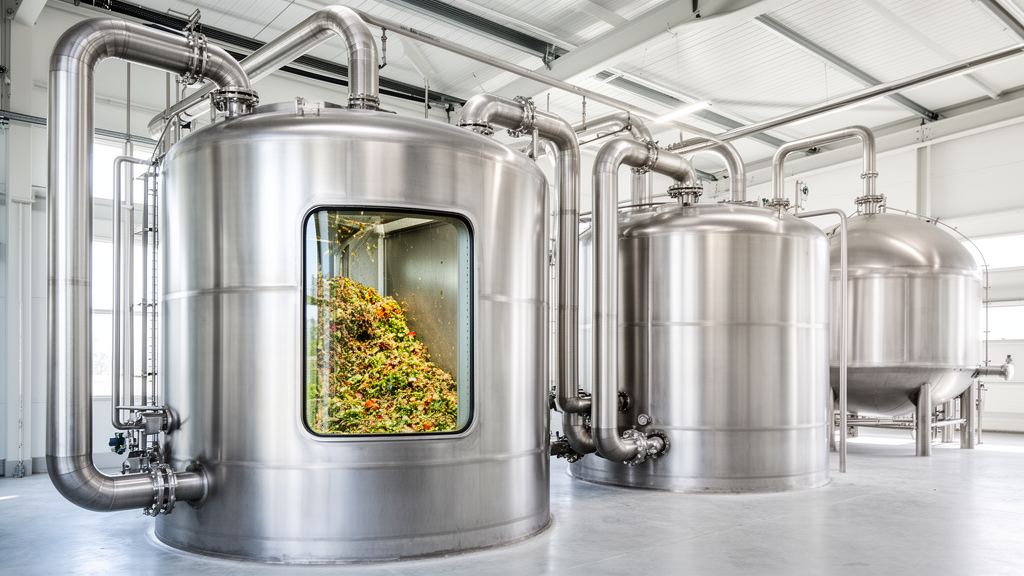
The experimental setup at NM-AIST utilized a system consisting of a grinder and a strip blender, equipped with three neoprene-insulated 4.5-cubic-meter reactors capable of operating in series, individually, or in parallel. The kitchen waste, collected daily from the university cafeteria, served as the primary substrate after being stored at 4 degrees Celsius and processed through a 45-mesh screen. The digesters were seeded with a mixture of kitchen waste and cow dung inoculum at a 10 percent concentration. Throughout the 300-day study, the daily substrate feed averaged 25.5 kilograms during the single-stage phase and 20.5 kilograms during the two-stage phase, with organic loading rates incrementally increased to reach a target of 2 grams of volatile solids per liter per day.
In single-stage systems, the lack of phase separation frequently leads to acidification, particularly when the reactor pH drops below 6. This condition is often caused by the accumulation of volatile fatty acids, which creates an acidic and stressful environment that inhibits the activity of methane-producing archaea. Because kitchen waste is inherently heterogeneous, its variable solid content and chemical composition can quickly induce an overloading effect in a single-stage reactor, leading to system instability and frequent pH fluctuations. In practice, while pH levels can be regulated to between 6 and 8, the lack of uniformity in a single-stage system often makes such manual adjustments insufficient to maintain a stable methanogenesis process.
The two-stage system addresses these limitations by physically separating the acid-producing stages from the methanogenesis stage, allowing each to be monitored and regulated effectively. By configuring the first reactor to control hydrolysis, acidogenesis, and acetogenesis, and the second to specifically manage methanogenesis, the interaction between microbial communities is minimized. This separation helps to inhibit the overloading effect and prevents the excessive accumulation of volatile fatty acids. Furthermore, the two-stage system provides a more conducive environment for the microorganisms by preventing the conditions that typically lead to the inhibition of methane-producing archaea, which require a stable, optimal pH range of 6 to 8 for sustained biogas production.
The stability of the anaerobic digestion process is intrinsically linked to the ratio of volatile fatty acids to alkalinity, a parameter that serves as a critical indicator for digester health. In this study, the volatile fatty acid to alkalinity ratio in the two-stage system remained within the suggested threshold values of 0.3 to 0.4. In contrast, the overall volatile fatty acid level in the single-stage system was measured at 352.68 milligrams per liter, which was higher than the 252.25 milligrams per liter recorded in the two-stage system. This lower accumulation of volatile fatty acids in the two-stage setup highlights its superiority in managing acid stress, providing a more stable environment that allows for consistent methane harvesting even under higher loading conditions.
The research also evaluated volatile solids and chemical oxygen demand removal efficiencies. Interestingly, while the single-stage system showed higher removal percentages, the two-stage system demonstrated a significantly higher conversion efficiency of the organic substrate into methane. The study notes that the high methane content and yield achieved in the two-stage system are indicative of effective biodegradation influenced by the robust activity of methanogenic bacteria throughout the process. The results suggest that in a two-stage system, the input substrates are utilized more efficiently to produce energy, rather than being lost through incomplete degradation or process inhibition, confirming the advantages of phase separation for complex organic wastes.
Previous literature on anaerobic digestion indicates that methane yields from food waste inoculated with manure typically range between 282 and 311 liters per kilogram of volatile solids. The yield of 640.31 liters of methane per kilogram of volatile solids achieved in this study demonstrates the high potential of two-stage systems for treating kitchen waste. By maintaining a stable pH range between 6.0 and 7.5, the two-stage configuration effectively supports the growth and sustainability of methane-producing archaea. The study indicates that the two-stage operation system acts as a shock and instability resistor, providing a robust solution to the acidification and overloading upsets that are commonly experienced in single-stage operations.
Analytical methods employed throughout the study included measuring chemical oxygen demand using high-range vials in accordance with HACH protocols, and quantifying volatile fatty acids and total alkalinity via Ripley and Kapp titration methods. pH was monitored with a specialized meter following sample centrifugation. The experimental consistency was maintained through triplicate analysis for chemical oxygen demand and total solids, alongside daily measurements of methane content using a biogas analyzer. These rigorous procedures ensured that the differences in performance between the single-stage and two-stage systems were based on reliable and reproducible experimental data.
In conclusion, the study validates that kitchen waste is a highly viable substrate for biogas production, provided that the digestion process is managed to prevent acidification and process instability. The research specifically underscores that the transition to a two-stage system can successfully resolve pH fluctuations and overloading effects, even when treating complex, heterogeneous waste materials. Given the observed outcomes, the researchers recommend the adoption of two-stage operation systems as a standard for treating kitchen waste to ensure a reliable, stable, and high-yield biogas production process, ultimately contributing to more effective energy recovery from municipal solid waste streams.
Detailed operational parameters governed the digester progression across the experimental timeline. Rather than running both configurations concurrently from the outset, the system transitioned on the 151st day from single-stage operation to the two-stage configuration, responding directly to heavy acidification and suppressed methane production observed during the opening phase. The subsequent two-stage phase operated for 150 days under identical loading parameters at 37.5 degrees Celsius. During reactor startup, feeding rates were ramped progressively, raising the organic loading rate by increments of 0.5 grams of volatile solids per liter per day until attaining the targeted two grams per liter daily. Within the two-phase setup, a hydraulic retention time of 48 hours was controlled by adjusting pump speed prior to each step. Fluid and biogas samples were drawn three times per week initially, shifting to daily collections at higher organic loading rates and reduced retention times, with liquid samples held at 37.5 degrees Celsius prior to testing.
Feedstock and equipment specifications further clarify the operational environment. Baseline analysis of the kitchen waste feedstock demonstrated a chemical oxygen demand of 258 ± 132 grams per liter, a volatile solids content of 19.21 ± 11 percent, and a volatile solids to total solids ratio of 94.54 ± 0.13 percent. The substrate was moved into the digestion system using a Watson-Marlow SPX40 hose pump, while feed acidity was adjusted to desired targets using a five percent sodium bicarbonate solution. Beyond the primary reaction chambers, the campus facility incorporated a third vessel consisting of a 5.7-cubic-meter polyethylene tank that received effluent digestate discharged from the main reactor. This resulting byproduct was retained and managed for prospective utilization as an agricultural fertilizer.
The research also contextualized its outcomes against earlier multi-stage digestion trials on alternative organic waste streams. Prior investigations on potato waste documented yields of 68 liters of hydrogen and 225 liters of methane per kilogram of total solids alongside 2.74 kilowatt-hours of total energy per kilogram of total solids, whereas continuous cheese whey digestion achieved daily rates of 7.53 liters of hydrogen and 75.6 liters of methane. When digesting molasses, peak generation rates reached 2.8 liters of hydrogen and 1.48 liters of methane per liter of reactor volume daily. In the current trial, tracking volatile fatty acid accumulation against alkalinity indicated that the two-stage configuration maintained stability well beyond the 200th day of operation, preventing the microbial stress and process failure observed when volatile acids accumulate unchecked.
Subject of Research: Comparison of single-stage and two-stage anaerobic digestion systems for biogas production from kitchen waste.
Article Title: Anaerobic digestion of kitchen waste operating at two-phase mesophilic scale digester: the impact of system performance based on methane production
Article References: Mutegoa, E. (2025). Anaerobic digestion of kitchen waste operating at two-phase mesophilic scale digester: the impact of system performance based on methane production. Discover Catalysis, 2(1), Article 5. https://doi.org/10.1007/s44344-025-00009-4
Image Credits: AI Generated
DOI: 10.1007/s44344-025-00009-4
Keywords: Anaerobic digestion, Methane production, Kitchen waste, Renewable energy, Biogas, Mesophilic conditions, Two-stage digester, Volatile solids, Chemical oxygen demand, Sustainable energy, Waste management, NM-AIST, Tanzania, Methanogenesis, Volatile fatty acids, Process stability, Renewable fuel, Organic waste treatment, Biochemical methane potential, Bioreactor optimization
News Source: Bethany Barker. (November 18, 2026). Two-Stage Digestion Significantly Increases Methane Yield From Kitchen Waste. Scienmag.