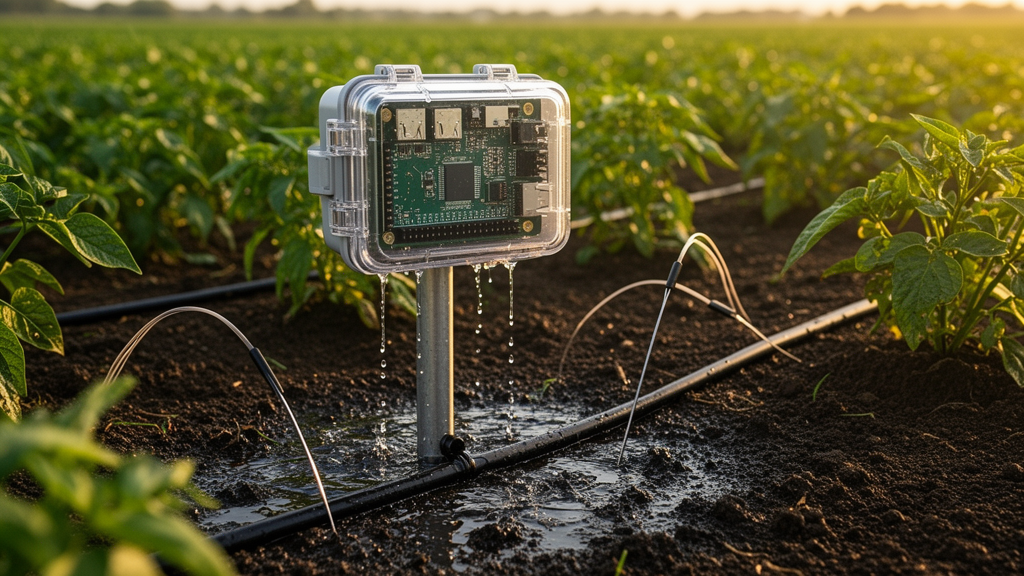
Agricultural engineers have developed an ultra-lightweight, physics-informed edge artificial intelligence architecture capable of executing autonomous deficit irrigation modeling directly on resource-constrained microcontrollers while consuming 73.3 percent less computational energy than uncompressed baselines. Described in an evaluation published in the Journal of the Saudi Society of Agricultural Sciences, the framework addresses severe infrastructure deficits across remote arid farming regions where continuous cloud connectivity and dependable electrical grids remain unavailable. By translating complex biophysical relationships into an 8-bit integer quantized surrogate model, the system executes precision irrigation logic within an 8-kilobyte execution memory envelope. The computational design simultaneously couples deterministic agronomic guardrails with an unsupervised sensor degradation monitoring protocol, demonstrating that smallholder agricultural communities can deploy sophisticated water conservation algorithms on low-power hardware without risking catastrophic crop mortality or depending on remote server telemetry.
Contemporary smart irrigation systems predominantly rely on centralized cloud computing platforms to process incoming telemetry from distributed Internet of Things sensor networks. While cloud servers possess the memory and compute capacity to run complex predictive algorithms, their continuous dependency on internet access introduces critical points of failure in remote agricultural regions. Deep neural networks and dense ensemble architectures also impose steep computational burdens that rapidly deplete battery reserves when deployed on localized, solar-powered field installations. In contrast, local execution on ultra-low-power microcontrollers presents severe physical boundaries, as standard embedded chips offer limited onboard flash storage and volatile random-access memory. Furthermore, purely data-driven black-box machine learning models frequently exhibit out-of-distribution hallucinations or statistical overconfidence, producing erroneous recommendations that could severely under-irrigate crops during unanticipated meteorological anomalies or extreme drought events.
To overcome these empirical and computational challenges without risking living agricultural assets, the researchers implemented a physics-informed in silico data synthesis protocol that constructed 500,000 deterministic vectors using a fixed random seed of 42. Controlled generation allowed the researchers to stress-test the model against extreme physiological boundaries, specifically field capacity and the permanent wilting point, while avoiding the systemic biological survival bias inherent in observational field datasets where human farmers routinely intervene before crops reach terminal wilting states. The synthesis engine simulated environmental variables based on truncated Gaussian distributions, generating ambient temperatures with a mean of 32.00 degrees Celsius and standard deviation of 5.00 degrees, relative humidity averaging 64.96 percent with a standard deviation of 15.00 percent, and solar radiation centered at 547.81 Watts per square meter with a standard deviation of 150.00 Watts per square meter. A deterministic linear surrogate model computed reference evapotranspiration, providing an objective mathematical foundation for downstream algorithmic training.
The biological core of the synthetic data architecture incorporated phenological crop coefficient dynamics and cumulative plant stress histories. The framework scaled the dimensionless crop coefficient between a static minimum of 0.3 and a maximum of 1.2 through a sinusoidal function tracking cumulative growing degree days across a physiological lifespan capped at 2,500 thermal units. Required volumetric soil moisture was calculated using a standard soil retention multiplier set to 1.0 for simulated loam conditions. To capture physiological stress accumulation, the researchers formulated an epigenetic stress memory index combining the normalized thermal age of the plant with cumulative volumetric soil moisture deficits and a uniform stochastic scaling factor. This mathematical formulation caused cumulative biological stress values to reach up to 53.7 units near plant maturity, ensuring that subsequent machine learning models learned to prioritize cumulative moisture history over brief, instantaneous fluctuations in atmospheric readings.
Data engineering protocols partitioned the 500,000-record synthetic matrix into a stratified split consisting of 350,000 training records, 75,000 validation records, and an isolated test set of exactly 74,999 records. To prevent over-parameterized decision trees from exceeding microcontroller storage limits, an autonomous algorithm tournament first evaluated nine distinct classification blueprints on a 50,000-record subset. Using validation macro F1-scores as the primary metric and training latency as a tie-breaker, the system applied a pruning rule that automatically eliminated any algorithm displaying a performance drop greater than three percent relative to the leading model. Three algorithms successfully survived this threshold: Support Vector Machines, Gradient Boosted Trees, and Random Forests. These champion architectures were subsequently retrained on a 100,000-record partition and combined through a vectorized soft-voting ensemble, which achieved an uncompressed baseline macro F1-score of 0.993 across ten independent seeded iterations with a standard deviation of 0.0002 and a 95 percent confidence interval between 0.9930 and 0.9933.
Translating the trained ensemble into a deployable embedded firmware required post-training 8-bit integer quantization and architectural weight collapsing. By enforcing a linear hyperplane during quantization, researchers compressed thousands of floating-point support vectors into a single 8-bit weight vector and scalar bias, reducing inference to a dot product calculation. Parameter reduction slashed flash memory requirements from 205 kilobytes in the original 32-bit floating-point version down to exactly 51 kilobytes in the quantized configuration, while static random-access memory requirements compressed from 31 kilobytes to 8 kilobytes. This 75 percent reduction in total memory footprint yielded an operational INT8 macro F1-score of 0.977 on the isolated test partition, reflecting a marginal accuracy trade-off of only 1.6 percent. Statistical Y-scrambling tests generated a baseline retention score of 0.952 against a null distribution mean of 0.330, confirming that the compressed model captured genuine biophysical rules rather than exploiting dataset artifacts.
Cycle-accurate hardware profiling performed against a 32-bit ARM Cortex-M4 microcontroller running at 80 megahertz under a constant 150-milliwatt active power draw confirmed dramatic efficiency improvements. The uncompressed 32-bit floating-point architecture required 2,363.0 micro-joules of energy and 15.750 milliseconds of execution latency per inference cycle. Following INT8 quantization, execution latency dropped to 4.200 milliseconds and per-inference energy consumption fell to exactly 630.0 micro-joules, representing a direct 73.3 percent reduction in both temporal and energy requirements. Comparative benchmarking against logistic symbolic distillation baselines further demonstrated the superiority of integer quantization. While symbolic distillation formulas spanning Tier 1 through Tier 8 polynomial complexities peaked at a maximum fidelity score of 0.845 with a leaf complexity of 113 terms, the INT8 surrogate maintained its 0.977 operational macro F1-score, proving that symbolic approximations failed to capture the non-linear boundaries governing crop moisture transitions.
To prevent catastrophic algorithmic miscalculations during real-world deployments, the architecture integrates deterministic biophysical safety valves directly into the microcontroller runtime execution logic. Operating as a hybrid deterministic-AI routing engine, the firmware extracts hard operational limits from the empirical data distribution, placing the permanent wilting point at the first percentile of volumetric soil moisture (5.00 percent) and field capacity at the ninety-ninth percentile (53.09 percent). When environmental sensors report moisture readings falling outside this biologically viable envelope, the system autonomously bypasses the machine learning inference engine and executes deterministic emergency irrigation routines. On the 74,999-record test evaluation, the quantized model achieved true positive rates of 0.99 for critical moisture conditions, 0.99 for deficit conditions, and 1.00 for optimal moisture states, completely eliminating extreme false-negative classifications where dry crops might otherwise be misclassified as optimal.
Model interpretability analyses utilizing permutation feature importance verified that the quantized architecture adhered strictly to biological fundamentals. The epigenetic stress memory index accounted for 74.1 percent of overall predictive importance, while ambient temperature and volumetric soil moisture contributed 11.3 percent and 10.1 percent, respectively. Partial dependence plots confirmed that critical irrigation predictions followed a non-linear step-function response governed by the cumulative stress memory threshold rather than erratic responses to secondary environmental noise. Furthermore, when artificial white Gaussian noise was injected into the test inputs to simulate physical sensor degradation, standard ensemble architectures deteriorated to an F1-score of 0.650 under 50 percent noise intensity. In contrast, the integration of a Mahalanobis distance rejection mechanism allowed the proposed system to isolate anomalies, maintaining an F1-score of 0.915 while discarding 42.80 percent of corrupted signals.
To resolve the challenge of silent algorithmic failures in remote environments where labeled verification data does not exist, the framework incorporates an unsupervised feature drift index based on continuous statistical mean and variance shifts. Accelerated life testing evaluated across a simulated sixty-month hardware degradation timeline demonstrated that the drift index steadily tracked sensor deterioration without ground-truth labels. The architecture autonomously triggered a preventive maintenance alert at simulated month 18 as the drift index exceeded 0.15 and the hidden oracle F1-score reached 0.896. By simulated month 37, cumulative statistical degradation pushed the drift index beyond its 0.30 critical safety limit, autonomously terminating automated inference as oracle accuracy breached the 0.80 industrial viability threshold, thereby preventing erroneous irrigation commands during terminal hardware failure.
A cost-sensitive economic valuation demonstrated that the quantized surrogate framework substantially outperforms conventional management strategies under realistic asymmetric risk conditions. Misclassifications were weighted according to severe agronomic consequences, penalizing fatal crop mortality at 1,000 units, stress-induced yield loss at 100 units, resource waste at 50 units, and deficit water costs at 20 units. Under these parameters, a naive risk-averse heuristic timer that continuously over-irrigated to prevent crop death accumulated a total expected cost of 2,087,600 units, whereas a basic univariate moisture threshold recorded 674,890 units. The quantized surrogate model reduced total expected cost to 78,750 units, establishing an Economic Savings Index of 96.23 percent relative to the heuristic timer baseline. Sensitivity analyses across varying crop asset valuations indicated sustained financial savings ranging between 81.76 percent and 98.04 percent.
Despite these simulated operational successes, the authors emphasize explicit experimental limitations inherent to in silico evaluations. Relying on synthetic agronomic datasets allowed precise quantification of quantization loss and boundary conditions without crop destruction, but it omitted the unpredictable environmental stochasticity and micro-climatic spatial variance encountered in living fields. Furthermore, deploying fixed physiological constants within an 8-kilobyte execution memory envelope prevents the microcontroller from dynamically recalculating osmotic potentials, soil salinity accumulation, or phenotypic plasticity such as adaptive root architecture restructuring during prolonged deficit irrigation cycles. Future research must transition from cycle-accurate simulations to multi-site physical greenhouse and open-field trials, while exploring decentralized edge-federated learning and swarm intelligence to coordinate multi-node sensor deployments across variable agricultural topographies.
Subject of Research: Lightweight quantized surrogate edge artificial intelligence for smart agricultural irrigation and water use efficiency
Article Title: Lightweight physics-informed edge AI: a scalable quantized surrogate framework for smart irrigation and water use efficiency
Article References: Yaiprasert, C., & Nizar Hidayanto, A. (2026). Lightweight physics-informed edge AI: a scalable quantized surrogate framework for smart irrigation and water use efficiency. Journal of the Saudi Society of Agricultural Sciences, 25(7), Article 100. https://doi.org/10.1007/s44447-026-00193-1
Image Credits: AI Generated
DOI: 10.1007/s44447-026-00193-1
Keywords: edge artificial intelligence, smart irrigation, post-training quantization, microcontrollers, physics-informed modeling, water use efficiency, precision agriculture, surrogate modeling, epigenetic stress memory, ARM Cortex-M4, feature drift detection, TinyML, biophysical guardrails, cost-sensitive learning, evapotranspiration, soil moisture dynamics, sensor degradation
News Source: Blake Davidson. (November 18, 2026). Quantized Edge Artificial Intelligence Cuts Microcontroller Irrigation Energy by Seventy-Three Percent. Scienmag.