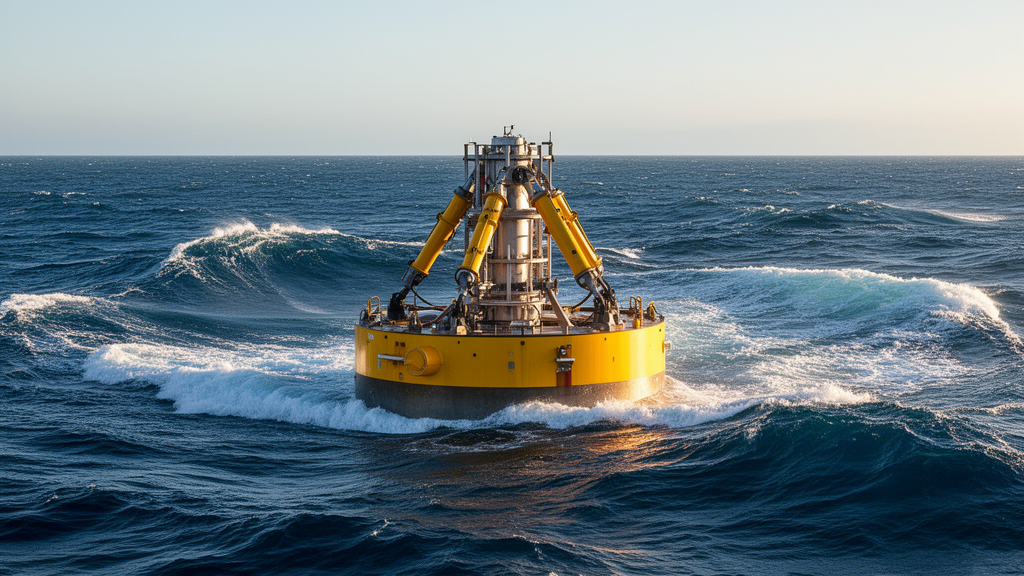
A computational investigation published in Results in Engineering demonstrates that tuning proportional-integral controllers with a nature-inspired metaheuristic algorithm significantly improves the dynamic stability and fault-ride-through capability of grid-connected ocean wave energy conversion systems. Researchers Ayedh H. Alqahtani, Habiba A. ElDemery, and Hany M. Hasanien evaluated a 150-kilowatt wave generation setup that pairs an oscillating water column with a permanent magnet synchronous generator linked to an electrical network through back-to-back power converters. By implementing Pied Kingfisher Optimization to determine the optimal gains across six system controllers, the simulation achieved an average multi-objective integral squared error of 0.18309 across twenty independent runs. This performance represents a 26.18 percent reduction in error compared to identical controllers optimized via a conventional Genetic Algorithm and a 28.38 percent reduction relative to Grey Wolf Optimization, providing superior dampening of electrical oscillations during severe symmetrical and unsymmetrical grid disturbances.
Harnessing ocean wave energy has emerged as an attractive frontier for clean power generation because water covers approximately 71 percent of the Earth’s surface, offering an estimated global theoretical potential of up to 2.11 terawatts of electrical power at localized power densities near 3 kilowatts per square meter. In addition to high energy density, ocean waves exhibit predictability that permits forecasting up to 84 hours in advance, providing distinct operational advantages over several alternative renewable resources. Nevertheless, converting raw wave motion into steady grid electricity presents steep technical challenges due to the inherent intermittency and hydrodynamic fluctuations of oceanic swells.
The physical system examined in the study centers on an oscillating water column, an ocean energy device favored for its structural and mechanical simplicity. The modeled structure consists of two vertical chambers positioned one above the other: a semi-submerged, open-ended lower capture chamber and an upper chamber housing an axial-flow Wells turbine. As incoming ocean waves propagate through the lower chamber, the internal water column rises and falls around the still water level, creating cyclic air pressure differentials within the capture chamber. This differential drives bidirectional airflow through the upper chamber, where the symmetrical blade profile of the Wells turbine enables continuous unidirectional mechanical rotation regardless of whether air is being expelled or drawn into the chamber. The turbine is directly coupled to a permanent magnet synchronous generator that converts the mechanical rotational energy into electrical power, governed by rotational inertia and friction dynamics characterized by a 152 kilogram-square-meter moment of inertia and a 4.6 kilogram-meter-squared-per-second friction coefficient.
To model incoming ocean waves, the research team utilized linear Airy wave theory, configuring wave parameters to resemble empirical oceanic conditions documented at the Mutriku wave power plant. The simulated sea state assumed a wave period of 10 seconds and a wave height of 1.40 meters, driving an oscillating chamber measuring 4.70 meters in width and 4.30 meters in length. The Wells turbine model incorporated eight symmetrical blades with an outer mean radius of 0.7285 meters, a blade height of 0.40 meters, and a blade chord length of 0.380 meters, establishing an upper chamber cross-sectional area of approximately 1.1763 square meters. Mathematical representations of airflow velocity through the chamber determined the resulting aerodynamic pressure drops, mechanical torque, and airflow coefficients that dictate the mechanical input delivered to the generator shaft during regular wave cycles.
Electrical power conditioning relies on a full-scale back-to-back converter system composed of a generator-side converter and a grid-side inverter, each utilizing six insulated-gate bipolar transistor switches operating with 1000-hertz carrier modulation. The generator-side converter regulates the stator direct-axis and quadrature-axis currents of the synchronous generator, driving the direct-axis reference current to zero to minimize generator winding losses while modulating the quadrature-axis reference current to track optimal aerodynamic torque points derived from the turbine characteristic curves. The grid-side inverter couples to the generator-side converter across a 15-millifarad direct-current link capacitor and connects to the utility network through a step-up three-phase transformer and a parallel double-circuit transmission line protected by circuit breakers. The inverter control strategy uses a cascaded architecture where outer loops regulate direct-current bus voltage and the point of common coupling voltage, while inner loops regulate the corresponding grid-side direct-axis and quadrature-axis currents to ensure compliant power injection at a 50-hertz system frequency.
Tuning the six proportional-integral controllers across the converter system presents an intricate multi-variable optimization challenge governed by conflicting dynamic objectives. The authors formulated a comprehensive objective function based on the integral squared error, combining two equally weighted terms to govern dynamic response. The first term evaluates the cumulative squared tracking errors of the generator stator current components, directly addressing internal machine efficiency and power extraction. The second term aggregates the squared deviations of the direct-current bus voltage, the point of common coupling voltage, and the grid-side inverter current components relative to their desired reference values. Minimizing this composite integral squared error requires an optimization algorithm capable of traversing complex twelve-parameter decision spaces without falling into localized numerical traps, ensuring coordinated tuning that simultaneously stabilizes internal generator electrodynamics and external grid interconnection variables.
In nature, the bird perches on elevated structures or hovers stationary in midair using rapid wing strokes to scan aquatic surfaces, dives at high velocities with streamlined posture to capture prey, and frequently participates in commensal foraging relationships with otters to exploit disrupted schools of fish. The mathematical implementation models these biological traits through discrete exploration, exploitation, and local escape phases. Exploration simulates perching and hovering searches modulated by crest angle trigonometry and beating rates, exploitation models rapid diving trajectories using calculated hunting ability coefficients, and the local escape mechanism introduces predatory efficiency bounds that prevent premature stagnation by referencing diverse population positions.
The authors executed extensive simulation experiments using MATLAB and Simulink software, executing dynamic differential equations via the variable-order ode23t solver at an integration step size of 10 microseconds. Over twenty independent computational optimization trials per algorithm, each running for 50 iterations with a population of 10 candidate solutions, Pied Kingfisher Optimization attained an absolute minimum objective function error of 0.1597. In comparison, the Genetic Algorithm reached a minimum error of 0.203989, and Grey Wolf Optimization achieved 0.2195. Although the total execution time of Pied Kingfisher Optimization reached 5.9 hours on an AMD Ryzen 5 PRO processor with 32 gigabytes of random access memory—longer than the 2.98 hours and 2.90 hours recorded for the comparative methods—it converged to an objective value by its third iteration, after only 0.354 hours, that was superior to the final 50-iteration solutions produced by both competing algorithms.
The dynamic robustness of the optimized controllers was subjected to rigorous verification across multiple simulated fault scenarios on the interconnected power grid. In a severe symmetrical three-phase-to-ground fault applied along a transmission circuit between 0.1 and 0.2 seconds, circuit breakers tripped to isolate the faulted line before successfully reclosing at 1.0 second. Upon clearing the fault, the Pied Kingfisher controllers contained direct-current bus voltage fluctuations to an undershoot of just 0.006 per unit, corresponding to a 0.6 percent reduction, whereas controllers designed via the Genetic Algorithm and Grey Wolf Optimization exhibited undershoots of 0.015 per unit and 0.030 per unit, translating to 1.5 percent and 3.0 percent reductions, respectively. The proposed method also yielded superior oscillation dampening upon circuit breaker reclosure, restricting active power overshoot to 0.932 per unit compared to 0.960 per unit for the Genetic Algorithm and 0.970 per unit for Grey Wolf Optimization, while containing reactive power surges and point of common coupling voltage sags.
Complementary evaluations under unsymmetrical grid disturbances confirmed the generalized resilience of the proposed control framework. During a double-line-to-ground fault, the active power output under the proposed control experienced an initial dip to only 0.20 per unit before recovering, whereas the comparative schemes dropped steeply to approximately 0.06 per unit. In single-line-to-ground and line-to-line fault trials, the pied kingfisher tuning maintained superior voltage retention at the point of common coupling, holding line voltage to 0.84 per unit during ground faults where comparative methods dropped to 0.80 and 0.745 per unit. The control framework was further stressed through an unsuccessful reclosure sequence during a three-phase-to-ground fault, where lines were reconnected into an uncleared fault at 1.0 second, tripped again at 1.1 seconds, and successfully reconnected at 5.0 seconds. Across both premature and final switching instances, the proposed control sustained stable direct-current bus voltage, recording minimal undershoots of 0.994 per unit and 0.990 per unit, markedly outperforming the fluctuating profiles of alternative controllers.
While the computational findings demonstrate significant control improvements, the authors emphasize that the study remains a simulation-based investigation governed by fixed wave parameters and modeled hydrodynamic assumptions. The modeled sea state relied on idealized regular sinusoidal waves derived from linear Airy theory rather than complex, irregular multi-directional sea spectra typical of real-world open ocean environments. Supported by funding from the Kuwait Foundation for the Advancement of Sciences, future research will explore physical hardware implementation to confirm whether these bio-inspired metaheuristic tuning strategies can maintain their demonstrated dynamic stability benefits within operational offshore wave energy conversion facilities.
Subject of Research: Dynamic performance enhancement of grid-connected wave energy conversion systems using Pied Kingfisher Optimization
Article Title: Wave energy conversion systems dynamic performance enhancement using Pied Kingfisher Optimization–based control approach
Article References: Alqahtani, A. H., ElDemery, H. A., & Hasanien, H. M. (2026). Wave energy conversion systems dynamic performance enhancement using Pied Kingfisher Optimization–based control approach. Results in Engineering, 32, Article 114032. https://doi.org/10.1016/j.rineng.2026.114032
Image Credits: AI Generated
DOI: 10.1016/j.rineng.2026.114032
Keywords: Wave Energy Conversion Systems, Oscillating Water Column, Permanent Magnet Synchronous Generator, Pied Kingfisher Optimization, Proportional-Integral Controllers, Grid Integration, Voltage Source Converters, Point of Common Coupling, DC Link Voltage, Integral Squared Error, Symmetrical Faults, Unsymmetrical Faults, Circuit Breaker Reclosure, MATLAB Simulink Simulation, Marine Renewable Energy, Wells Turbine Dynamics, Generator Side Converter, Grid Side Inverter
News Source: Denise Maddox. (November 18, 2026). Pied Kingfisher Optimization Enhances Dynamic Stability In Simulated Wave Energy Conversion Systems. Scienmag.