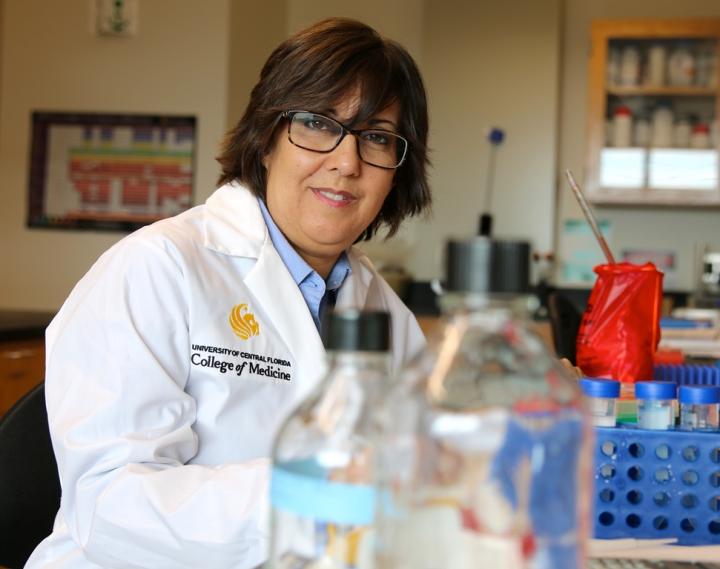
A University of Central Florida cancer researcher has discovered a way to kill spreading breast cancer cells and her new technology has generated a licensing agreement that will accelerate the therapy's path to clinical trials.
Metastatic cancer cells that spread from the original tumor to the brain, lungs and bones are the leading cause of death for most cancer patients, said Annette Khaled, the researcher at the university's College of Medicine who made the discovery. Her work is featured in the September edition of Clinical Cancer Research.
In the study, she details how the peptide CT20, which she discovered in 2012, kills fleeing cells. It disrupts the folding mechanism inside cancer cells mediated by a chaperonin. If the inner workings of the cell can't fold into 3D units, the cell dies.
Metastatic breast cancer cells have especially high levels of the chaperonin; the higher the levels, the sicker the patient. By discovering how the peptide inhibits the chaperonin's folding ability, Khaled said scientists can develop multiple therapies for fighting metastatic cancer. An advantage of the peptide is that the amounts that kill cancer cells do not kill healthy, non-cancer cells. That means using the CT20 peptide may have less traumatic side effects compared to most chemotherapies. As part of her research, J. Manuel Perez, a former UCF researcher who specializes in chemistry and nanotechnology, developed nanoparticles to transport the peptide specifically to metastatic cancer cells.
The next step in the research is to put the therapy into preclinical testing and clinical trials.
That's where SEVA Therapeutics Inc., a Massachusetts-based pre-clinical biotechnology company, comes in. It has now licensed the nanoparticle-peptide technology for the purposes of future research that ultimately could lead to new therapies. The nanoparticle-peptide combo, now called SEVA-108, is expected to undergo a comprehensive safety evaluation by the end of this year.
If successful, clinical testing in patients would start as early as the fourth quarter of 2017.
"We are very pleased with the opportunity to work with UCF and its researchers, as we develop breakthrough therapies for cancer," said Paul S. Krysiak, president and CEO of SEVA Therapeutics Inc. "These discoveries have the potential to change the paradigm of how the metastatic breast cancer and other invasive solid tumors can be treated, and represent a tremendous opportunity for unmet patient needs. Our job, at SEVA Therapeutics, is now to translate this significant innovation into meaningful therapies and bring them to the marketplace for the benefit of patient and medical communities, as quickly as practically possible. We look forward to continuing our collaboration with UCF and its staff on this journey."
The National Institutes of Health and the Breast Cancer Research Foundation has funded Khaled's work. She also was a key recipient of funds raised at the last AutoNation Cure Bowl football game in Orlando.
Khaled is the head of the College of Medicine's Cancer Research Division and because of her research has been nicknamed "the cancer assassin." Khaled joined UCF in 2002 and is an associate professor. She has several degrees including a Ph.D. in molecular genetics and immunology from the University of Florida. Before joining UCF she served as a postdoctoral fellow at the National Cancer Institute.
###
Media Contact
Wendy Sarubbi
[email protected]
407-266-1418
@UCF
Home