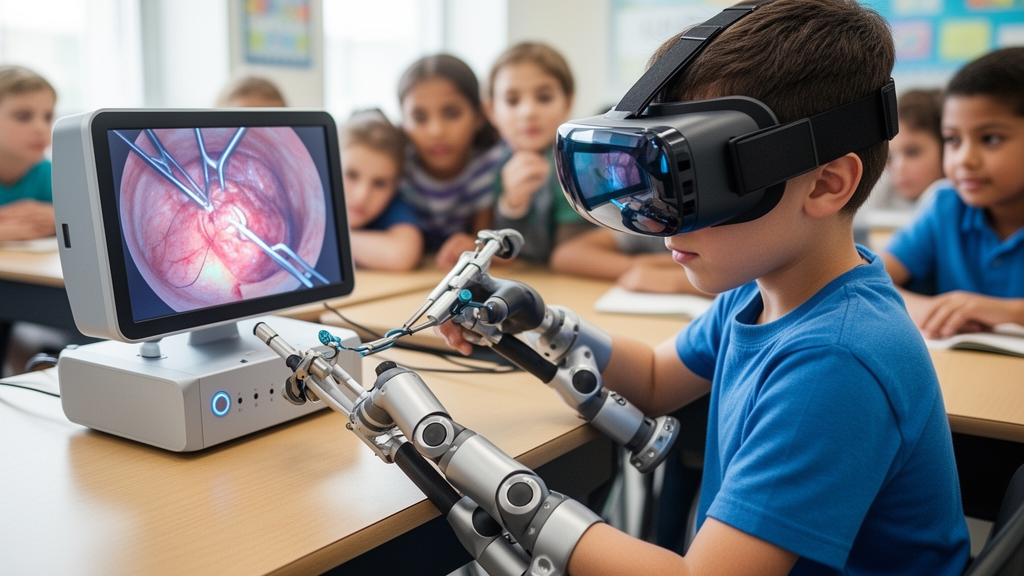
In an observational investigation evaluating pediatric motor acquisition on simulated surgical hardware, primary school children demonstrated significant age-dependent proficiency and rapid trial-by-trial learning when executing precision tasks on the Advanced Laparoscopy trainer. Researchers assessed thirty-five children between four and twelve years of age who had no previous background in robotic surgery or virtual simulation, stratifying the cohort into three developmental cohorts to observe how foundational motor coordination evolves across childhood. The participants engaged with a custom dual-handle robotic master linked to an interactive virtual reality environment designed to replicate the kinematic demands of minimally invasive procedures. Across three consecutive standardized attempts, overall performance metrics exhibited pronounced divergence across age groups, with task completion speed, instrument travel paths, and spatial precision showing systematic improvements as developmental age increased. The empirical findings reveal that even young children can successfully navigate complex bimanual surgical simulations, identifying key windows where targeted motor practice yields substantial gains in movement efficiency.
The broader initiative behind the investigation centers on the Advanced Laparoscopy project, an engineering and educational effort focused on designing modular, reusable robotic components to lower the equipment costs and environmental impacts associated with modern surgical platforms. Emphasizing sustainability and global accessibility, the development team created the system to help overcome the financial and infrastructure barriers encountered by healthcare systems in resource-limited settings. A primary pillar of this technological framework is a specialized virtual reality training module that allows individuals of varying experience levels to cultivate essential technical capabilities without compromising safety. By delivering an interactive, controlled environment for laparoscopic practice, the simulator supports educational training, early assessment of psychomotor mechanics, and advanced procedural refinement. While surgical simulation has traditionally targeted medical students and surgical residents, emerging developmental evidence indicates that interactive virtual platforms can effectively reinforce spatial perception and manual dexterity in younger groups, potentially offering insight into early technical aptitude.
Children and adults acquire manual proficiencies through fundamentally different neurodevelopmental mechanisms, making empirical evaluation essential when calibrating simulation systems for younger users. During early and middle childhood, the central nervous system undergoes intensive neural maturation and heightened neuroplasticity, establishing a critical developmental period during which repetitive motor practice can consolidate foundational neuromuscular pathways. Previous research demonstrates that while children under ten years of age frequently adapt to unfamiliar motor requirements more rapidly than mature individuals, their movements tend to exhibit lower precision due to incomplete development of refined sensorimotor feedback loops. Adult operators typically rely on mature motor control architectures that prioritize deliberate economy of motion and error prevention. Consequently, effective pediatric simulation protocols require careful calibration to align cognitive load with developmental maturity. Applying virtual simulation during this malleable developmental phase provides a safe mechanism for observing early psychomotor learning, while generating quantitative data on how technical skills emerge across distinct stages of childhood growth.
To rigorously evaluate fine motor skill progression, the research team recruited thirty-five healthy school-aged participants and grouped them into three balanced developmental tiers. The lower primary group consisted of eleven children between four and six years of age, the middle primary group included twelve children aged seven to nine years, and the upper primary group comprised twelve participants between ten and twelve years of age. All enrolled participants were completely naive to virtual reality surgical training platforms, and children presenting with prior laparoscopic exposure, robotic master experience, or motor impairments were excluded from participation to preserve baseline equivalence. The experimental protocol received formal institutional ethical approval before data collection began. By comparing these three cohorts, the investigators sought to clarify how basic motor coordination transforms across the early school years, while determining whether structured practice within an immersive simulated environment produces measurable short-term improvements in movement economy and collision avoidance across successive performance attempts.
The hardware configuration utilized in the study was the Portable Laparoscopic Robotic Master of the Advanced Laparoscopy system, a custom-engineered master controller providing fourteen total degrees of freedom. The physical console features two independent multi-joint manipulators, with each robotic handle delivering seven degrees of freedom to replicate the operational kinematics of clinical teleoperated consoles such as the da Vinci Surgical System. Mechanical inputs generated by the operator are captured through a custom-built input and output circuit board that translates the kinetic physical movements of the articulated arms into digital electrical signals. The accompanying virtual reality simulation software was developed using the Unity game engine and operated locally on a standard commercial Windows laptop. Engineered for operational flexibility, the complete portable apparatus can be mounted on standard table surfaces across adjustable heights, allowing young participants to operate the input controllers comfortably from either a seated or a standing posture.
Each testing session commenced with a standardized five-minute instructional demonstration during which participants were individually shown how to manipulate the robotic controllers and interact with the virtual environment. To maintain experimental uniformity, every child received the identical orientation before initiating the testing protocol. The experimental task required participants to manipulate virtual objects within a simulated workspace calibrated to mirror laparoscopic surgical precision through a structured bimanual marble-sorting exercise. Children were instructed to manipulate and sort green marbles using their left hand into a corresponding bowl, while sorting blue marbles into an adjacent receptacle using their right hand. Participants were required to alternate between left and right hands for each sorting cycle, ensuring strictly balanced bimanual coordination and preventing participants from adopting asymmetric compensatory strategies. The virtual configuration, including target starting points and bowl dimensions, remained identical across all trials.
Every participant completed three consecutive trials of the bimanual marble-sorting task, with standardized thirty-second rest intervals interspersed between rounds to mitigate physical fatigue while preserving cognitive engagement. Each trial reached termination when the child successfully transported all twelve target marbles—consisting of six green spheres and six blue spheres—into their respective containers, or when a maximum allowable duration of five minutes elapsed. Adopting this dual-criterion completion protocol enabled the research team to balance the objective assessment of motor proficiency against operational time limits. Performance data were collected continuously through the AdLap system master dataset, which recorded task completion time, instrument path length, unintended collisions, spatial motion volume, task accuracy based on correctly completed task elements, and manual resets representing attempts to repeat or correct individual task components.
Cross-cohort statistical comparisons using one-way analysis of variance revealed pronounced differences across the developmental tiers, demonstrating that technical proficiency scaled directly with age. Total task completion time exhibited marked divergence across cohorts: children in the lower primary group required an average of 201,147 milliseconds to complete the sorting exercise, whereas participants in the upper primary group accomplished the exercise in an average of 97,155 milliseconds, establishing a statistically significant difference with p less than 0.001. Similarly, cumulative instrument path length was significantly longer among younger participants for both the left hand (p = 0.007) and the right hand (p < 0.001), reflecting less efficient hand trajectory control compared to older peers. Spatial motion volume measurements also demonstrated significantly greater dispersion and variability in the lower primary cohort (p = 0.003 for the left manipulator and p < 0.001 for the right manipulator), indicating reduced spatial containment, while reset frequencies remained statistically comparable across all three groups (p = 0.095).
Analysis of collision metrics highlighted clear developmental divergences in fine movement control and spatial monitoring within the virtual workspace. Unintended contacts involving the simulated tools, hands, or task boundaries occurred far more frequently among younger operators than among older participants. Left-sided collisions revealed particularly sharp disparities across cohorts (p < 0.001), while right-sided collisions also demonstrated significant age-dependent differences (p = 0.014). Children in the youngest age bracket exhibited collision frequencies approximately 3.2 times greater than those documented among the older children. Because collisions directly signal degraded spatial precision and tool awareness, these elevated collision rates illustrate the challenges novice pediatric operators experience when regulating multi-axis kinetic trajectories. The researchers noted that the immediate kinematic and visual feedback provided by the virtual environment served as an indispensable guide for these younger participants, allowing them to perceive unintended contacts and gradually adjust their manual control strategies across subsequent rounds.
Longitudinal evaluation across the three consecutive attempts revealed striking differences in intra-group learning curves, with the middle and lower primary tiers demonstrating substantial trial-by-trial progress. In the middle primary cohort, significant performance improvements emerged across multiple kinematic parameters. Experimental motion volume on the left side decreased significantly between the second and third trials (p = 0.035) and between the first and third trials (p = 0.027), while right-sided motion volume exhibited parallel reductions between trials one and three (p = 0.014) and trials two and three (p = 0.016). Left-sided path length in this group declined significantly between the second and third attempts (p = 0.049), contributing to an overall 34 percent reduction in total path length and a 41 percent reduction in collision events. These rapid refinements highlight how repeated exposure within a structured simulated environment enables seven-to-nine-year-old learners to optimize physical trajectories and suppress extraneous kinetic motion.
The youngest participants in the lower primary tier also achieved notable performance gains across repeated trials, particularly in operational efficiency and motion containment. Between the initial and second attempts, children aged four to six demonstrated a statistically significant reduction in overall task completion time (p = 0.019), demonstrating rapid adaptation to the unfamiliar console controls. Left-sided experimental motion volume improved significantly between the first and second trials (p = 0.013), while right-sided motion volume exhibited significant improvements between the first and second attempts (p = 0.027) as well as across the full interval from the first to the third trial (p = 0.047). Conversely, participants in the upper primary tier demonstrated stable, high-level metrics from their baseline attempt onward, showing no statistically significant changes across subsequent trials. This stability suggests a performance ceiling effect, wherein older children quickly reached the maximal efficiency permitted by the uncomplicated marble-sorting task.
The observed disparities in developmental trajectory and learning velocity align closely with established physiological principles governing pediatric neurodevelopment and motor control. The gradual, incremental progress documented among four-to-six-year-old children corresponds with ongoing biological myelination within descending corticospinal motor tracts, where nerve signal conduction and refined bimanual coordination are still developing. In contrast, the robust, multi-metric progression exhibited by children aged seven to nine reflects a critical developmental nexus where heightened neural plasticity intersects with emerging executive functioning, cognitive maturity, and enhanced attention control. This convergence enables middle primary children to interpret kinematic error feedback rapidly and convert corrective information into optimized motor commands. For the oldest participants, the apparent ceiling effect underscores that standard introductory sorting exercises may lack sufficient cognitive and technical complexity, indicating that older cohorts require advanced simulation tasks with variable resistance, path constraints, and higher precision demands to foster ongoing skill development.
The study authors highlighted several methodological limitations that contextualize their findings and point toward necessary future research directions. Because the investigation utilized an observational framework involving a modest sample of thirty-five participants, broader generalizability across diverse pediatric populations remains to be verified through larger cohorts. Furthermore, the administration of only three consecutive trials within a single testing session limits the ability to evaluate long-term skill retention, motor memory consolidation, or multi-week learning trajectories. The experimental design also omitted an active control group performing the identical marble-sorting tasks using conventional physical box trainers, preventing direct comparative analysis of the unique educational advantages conferred by virtual reality simulation over mechanical trainers. Future studies will need to incorporate extended training intervals, longitudinal retention assessments, direct physical trainer comparisons, and progressively challenging simulated tasks to fully characterize how early virtual reality training influences subsequent surgical aptitude.
Subject of Research: Robotic surgical simulator motor skill development in primary school children
Article Title: Development of technical skills in young schoolchildren using the Advanced Laparoscopy(AdLap) trainer for robotic surgery
Article References: Greve, J. P. W., Postema, R. R., Rahimi, M., Caspers, S., Hardon, S. F., Bonjer, H. J., Schijven, M. P., & Horeman-Franse, T. (2026). Development of technical skills in young schoolchildren using the Advanced Laparoscopy(AdLap) trainer for robotic surgery. Innovative Surgical Trends, 2(1), Article 12. https://doi.org/10.1007/s44414-026-00023-5
Image Credits: AI Generated
DOI: 10.1007/s44414-026-00023-5
Keywords: Advanced Laparoscopy trainer, robotic surgery simulation, virtual reality surgical training, fine motor skill development, primary school children, bimanual coordination, instrument path length, kinematic motion analysis, collision frequency, motion volume, task completion time, neuroplasticity, myelination, executive function, pediatric motor learning, Unity game engine, minimally invasive surgery, portable robotic master
News Source: Ophelia Keating. (November 18, 2026). Young Schoolchildren Rapidly Develop Robotic Surgery Skills on Portable Virtual Reality Simulator. Scienmag.