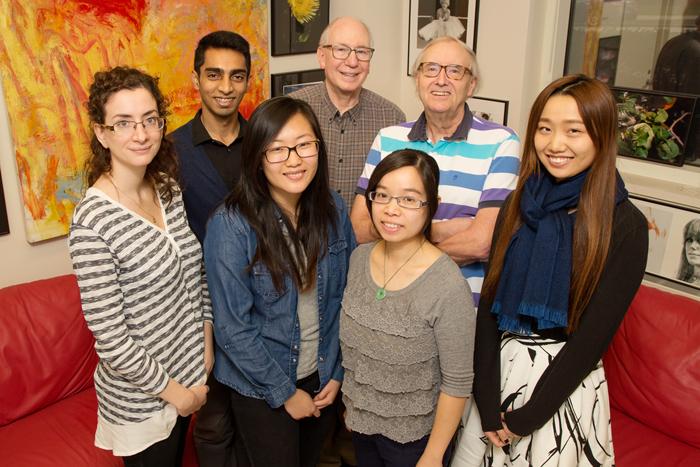
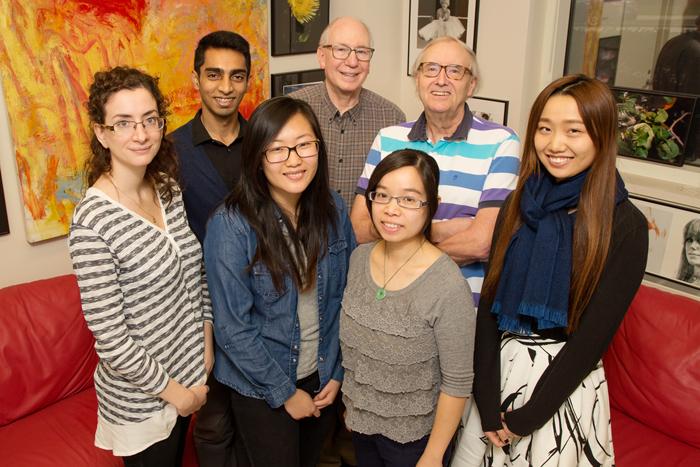
IMAGE: University of Illinois chemists found that a number of drugs approved to treat various conditions also have antibiotic properties. Pictured, from left: research scientist Lici A. Schurig-Briccio, graduate students Noman…
Credit: Photo by L. Brian Stauffer
CHAMPAIGN, Ill. — A number of drugs already approved to treat parasitic infections, cancers, infertility and other conditions also show promise as antibiotic agents against staph and tuberculosis infections, according to a new study by University of Illinois chemists and collaborators. Because these agents act against multiple targets within the bacteria, it may be harder for bacteria to develop resistance.
The new study, led by Illinois chemistry professor Eric Oldfield, was published in the Proceedings of the National Academy of Sciences.
"There is obviously a huge need for new antibiotics," said Oldfield. "We now have bacteria that are totally drug resistant. Bugs are clever: They can adapt and find ways around the things we develop to kill them. So if we attack them at multiple targets, it's harder for them to make one little change to get around it."
The researchers were interested in finding compounds that sabotage the bacteria's energy production line, shutting down cellular processes within the bacterium. These agents, called uncouplers, are already used to treat parasitic infections. Inspired by clofazimine, a leprosy drug that is now being used to treat tuberculosis, the researchers searched among drugs that are either already available or in development to find uncouplers based on their chemical structures.
"What we found is that a lot of FDA-approved molecules that are in use actually do kill bacteria and also act as uncouplers. We were kind of surprised to find that," Oldfield said. "What's even better is that some of those molecules also inhibit enzymes specific to bacteria, or disrupt the membrane or the cell wall."
Such multitarget drugs could have broader applications against an assortment of infections.
For example, one of the most promising uncouplers the study found was vacquinol, a compound being developed to treat glioblastoma, a form of brain cancer. They found that vacquinol inhibits a key enzyme involved in virulence in tuberculosis bacteria, in addition to its uncoupling properties.
The researchers then searched for other compounds with similar structures to vacquinol and found compounds that were potent antibiotics against tuberculosis and Staphylococcus aureus.
"It's a new approach to antibiotics, targeting enzymes together with bacterial energy production," Oldfield said.
Next, Oldfield hopes to develop compounds that are metabolized into uncouplers inside the bacterial cell, further reducing cross-reactivity with human cells and making it more difficult for bacteria to develop resistance. For example, certain heartburn drugs are metabolized within the cell into a compound that acts against tuberculosis.
"The whole idea is that it's possible that some of these compounds that are FDA-approved will work. You can screen a million chemicals to find a new compound but in general you have no idea about its toxicology, or you can start with something that's known," Oldfield said. "Once you start making derivatives, you'll have to prove they're safe, but there's a greater chance to get something that's safe and effective by starting with an approved drug than if you just go into the chemistry lab and screen unknown compounds."
###
The National Institutes of Health supported this work.
Editor's notes: To reach Eric Oldfield, call 217-333-3374; email [email protected]
The paper "Antiinfectives targeting enzymes and the proton motive force" is available online.