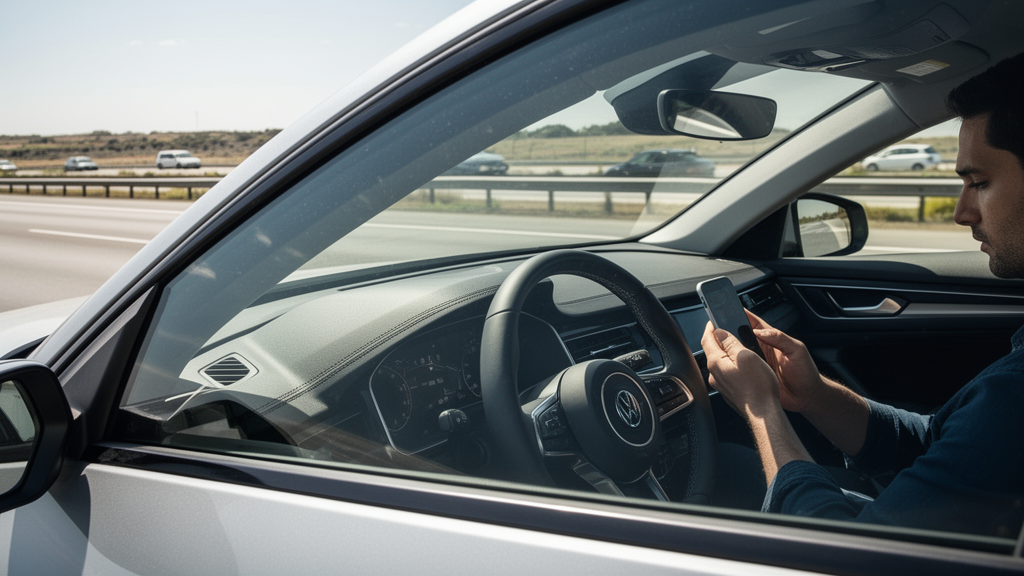
A newly developed deep learning framework identifies bad driving behaviors within surveillance video footage, overcoming persistent detection difficulties caused by heavy traffic and crowded street environments. Developed by researchers Li Gao and Lihua Han and reported in the International Journal of Computational Intelligence Systems, the computational model targets the practical traffic surveillance challenges that emerge when monitoring busy roadways where dense vehicle movement, pedestrian crowds, and diverse driver actions complicate automated safety analysis.
In contemporary traffic monitoring, accurately detecting improper or dangerous driving behavior represents a persistent technical hurdle. Complex visual scenes frequently obscure driver actions and introduce multi-target interference from nearby vehicles and passing pedestrians. These crowded conditions regularly lead to insufficient segmentation accuracy, the omission of small abnormal behaviors, and diminished recognition robustness across visual surveillance streams. To overcome these constraints, the study introduces a specialized multistage deep learning architecture designed to isolate driver actions from complex backgrounds.
To address the problem of insufficient segmentation accuracy under multi-target interference, the researchers formulated an innovative foreground segmentation strategy. The method couples a maximum-threshold processing algorithm with particle swarm optimization to evaluate surveillance video frames. By calculating the total image entropy across each image, the optimization process extracts foreground human figures while suppressing background clutter, thereby markedly improving target segmentation accuracy and providing robust anti-interference capability within highly complex traffic settings.
Detecting minor abnormal actions has historically proven difficult due to the subtle visual footprint of small-scale driving infractions. To capture these elusive features, the framework incorporates a specialized keyframe localization algorithm driven by keypoint motion velocity and keypoint acceleration. This localization mechanism extracts a discrete set of keyframe sequences containing the driver’s skeleton map and structural node sets directly from the segmented foreground imagery, enabling the system to segment the driving task with high spatial and temporal precision.
Once the keyframe sequences are established, they are processed through a spatio-temporal feature-enhanced graph convolutional network. The architecture relies on specialized graph convolutions alongside hybrid pooling processing to capture both the spatial posture and temporal transitions embedded in the driver’s skeletal movements. This structured graph analysis allows the network to extract rich spatial and temporal feature vectors representing the subtle physical dynamics of distinct driving behaviors.
At the final stage of the network, a deep embedding clustering algorithm deployed in the output layer classifies the extracted feature vectors. This clustering mechanism specifically mitigates the disruptive impact caused by the wide diversity and variability of bad driving behaviors across different drivers and driving environments. By clustering the spatio-temporal representations, the output layer accurately generates final classification results for distinct categories of bad driving behaviors captured in surveillance video images.
Rigorous test evaluations confirm that the proposed algorithm delivers superior performance across critical image processing and classification metrics. In experimental testing, pixel segmentation accuracy, inter-region contrast, and intra-region consistency all exceeded 0.92, demonstrating that the system effectively separates individual drivers from their surrounding environment. Furthermore, the overall recognition robustness of the model in complex traffic scenarios proved significantly better than the standard comparison methods evaluated in the study.
Subject of Research: Deep learning algorithm for recognizing bad driving behavior in surveillance video
Article Title: Recognition Algorithm of Bad Driving Behavior in Surveillance Video Images Based on Deep Learning
Article References: Gao, L., & Han, L. (2026). Recognition Algorithm of Bad Driving Behavior in Surveillance Video Images Based on Deep Learning. International Journal of Computational Intelligence Systems. https://doi.org/10.1007/s44196-026-01615-2
Image Credits: AI Generated
DOI: 10.1007/s44196-026-01615-2
Keywords: deep learning, bad driving behavior, surveillance video, traffic monitoring, image segmentation, particle swarm optimization, maximum-threshold processing, image entropy, keyframe localization, keypoint motion velocity, acceleration analysis, driver skeleton map, graph convolutional networks, hybrid pooling, deep embedding clustering, behavior recognition, spatio-temporal features
News Source: Blake Davidson. (November 18, 2026). Deep Learning Framework Detects Bad Driving Behavior in Surveillance Video Images. Scienmag.