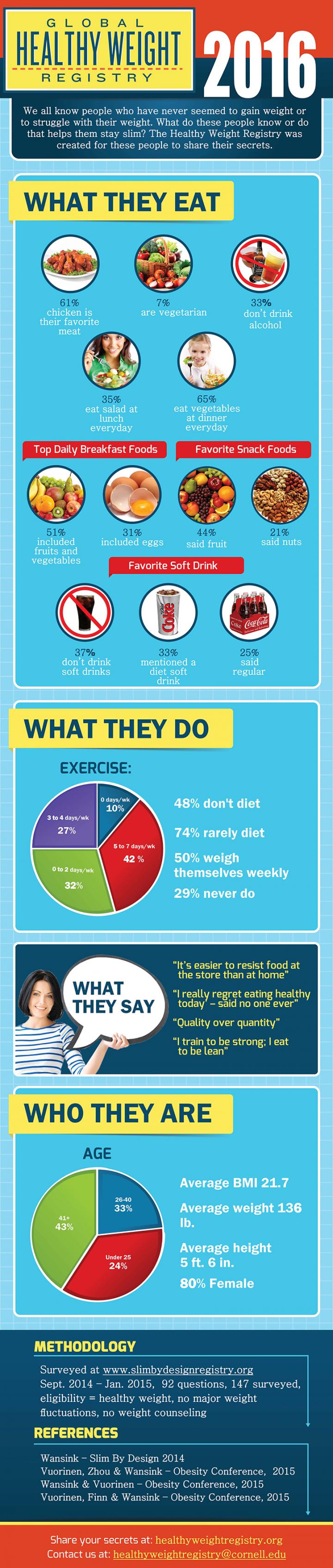
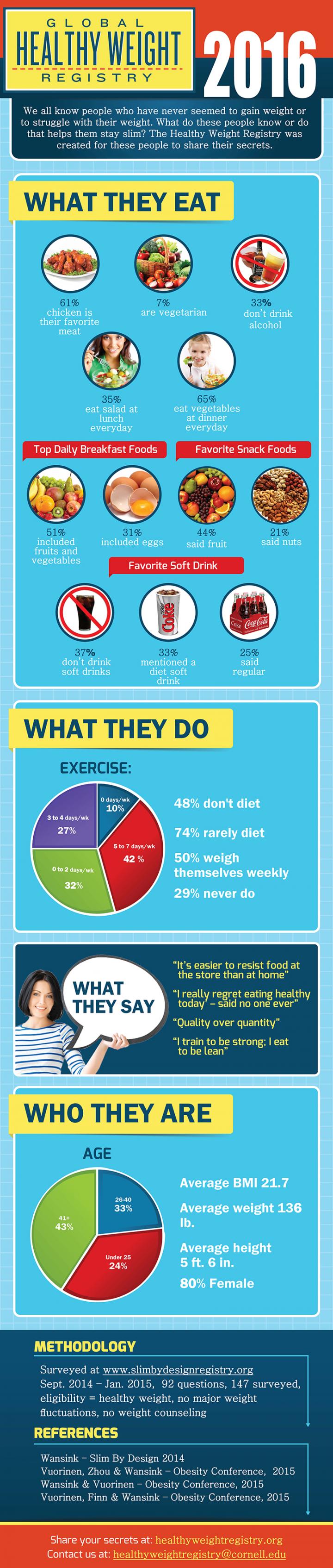
IMAGE: This infographic illustrates registry responses from 147 healthy weight adults including those who did not maintain strict diets.
Credit: Cornell Food and Brand Lab
You know that one friend that never worries about weight and seems to stay effortlessly slim? That friend, and others like them might unknowingly possess secrets to helping those who struggle with their weight.
New Cornell Food and Brand Lab research findings have helped to uncover lifestyle secrets of the "mindlessly slim." The Food and Brand Lab researchers created the Slim by Design Registry (now called the Global Healthy Weight Registry) to survey adults who have successfully maintained a healthy body weight throughout their lives. Those who voluntarily signed up for the registry answered a series of questions about diet, exercise and daily routines. The infographic included in this release illustrates initial findings from all registry respondents.
The researchers then divided the respondents into two groups. Group one, the mindlessly slim, consisted of 112 adults who reported that they didn't maintain strict diets. The other group consisted of those who dieted regularly, thought about food frequently and were highly conscious of what they ate. "We wanted to see what health behaviors differed between those struggling to lose or maintain weight and the mindlessly slim," explains Brian Wansink, PhD, co-author, director of the Cornell Food and Brand Lab and author of Slim by Design. "We wanted to find the small or simple behaviors that might have a big impact."
After comparing the responses from each group, the researchers found that mindlessly slim individuals were more likely to use strategies that differ from traditional recommendations for weight loss or maintenance. These strategies include: eating high-quality foods, cooking at home, and listening to inner cues in order to stay slim. Also they didn't indicate feeling as guilty as the other group about overeating. Furthermore, mindlessly slim people were more likely to have an enjoyment-based, internally informed approach to food and eating.
"These results are encouraging because they imply that instead of putting restrictions on one's diet and avoiding favorite foods, weight gain could be prevented early on by learning to listen to inner cues and putting emphasis on the quality instead of the quantity of food," says lead researcher Anna-Leena Vuorinen, of VTT Technical Research Centre in Finland, PhD student at the University of Tempere, and former visiting scholar at the Food and Brand Lab.
###
The findings of this study were presented at Obesity Week 2015, Los Angeles, CA on Nov. 4th, 2015 and are published in the conference proceedings on page 75. The research was conducted by Anna-Leena Vuorinen, Megan Zhou, a Cornell University alumna and Brian Wansink. The study was self-funded by the Cornell Food and Brand Lab.
Media Contact
Sandra Cuellar
[email protected]
607-254-4960
@CUFood_BrandLab
http://foodpsychology.cornell.edu/