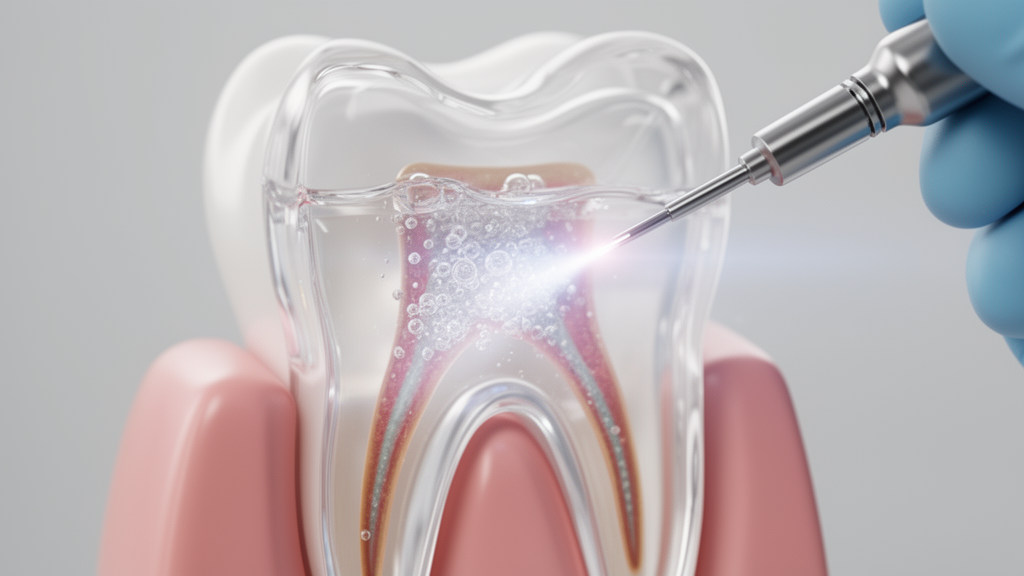
A systematic review and meta-analysis published in Frontiers in Medicine suggests that pairing conventional root canal irrigation with semiconductor laser activation can enhance bacterial clearance and reduce microbial loads within infected root canals. Conducted by researchers Xinyu Hao, Chengyu Xu, and Jin Wang from the School of Stomatology at Hubei University of Medicine and The Third People’s Hospital of Hubei Province, the review quantitatively evaluated whether adding semiconductor laser activation to standard two-point-five percent sodium hypochlorite irrigation outperforms chemical irrigation alone. Successful endodontic therapy for prevalent clinical conditions like pulpitis and apical periodontitis hinges fundamentally on the thorough eradication of persistent microorganisms from the intricate spaces of the root canal system. While sodium hypochlorite serves as the predominant chemical disinfectant in modern clinical practice due to its substantial tissue-dissolving and antimicrobial properties, traditional irrigation methods frequently struggle to sanitize complex anatomical niches such as the canal isthmus, lateral canals, and deep dentinal tubules.
Chemical irrigants like sodium hypochlorite present notable clinical tradeoffs that have encouraged the development and evaluation of adjunctive activation modalities. Although sodium hypochlorite breaks down necrotic organic tissue and disrupts microbial biofilms, it exhibits marked cytotoxicity and irritancy at elevated concentrations, carrying risks of periradicular tissue damage, dentin ultrastructural degradation, and harm to adjacent structures such as oral mucosa and permanent tooth buds in younger patients. Consequently, researchers focused on a moderate two-point-five percent sodium hypochlorite concentration while seeking physical mechanisms to intensify its cleaning efficacy without escalating toxicity. Semiconductor lasers, operating as minimally intrusive dental instruments, generate photothermal effects, cavitation, and chemical activation when applied within the root canal space. Light emitted by diode lasers can penetrate dentin up to one thousand one hundred micrometers, substantially deeper than standard chemical diffusion alone, mechanically agitating the irrigant, promoting dentin tubule remodeling, and directly damaging the structural integrity of hidden bacterial cells that survive initial chemomechanical preparation.
To rigorously evaluate the evidence behind laser activation, the investigation was formally registered in the PROSPERO International Prospective Register of Systematic Reviews under registration number CRD420261419571 and structured according to PRISMA 2020 guidelines and the PICOS framework. The review team targeted human permanent or primary teeth requiring endodontic treatment, comparing semiconductor laser-assisted two-point-five percent sodium hypochlorite irrigation directly against two-point-five percent sodium hypochlorite irrigation without laser activation. In January 2026, researchers searched seven major international and regional biomedical databases, including PubMed, Web of Science, Embase, The Cochrane Library, CNKI, Wanfang Data, and VIP, alongside manual screening of bibliographies. Eligible designs comprised randomized controlled trials and controlled laboratory studies using extracted human teeth that measured intracanal bacterial count reduction or bacterial clearance rate. Studies involving immature apices, vertical root fractures, root resorption, alternative irrigation activation technologies, surgical approaches, animal models, or varying irrigant concentrations were systematically excluded to maintain methodological consistency across the analyzed literature.
The extensive multi-database literature search initially retrieved nine hundred fifty-one articles, from which two hundred sixty-one duplicate records were removed. Two reviewers independently evaluated the remaining six hundred ninety titles and abstracts, excluding five hundred forty-nine irrelevant papers, animal experiments, and case reports. Detailed full-text assessment of one hundred forty-one remaining publications led to the exclusion of one hundred thirty-seven studies due to unsuitable subjects, varying irrigant concentrations, unobtained full texts, or insufficient outcome data. Ultimately, four published articles spanning five discrete datasets met all inclusion requirements for quantitative synthesis, encompassing a total sample size of one hundred forty-four teeth. These investigations, published between 2021 and 2025, consisted of two in vivo randomized controlled trials conducted by Ahmed in 2022 and Nikhil in 2021, and two in vitro controlled laboratory studies conducted by Ivan in 2025 and Yavagal in 2023, with Ivan’s trial contributing two distinct experimental datasets based on laser wavelengths.
Methodological quality across the included investigations revealed notable variability and common procedural limitations that warrant careful interpretation of the findings. The two clinical randomized controlled trials, encompassing sixty patients, were evaluated using the Cochrane Risk of Bias 2.0 tool across seven primary domains. Both clinical trials were judged to have an overall high risk of bias, primarily stemming from performance bias due to the lack of blinding among clinical operators and participants, accompanied by unclear allocation concealment and random sequence generation procedures. Methodological quality for the two laboratory studies was appraised using the twelve-item QUIN checklist, where Yavagal’s 2023 investigation demonstrated low risk of bias with a score of twenty-three out of twenty-four points, having reported sample size calculations, randomization, and assessor blinding. In contrast, Ivan’s 2025 study scored fifteen out of twenty-four points, falling into moderate risk due to omitted reporting regarding operator identity, outcome assessor details, and procedural blinding.
Pooled meta-analyses utilizing random-effects models in RevMan software revealed consistent improvements in microbiological eradication when semiconductor lasers were utilized. Given inherent differences between biological environments and laboratory conditions, the authors stratified primary outcomes by study design. For bacterial reduction, quantified as logarithmic colony-forming unit reduction using standardized mean differences, laser-assisted irrigation achieved statistically significant advantages in both clinical and laboratory settings. The two in vivo randomized trials demonstrated a pooled standardized mean difference of zero-point-seventy-two with a ninety-five percent confidence interval from zero-point-nineteen to one-point-twenty-four, accompanied by zero percent heterogeneity. The three in vitro datasets showed a pooled standardized mean difference of one-point-thirty-two with a ninety-five percent confidence interval from zero-point-forty to two-point-twenty-four and moderate heterogeneity of sixty-nine percent. A test for subgroup differences between clinical and laboratory designs was not statistically significant, confirming that both experimental formats observed comparable enhancements in log bacterial reduction.
In contrast, the secondary primary metric of bacterial clearance rate yielded divergent results across the stratified study categories. Among the in vivo clinical trials, laser-assisted sodium hypochlorite irrigation achieved a statistically significant improvement in bacterial clearance rate over conventional irrigation alone, producing a pooled standardized mean difference of two-point-ninety-seven with a ninety-five percent confidence interval of zero-point-twenty-nine to five-point-sixty-six. However, this clinical estimate exhibited high heterogeneity of eighty-seven percent, and the ninety-five percent prediction interval spanned widely from negative three-point-twenty-eight to nine-point-twenty-two. Conversely, in the three in vitro datasets, the bacterial clearance rate did not reach statistical significance, yielding a pooled standardized mean difference of zero-point-thirty-two with a confidence interval ranging from negative zero-point-eleven to zero-point-seventy-five. The researchers explained that laboratory control groups often reached near one-hundred percent bacterial clearance, compressing numerical variance on percentage scales, whereas logarithmic reductions more sensitively reflected persistent bacterial load differences.
The meta-analysis examined potential sources of heterogeneity through predefined subgroup analyses focusing on laser wavelength and operational power settings. Subgroup evaluations across three laser wavelength categories—four hundred forty-five nanometers, eight hundred ten nanometers, and nine hundred sixty plus-or-minus twenty nanometers—showed no statistically significant differences in bacterial reduction or bacterial clearance rate, suggesting that wavelength variations did not drive the observed inconsistencies. However, laser power output demonstrated a marked effect on bacterial reduction outcomes. Comparing low-power settings between zero-point-eight and one watt against a higher power setting of one-point-five watts revealed a statistically significant subgroup difference. The low-power group showed a pooled standardized mean difference of zero-point-sixty-two, whereas the one-point-five watt group yielded a standardized mean difference of one-point-seventy-seven. While indicating that higher power may amplify photothermal and cavitation activity, this elevated power finding relied solely on two in vitro datasets from a single study and remains exploratory.
Clinical outcomes beyond microbiological metrics were scarcely represented in the available literature, highlighting an important limitation in contemporary endodontic research. Only the randomized controlled trial by Ahmed in 2022 documented patient-reported postoperative discomfort using visual analog scale scores at six hours post-treatment. Patients in the laser-assisted irrigation group reported a mean pain score of fifty-eight-point-nine compared to seventy-four-point-five in the conventional sodium hypochlorite group, representing a statistically significant pain reduction. While this single trial suggests a potential benefit for early postoperative comfort, the authors emphasized that one small cohort cannot establish generalizable clinical efficacy. Sensitivity analyses utilizing a leave-one-out methodology confirmed that overall conclusions for logarithmic bacterial reduction remained robust across individual study exclusions, while pooled bacterial clearance rates lost significance whenever either clinical trial was removed. Furthermore, formal publication bias assessments could not be reliably performed because the total study count was below the standard threshold of ten.
Evaluating the body of evidence through the GRADE framework resulted in a low certainty rating for bacterial clearance rate, downgraded due to substantial inconsistency, high heterogeneity, and sample imprecision. The authors cautioned that while semiconductor laser-assisted irrigation serves as a promising adjunctive measure during endodontic treatment, it should not currently be regarded as an established standard protocol. Laboratory models cannot fully simulate the intricate anatomical variations, polymicrobial biofilms, and host immune defenses present in living patients, and microbiological clearance serves as a surrogate marker rather than a definitive predictor of tooth survival or periapical healing. Significant clinical barriers, including specialized equipment costs, operator training requirements, and safety risks concerning thermal injury to the periodontal ligament and apical tissues, continue to influence practical adoption. The authors concluded that well-designed, large-scale randomized controlled trials with blinded protocols and long-term evaluations of periapical repair are essential before standardized clinical guidelines can be established.
Subject of Research: Efficacy of semiconductor laser-activated sodium hypochlorite irrigation in root canal disinfection
Article Title: Antibacterial efficacy of semiconductor laser-activated 2.5% sodium hypochlorite compared with conventional sodium hypochlorite irrigation in root canal disinfection: a systematic review and meta-analysis
Article References: Hao, X., Wang, J., & Xu, C. (2026). Antibacterial efficacy of semiconductor laser-activated 2.5% sodium hypochlorite compared with conventional sodium hypochlorite irrigation in root canal disinfection: a systematic review and meta-analysis. Frontiers in Medicine, 13, Article 1935002. https://doi.org/10.3389/fmed.2026.1935002
Image Credits: AI Generated
DOI: 10.3389/fmed.2026.1935002
Keywords: semiconductor lasers, diode laser, root canal disinfection, sodium hypochlorite, endodontics, bacterial clearance rate, bacterial reduction, Enterococcus faecalis, laser-activated irrigation, in vivo randomized controlled trials, in vitro dental models, visual analog scale, postoperative pain, laser power settings, Cochrane RoB 2, QUIN checklist, photothermal effect, dentinal tubules
News Source: Ophelia Keating. (November 17, 2026). Semiconductor Laser Activation May Boost Sodium Hypochlorite Root Canal Disinfection. Scienmag.