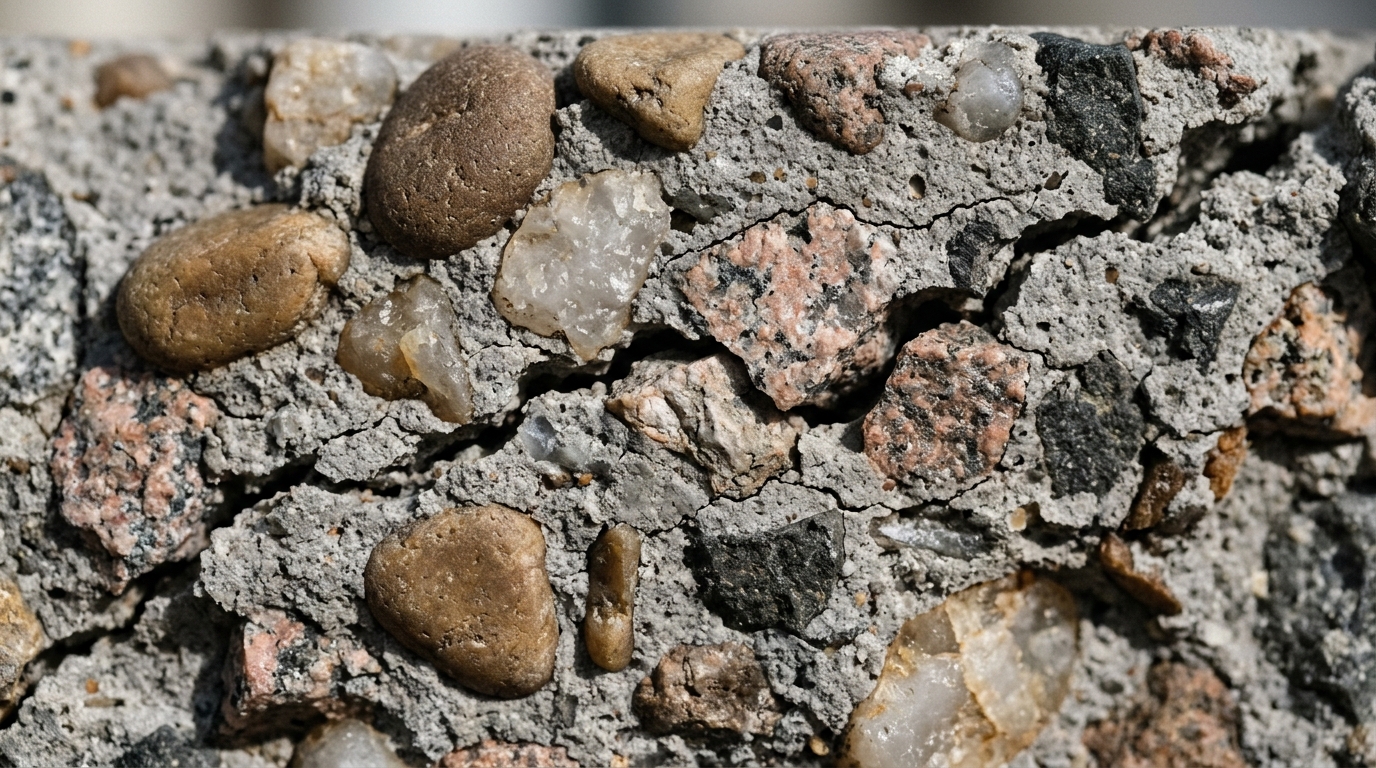
Shear failure in structural concrete remains a complex challenge, often leading to sudden and catastrophic failure in reinforced members. A recent experimental study has shed new light on the governing mesoscale mechanisms by utilizing modeled natural aggregate concrete (MNAC) to isolate the role of aggregate interlock in shear resistance. Researchers systematically evaluated the impact of aggregate particle size—specifically 17, 23, and 30 mm—and the number of aggregates, ranging from one to three, within test specimens. By controlling these variables, the investigation clarifies how meso-structural features directly influence macroscopic shear behavior and failure modes, providing a fundamental basis for refining existing, often semi-empirical, shear-design theories for concrete structures.
The study employed direct shear tests on 24 specimens, each carefully fabricated to ensure consistent material properties across all testing series. The research team utilized a customized loading jig that facilitated lateral confinement, enabling the observation of shear-transfer mechanisms under controlled conditions. By employing digital image correlation (DIC), the researchers were able to track surface speckle displacements with high precision, mapping strain evolution and crack propagation throughout the entire loading process. This experimental setup allowed for the precise quantification of both pre-cracking peak load (P1) and post-cracking secondary peak strength (P2), mapping these values against varying aggregate configurations.
A primary finding of the research is that both particle size and aggregate quantity exert a positive influence on shear capacity. Data indicated that increasing the particle size from 17 to 30 mm resulted in substantial gains in peak load values; for single-aggregate specimens, this size increase raised P1 by 42.3% and P2 by 43.2%. Similarly, increasing the number of aggregates from one to three within the 17 mm series produced a 35.9% increase in P1 and a 93.2% increase in P2. These results confirm that larger aggregate surface areas and higher aggregate quantities enhance the effective contact area and roughness along the potential shear plane, directly reinforcing the shear-transfer capacity of the matrix.
The researchers identified three distinct failure modes in the MNAC specimens, categorized by the interaction between the mortar and aggregates. Type I failure, characterized by aggregate fracture, occurred predominantly in specimens with smaller particle sizes and aggregate counts. Type II failure involved crack propagation along the external envelope of the aggregates, where the cracks developed through the interfacial transition zones (ITZ) and surrounding mortar. Type III failure, which was observed less frequently, occurred when cracks were confined entirely to the ITZs. The study found that Type II was the most common failure mode, particularly in multi-aggregate specimens, where crack coalescence through the mortar became the most energetically favorable path for fracture.
Strain field analysis provided further insights into the progressive nature of the failure. Early in the loading phase, approximately at 60% of P1, strain concentrations were localized at the interfaces between the mortar and aggregates. As the load approached P1, these localized strain zones reached critical levels—approximately 0.030 for shear strain and 0.080 for normal strain—triggering diagonal crack propagation. In specimens with larger aggregates, the strain redistribution was more distributed, leading to a shift from matrix-dominated behavior to a stable interlocking-controlled mechanism. The study observed that as the loading passed P1, the aggregate interlock became the dominant mechanism sustaining the post-cracking resistance.
To objectively quantify the localization, the team calculated the width of the localized zone, Wc, by fitting strain distribution profiles to a Gaussian distribution. The results demonstrated that Wc values ranged from 4.39 mm to 4.99 mm for specimens with 17 mm and 23 mm aggregates, while the 30 mm aggregate specimens exhibited slightly broader localized zones between 6.17 mm and 6.29 mm. This relationship suggests that increasing particle size contributes to a wider zone of strain localization, reflecting the change in mechanical behavior as the aggregate characteristics are modified within the concrete matrix.
The researchers validated their experimental findings using a mathematical framework based on Walraven’s aggregate interlock model. Despite the model’s idealized assumptions, such as the representation of cracks as planar surfaces crossing spherical inclusions, it provided a reasonable prediction of the shear load observed in the MNAC specimens. The analysis confirmed that specimens exhibiting Type III or a combination of Types II and III failure modes consistently achieved higher P2 values due to the larger effective interlocking area compared to specimens failing strictly via the Type II mode.
A comparative analysis with previous research using square-shaped aggregates highlighted the influence of aggregate geometry on crack patterns. While square-aggregate specimens often exhibit straight cracks aligned with the primary load transmission path, the circular aggregates used in this study produced more branched and tortuous fracture patterns. Furthermore, circular aggregates appear to rely more on frictional contact along curved interfaces, promoting a more gradual load decay compared to the brittle post-peak response observed in square-aggregate systems. These differences emphasize that aggregate shape is a critical factor influencing both the mechanical efficiency of interlock and the overall ductility of the shear failure.
The investigation acknowledges specific limitations inherent in the study of modeled concrete. While the controlled fabrication of MNAC specimens is highly effective for isolating mesoscale mechanisms, the specimens do not fully represent the complexity of ordinary concrete, which contains a wider distribution of aggregate sizes and varying porosities. Additionally, the size effect observed in small-scale laboratory tests requires cautious interpretation when extrapolating findings to full-scale structural members. Nonetheless, the comparative trends derived from the identical testing environment confirm that mesoscale aggregate interlock remains a foundational component of shear resistance in both plain and reinforced concrete structures.
Ultimately, this research clarifies the relationship between aggregate characteristics and the resultant shear capacity of concrete. By isolating the mesoscale parameters that govern aggregate interlock, the study offers a systematic approach to understanding the complex transition from interfacial cracking to stable shear transfer. These insights provide a necessary step toward the future refinement of shear-design standards, supporting the development of more accurate, physics-based predictive models that account for the structural impact of mesoscale constituents in emerging and traditional concrete composites.
Detailed specimen fabrication and mechanical testing procedures provided a tightly controlled experimental baseline. Each modeled natural aggregate concrete specimen measured 100 mm by 100 mm by 30 mm, with cylindrical marble aggregates positioned along the central loading axis. To ensure consistent crack propagation along the shearing path, the team precut rectangular guide notches measuring 2 mm in width and 5 mm in depth at both the top and bottom faces. Mortar casting occurred in two successive stages using P·II 52.5 Portland cement with a standardized cube compressive strength of 48.18 MPa. Aggregates were initially fixed in acrylic molds before pouring and compacting the first mortar half, which underwent seven days of standard curing before the remaining half was cast and cured for an additional 28 days. Testing was conducted under displacement control at a steady rate of 0.1 mm/min up to a final displacement of 5 mm. An optical acquisition setup featuring industrial cameras recorded the surface speckle patterns at 6 Hz with a spatial length resolution of 20,000 pixels per meter.
Stepwise comparisons across the test series exposed marked differences in how size and quantity govern capacity gains. In single-aggregate specimens, expanding the diameter from 17 to 23 mm increased P1 by 11.0% and P2 by 17.8%, while enlarging it from 23 to 30 mm produced further increases of 28.1% and 21.5%. Varying the aggregate quantity revealed clear diminishing returns. Within the 17 mm series, adding a second aggregate raised P1 by 27.0% and P2 by 71.0%, whereas adding a third aggregate yielded more modest improvements of 7.0% for P1 and 12.9% for P2. In the 23 mm series, specimens with two and three aggregates recorded virtually identical P1 values. Across all groupings, the most significant initial load jump occurred between single- and two-aggregate configurations, with MNA23-2 achieving a 62.88% higher P1 than MNA23-1, and MNA30-2 delivering an 80.64% higher P2 than MNA30-1. The researchers attributed these diminishing returns to aggregate crowding, where excessively dense particle spacing reduces the volume of intervening mortar available to transfer shear stresses.
Analysis of crack opening dynamics and structural load paths further elucidated the mechanical progression. Single-aggregate specimens relied on an isolated shear pathway traversing the particle; once fractured, this load conduit was severed, triggering an immediate loss of interlock. In contrast, multi-aggregate configurations provided redundant shear trajectories that maintained load transfer even when localized cracking appeared. Measured crack width evolution followed three distinct phases. Initially, crack width remained zero during elastic loading prior to through-cracking. Once macrocracks formed, crack widths expanded rapidly at a rate exceeding the applied shear displacement as interlock intensified. In the final stage, crack expansion slowed into a gentle linear ascent, as external lateral confinement from the shear jig constrained transverse dilation while shear displacement continued. Furthermore, analytical calculations based on Walraven’s formulations revealed that projected contact areas depend directly on whether relative shear displacement exceeds a geometry-dependent threshold displacement, providing a mathematical rationale for the superior post-cracking resistance observed in specimens displaying broad interfacial engagement.
Subject of Research: Shear transfer performance in modeled natural aggregate concrete.
Article Title: Study on shear transfer performance of modeled natural aggregate concrete
Article References: Sun, C., Guan, Z., Wang, Z., Liu, Q., & Singh, A. (2026). Study on shear transfer performance of modeled natural aggregate concrete. Low-carbon Materials and Green Construction, 4(1), Article 21. https://doi.org/10.1007/s44242-026-00118-9
Image Credits: AI Generated
DOI: 10.1007/s44242-026-00118-9
Keywords: concrete mechanics, shear failure, aggregate interlock, modeled natural aggregate concrete, mesoscale analysis, interfacial transition zone, structural engineering, digital image correlation, fracture mechanics, particle size effect, crack propagation, material testing, Walraven model, strain localization, load-bearing capacity, cementitious composites, shear resistance
News Source: Denise Maddox. (November 17, 2026). Mesoscale Aggregate Dynamics Govern Shear Transfer in Modeled Natural Aggregate Concrete. Scienmag.