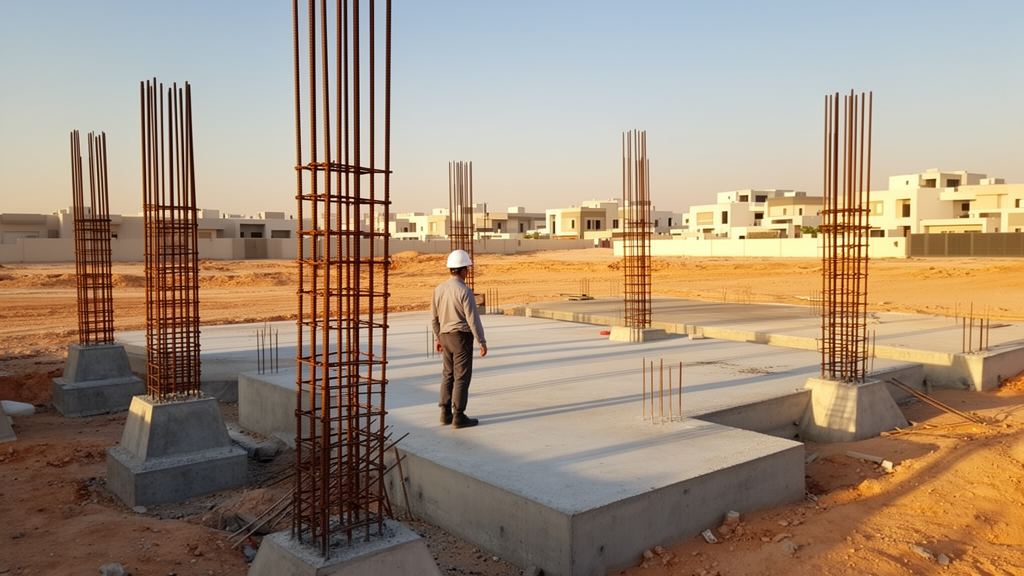
Designing low-rise residential structures using Saudi Arabia’s simplified residential building code produces significantly higher lateral forces and base shear compared to general structural load standards, according to a comparative structural analysis by Ahmed Ahmed Abdou Elabbasy and Ali Hassaballa published in the Journal of Umm Al-Qura University for Engineering and Architecture. The researchers evaluated the seismic design outcomes for a regular three-story reinforced-concrete moment-frame building situated in Jeddah on Site Class C, comparing the provisions of the Saudi Building Code SBC 301-24 against the Saudi Residential Building Code SBC 1101-24.
To evaluate how the two regulatory standards differ in practice, the authors applied distinct analytical approaches defined within the codes. For the general structural provisions of SBC 301-24, the team executed both dynamic and static procedures, specifically implementing modal response spectrum analysis using square root of sum of squares and complete quadratic combination methods, alongside the equivalent lateral force static procedure. For SBC 1101-24, the investigation implemented the simplified residential procedure, adhering strictly to the code’s explicit applicability limits.
The side-by-side evaluation revealed that the simplified procedure in SBC 1101-24 consistently produced higher lateral story forces, total base shear, and overturning moments than the dynamic and static methods of SBC 301-24. Specifically, the base shear calculated under SBC 1101-24 exhibited average increases ranging between 30 percent and 45 percent relative to modal response spectrum analysis. Furthermore, when compared directly to the equivalent lateral force method under Seismic Design Category A, the base shear demands from SBC 1101-24 were elevated by up to approximately 87 percent.
Despite the substantial differences in lateral force demands, structural performance checks indicated that the modeled reinforced-concrete frame possessed significant deformation reserves. The calculated interstory drifts for the three-story structure remained far below the allowable limits established by ASCE 7-22 standards. In addition, second-order P-delta stability coefficients stayed well below the critical threshold across the evaluations, confirming that the regular structural system retains ample drift capacity under the examined ground motion criteria.
The authors examined the underlying regulatory mechanisms responsible for the observed divergences in design forces between the two frameworks. Key contributing factors identified in the code-level analysis include differences in response modification factors, distinct rules governing vertical force distributions across building stories, and specific spectral acceleration scaling rules based on design parameters such as SDS.
In addition to providing practical guidance for the seismic engineering of low-rise residential buildings throughout the Kingdom of Saudi Arabia, the investigation is situated within broader regional seismic assessments. The findings are contextualized with recent probabilistic seismic hazard assessments conducted for the southwestern region of the country, encompassing areas such as Jazan and the Red Sea Rift, as well as related comparative code evaluations examining regional structural performance.
Subject of Research: Comparative seismic design of residential concrete buildings under Saudi building codes
Article Title: Seismic design of residential buildings in Saudi Arabia using SBC301-24 and SBC1101-24: a comparative study with dynamic analysis
Article References: Elabbasy, A. A. A., & Hassaballa, A. (2026). Seismic design of residential buildings in Saudi Arabia using SBC301-24 and SBC1101-24: a comparative study with dynamic analysis. Journal of Umm Al-Qura University for Engineering and Architecture. https://doi.org/10.1007/s43995-026-00304-7
Image Credits: AI Generated
DOI: 10.1007/s43995-026-00304-7
Keywords: SBC 301-24, SBC 1101-24, Saudi Building Code, seismic design, base shear, modal response spectrum analysis, equivalent lateral force, interstory drift, P-delta stability, reinforced-concrete frames, residential buildings, Jeddah, Site Class C, Seismic Design Category A, Red Sea Rift, Jazan
News Source: Denise Maddox. (November 17, 2026). Saudi Residential Code Yields Higher Seismic Design Forces Than General Standard. Scienmag.