• HOME
  • NEWS
  • EXPLORE
    • CAREER
      • Companies
      • Jobs
    • EVENTS
    • iGEM
      • News
      • Team
    • PHOTOS
    • VIDEO
    • WIKI
  • BLOG
  • COMMUNITY
    • FACEBOOK
    • INSTAGRAM
    • TWITTER
Saturday, July 4, 2026
BIOENGINEER.ORG
No Result
View All Result
  • Login
  • HOME
  • NEWS
  • EXPLORE
    • CAREER
      • Companies
      • Jobs
        • Lecturer
        • PhD Studentship
        • Postdoc
        • Research Assistant
    • EVENTS
    • iGEM
      • News
      • Team
    • PHOTOS
    • VIDEO
    • WIKI
  • BLOG
  • COMMUNITY
    • FACEBOOK
    • INSTAGRAM
    • TWITTER
  • HOME
  • NEWS
  • EXPLORE
    • CAREER
      • Companies
      • Jobs
        • Lecturer
        • PhD Studentship
        • Postdoc
        • Research Assistant
    • EVENTS
    • iGEM
      • News
      • Team
    • PHOTOS
    • VIDEO
    • WIKI
  • BLOG
  • COMMUNITY
    • FACEBOOK
    • INSTAGRAM
    • TWITTER
No Result
View All Result
Bioengineer.org
No Result
View All Result
Home Headlines

Cancer breakthrough miniature device shows which drugs perform best…

Bioengineer.org by Bioengineer.org
January 25, 2018
in Headlines, Health, Science News
Reading Time: 2 mins read
0
Share on FacebookShare on TwitterShare on LinkedinShare on RedditShare on Telegram
IMAGE

Credit: University of Huddersfield

"…the device allows early assessment of the effects of drugs, speeding up the adoption of those that are shown to be therapeutically effective…"

"…while there have been major improvements in knowledge of cancer cell biology, clinical approval of new drugs has not kept pace until now…"

RESEARCHERS at the University of Huddersfield have helped develop a lab device that could speed up the adoption of new anti-cancer treatments.

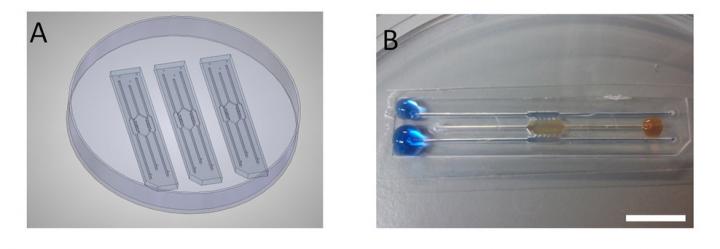
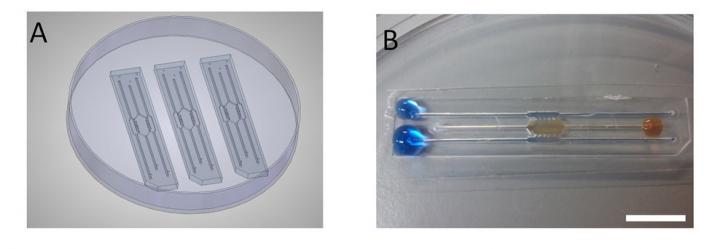
It is a small, versatile and simple-to-use microfluidic system that consists of a series of chambers, enabling scientists to monitor the response of hypoxic cells – deficient in oxygen and therefore resistant to therapy – when drugs are introduced.

Professor Roger Phillips and Dr Simon Allison at the University of Huddersfield formed a collaboration with researchers in Spain – based at institutions that include the Aragon Institute of Biomedical Research – after meeting them during a project that involved a UK scientific instrument-making company.

This led to research and development of the new microfluidic device, now described in an article, with Professor Phillips and Dr Allison among the co-authors. Titled Development and characterisation of a microfluidic model of the tumour microenvironment, it appears in Scientific Reports, from the publishers of leading journal Nature.

Professor Phillips is a specialist in the evaluation of new anti-cancer drugs, with a specific interest in the micro environments surrounding tumours as a target for drug development. He explained that the advantage of the new device – made of glass or plastic – is that it enables researchers to visualise the micro environment and monitor how cells respond in real time to the drug being tested.

Also, the test cells – after being grown in the lab – can be spheroid, as opposed to the flat "2D" cells normally relied on by researchers. The "3D" nature of cells inside the microfluidic device means that it is possible to visualise what is happening to them internally.

"We can see the drugs moving in, and see hypoxia developing in the centre," said Professor Phillips, who added that the new system could also be used for a wide range of other applications.

One of the conclusions of the article in Scientific Reports is that while there have been major improvements in knowledge of cancer cell biology, clinical approval of new drugs has not kept pace. One strategy in response is to "develop new in vitro preclinical models that are better predictors of success in advanced preclinical and clinical testing".

Now the microfluidic device will help address the urgent need for a new in vitro model able to mimic key aspects of the tumour microenvironment and therefore allow early assessment of the effects of drugs, speeding up the adoption of those that are shown to be therapeutically effective.

###

Media Contact

Nicola Werritt
[email protected]
01-484-473-315
@HudUniPR

http://www.hud.ac.uk/

Share12Tweet7Share2ShareShareShare1

Related Posts

Quasi-Bound States Boost Quantum Well Photoresponse — Technology and Engineering

Quasi-Bound States Boost Quantum Well Photoresponse

July 4, 2026

Lysine Pyruvylation Links Glycolysis to Epigenetics

July 4, 2026

Multiphysics Coupling: Single vs. Multiple DeepONet Branches

July 4, 2026

Personalized Neoantigen Dendritic Cell Vaccine in Glioblastoma

July 4, 2026
Please login to join discussion

POPULAR NEWS

  • Detection of EDCs in Breast Milk and Infant Urine Up to Six Months Highlights Early Exposure Risks

    77 shares
    Share 31 Tweet 19
  • Saying Goodbye to PGY-6: Pediatric Fellowship Realities

    103 shares
    Share 41 Tweet 26
  • New Drug Candidate Developed at McMaster Shows Potential for Treating Brain Cancer

    58 shares
    Share 23 Tweet 15
  • KTU Researchers Explore Ultrasound’s Role in Enhancing Blood Flow Beyond Diagnostics

    53 shares
    Share 21 Tweet 13

About

We bring you the latest biotechnology news from best research centers and universities around the world. Check our website.

Follow us

Recent News

Quasi-Bound States Boost Quantum Well Photoresponse

Lysine Pyruvylation Links Glycolysis to Epigenetics

Multiphysics Coupling: Single vs. Multiple DeepONet Branches

Subscribe to Blog via Email

Success! An email was just sent to confirm your subscription. Please find the email now and click 'Confirm' to start subscribing.

Join 83 other subscribers
  • Contact Us

Bioengineer.org © Copyright 2023 All Rights Reserved.

Welcome Back!

Login to your account below

Forgotten Password?

Retrieve your password

Please enter your username or email address to reset your password.

Log In
No Result
View All Result
  • Homepages
    • Home Page 1
    • Home Page 2
  • News
  • National
  • Business
  • Health
  • Lifestyle
  • Science

Bioengineer.org © Copyright 2023 All Rights Reserved.