Concrete production is a cornerstone of modern infrastructure, with its reliance so significant that it is considered a potential marker for the Anthropocene epoch. However, this ubiquity comes at a high environmental cost, including extensive natural resource use, high carbon emissions from Ordinary Portland Cement (OPC) manufacturing, intensive water consumption, and challenges in end-of-life waste management. Significant research effort has therefore shifted toward developing more sustainable concrete, utilizing supplementary cementitious materials (SCMs), recycled aggregates, or non-potable water. While traditional concrete mix design relies on empirical approaches based on target strength and workability, the complexity introduced by these alternative materials has prompted a recent trend toward machine learning (ML) to predict optimal mix designs. Despite the proliferation of ML-based predictive models, independent experimental validation of their results has remained surprisingly sparse, prompting a new study to put these computational designs to the test.
In a recent experimental study published in Case Studies in Construction Materials, researchers evaluated 21 distinct concrete mix designs proposed by 11 different ML models, alongside three control mixes derived using the traditional ACI Committee 211 codification approach. The study focused on validating these mixes by measuring slump—a standard indicator of workability—and the 28-day cylinder compressive strength. To ensure a standardized testing environment, all mixes were prepared using identical raw materials, including general-purpose cement, fly ash, ground granulated blast-furnace slag (GGBFS), and silica fume. The chemical compositions and specific gravities of these binders were meticulously quantified, and all mixes were adjusted for aggregate moisture content and absorption to ensure the accuracy of the water-to-binder ratios.
The results of the experimental campaign revealed significant discrepancies between the ML-predicted performance and the actual physical behavior of the batched concrete. Of the 21 ML-derived mixes tested, 11 exhibited zero slump, meaning they were either extremely stiff or on the verge of failing to form a cohesive concrete mixture. Among the remaining mixes that did exhibit measurable workability, several were found to be segregated, rendering them unsuitable for practical structural applications. Only two of the 21 ML-designed mixes performed acceptably in terms of workability, with one being described as very sticky due to an over-reliance on superplasticizers. In contrast, the three control mixes designed using the traditional ACI methodology produced workable concretes that performed as expected within their design parameters.
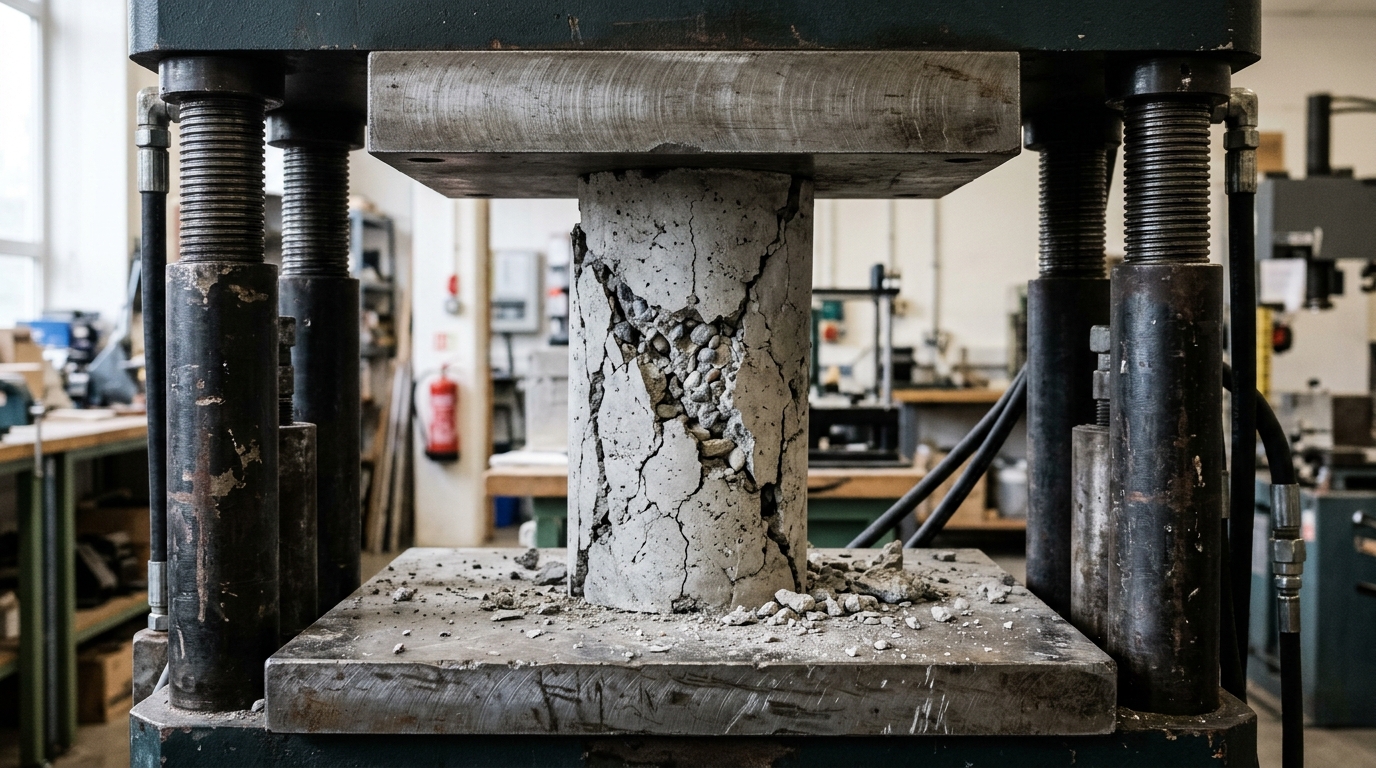
The predictive performance regarding compressive strength was similarly disappointing. The study found that ML-derived designs often dramatically overpredicted the actual 28-day compressive strength, with average prediction errors reaching approximately 20 MPa. Statistical analysis indicated that these errors were particularly prevalent at higher strength ranges. This poor correlation can be attributed to the fundamental nature of concrete behavior; because many of the ML designs were either too dry or suffered from segregation, they failed to achieve the necessary compaction required for structural integrity. The ACI-derived control mixes, by comparison, demonstrated significantly smaller predictive errors, highlighting the robustness of traditional empirical methods in current practice.
The study suggests that the failure of these ML models is not an inherent shortcoming of machine learning as a methodology, but rather a reflection of the overly simplistic frameworks currently in use. Most existing models are not physics-informed; they rely on narrow, data-driven regressions that often exclude critical real-world factors. Specifically, the researchers noted that training datasets frequently fail to capture the nuances of aggregate particle size distribution, the specific chemical properties of different superplasticizers, or the variations in binder chemical composition. Consequently, the models are often unable to extrapolate effectively to the complex range of material properties required for reliable structural design.
Furthermore, the reliance on reported successes in literature creates a reporting bias in training data. Studies almost exclusively report successful mix designs, omitting those that segregated or failed during batching. This creates a blind spot in the training data, as models cannot learn the essential boundaries between feasible and infeasible concrete mixes. When models are trained on incomplete data without considering physical constraints or the full characterization of source materials, their predictions inevitably diverge from empirical reality. This gap is particularly wide when models attempt to optimize for low global warming potential by minimizing cement content and maximizing SCM use, as these regions of the design space are often poorly represented in historical experimental test data.
To move forward, the research team emphasizes that future efforts must prioritize more rigorous data collection and integration. This includes the comprehensive reporting of all material properties, including chemical composition and particle size distributions, even for mixes that fail. Developing physics-informed machine learning models that can bridge the gaps in sparse training datasets is identified as a critical path toward more reliable predictions. Ablation studies, which examine the impact of individual mix components on the resulting concrete performance, are also recommended to refine model inputs. By better capturing the non-linear interactions between binders, fillers, and additives, researchers believe ML can eventually match or exceed the performance of codified design methods.
Ultimately, this experimental validation serves as a vital reality check for the field. While machine learning offers immense potential to handle the added complexity of sustainable concrete design—a task that exceeds the capacity of current traditional approaches—the current state of application requires more caution. Establishing quantitative relationships between input variables and performance outcomes remains the goal, but these relationships must be grounded in physical reality. As the global demand for sustainable infrastructure grows, the shift toward ML-driven optimization must be accompanied by a commitment to rigorous, independent experimental testing to ensure that computational efficiency does not come at the cost of structural reliability and safety.
A detailed examination of the physical test specimens highlighted why so many computational formulations failed once mixed. In the fresh state, several mixtures that developed measurable flow, such as Mix 4 and Mix 9, suffered severe segregation, which manifested as finer particles visibly migrating toward the upper surface during slump testing. Conversely, extremely dry formulations such as Mix 5 and Mix 6 yielded unworkable consistencies where binder hydration was fundamentally compromised. Despite undergoing standard moist curing inside a fog room for 24 days followed by laboratory storage until 28 days of age, test cylinders from these dry batches displayed crumbly, dusty exteriors from which aggregate particles could be pried loose by hand. Other non-flowing formulations, including Mix 10, Mix 13, and Mix 17, developed pronounced honeycombing and surface efflorescence, indicating that large networks of void spaces and internal porosity remained trapped inside the hardened concrete.
These severe physical defects directly undermined the load-bearing capacity of the hardened cylinders, demonstrating that compressive strength cannot be decoupled from fresh-state compaction. Across the full cohort of 21 machine learning mixtures, the mean absolute error for cylinder compressive strength reached 23.32 MPa under lower-bound assumptions and 24.86 MPa under upper-bound conversions, with corresponding root mean square errors of 29.93 MPa and 32.52 MPa. In fact, only two individual formulations—designated as Mix 3 and Mix 8—achieved experimental compressive strengths within 10 percent of their target computational predictions. Even these two apparent statistical successes were undermined by critical practical defects: Mix 8 registered zero slump despite a predicted slump of 15 millimeters, while Mix 3 segregated during casting, proving that matching an isolated compressive strength target does not guarantee a serviceable structural material.
The study also evaluated whether blending supplementary cementitious materials was the primary driver of prediction inaccuracy by separating formulations containing secondary binders from plain Portland cement systems. Among the 15 mixtures containing supplementary cementitious materials such as fly ash, slag, or silica fume, the models exhibited a lower-bound bias of 21.38 MPa and a root mean square error of 29.94 MPa. For the six mixtures formulated without supplementary cementitious materials, the lower-bound bias remained substantial at 17.76 MPa, with a root mean square error of 29.89 MPa. Because both cohorts displayed comparable error distributions, the authors concluded that predictive inaccuracies stem from broader structural gaps in model architecture rather than solely from the chemical variability of alternative binders.
By contrast, the empirical baseline established by the ACI Committee 211 framework delivered substantially narrower error margins across all measured properties. For compressive strength, the standard empirical design produced an absolute bias between negative 2.74 MPa and negative 11.125 MPa, yielding root mean square errors between 3.36 MPa and 12.73 MPa, which represents an error magnitude roughly 50 to 90 percent lower than that observed across the machine learning cohort. The empirical baseline also maintained manageable workability, producing measured slumps between 30 and 170 millimeters against an initial design target of 100 to 150 millimeters, whereas machine learning models exhibited an average slump underprediction bias of 58.84 millimeters alongside a root mean square error of 111.04 millimeters.
Compounding these operational errors, basic volumetric constraints proved problematic for several established algorithms. When verified against measured material specific gravities, multiple algorithms generated theoretical batches that failed to sum to one cubic meter, requiring volumetric scaling up to 1.52 cubic meters before mixing. Furthermore, three high-dosage chemical admixture batches visually expanded during setting. Addressing these systemic shortcomings will require machine learning frameworks that incorporate aggregate gradings, chemical binder compositions, and negative batching data rather than unconstrained regressions.
Subject of Research: Experimental validation of machine learning-derived concrete mix designs
Article Title: Application of machine learning approaches to concrete mix design: Experimental validation
Article References: Visintin, P., Dadd, L., Shobeiri, V., Xie, T., & Bennett, B. (2026). Application of machine learning approaches to concrete mix design: Experimental validation. Case Studies in Construction Materials, 25, Article e06721. https://doi.org/10.1016/j.cscm.2026.e06721
Image Credits: AI Generated
DOI: 10.1016/j.cscm.2026.e06721
Keywords: Machine Learning, Concrete Mix Design, Experimental Validation, Sustainable Concrete, Supplementary Cementitious Materials, Compressive Strength, Workability, Slump Test, Predictive Modeling, Construction Materials, Infrastructure Sustainability, Superplasticizer, Civil Engineering, Model Reliability, Physics-Informed Neural Networks, Material Characterization
News Source: Teresa Odom. (November 17, 2026). Machine Learning Concrete Mix Designs Often Fail Experimental Performance Tests. Scienmag.