Infertility currently affects approximately ten percent of reproductive-aged couples across the globe, leading up to twenty percent of couples in high-income countries to seek assisted reproductive technologies such as in vitro fertilization to achieve pregnancy. Although these medical advancements have facilitated the birth of more than ten million infants worldwide over recent decades, the rigorous treatment protocols place substantial emotional and physical strain on individuals undergoing therapy. Modern clinical regimens routinely demand daily self-administered injections to stimulate multi-follicular development during controlled ovarian stimulation or to support successful embryo implantation following transfer procedures. These frequent administrations regularly cause acute pain, localized bruising, and ongoing physical discomfort, while forcing patients and their partners to reorganize daily employment schedules, domestic routines, and social engagements around inflexible medication timetables. Compounding these daily disruptions, individuals frequently experience persistent psychological anxiety regarding potential dosing errors, complex medication reconstitution steps, cold-chain refrigeration requirements, and the safe domestic management of biohazardous sharps waste.
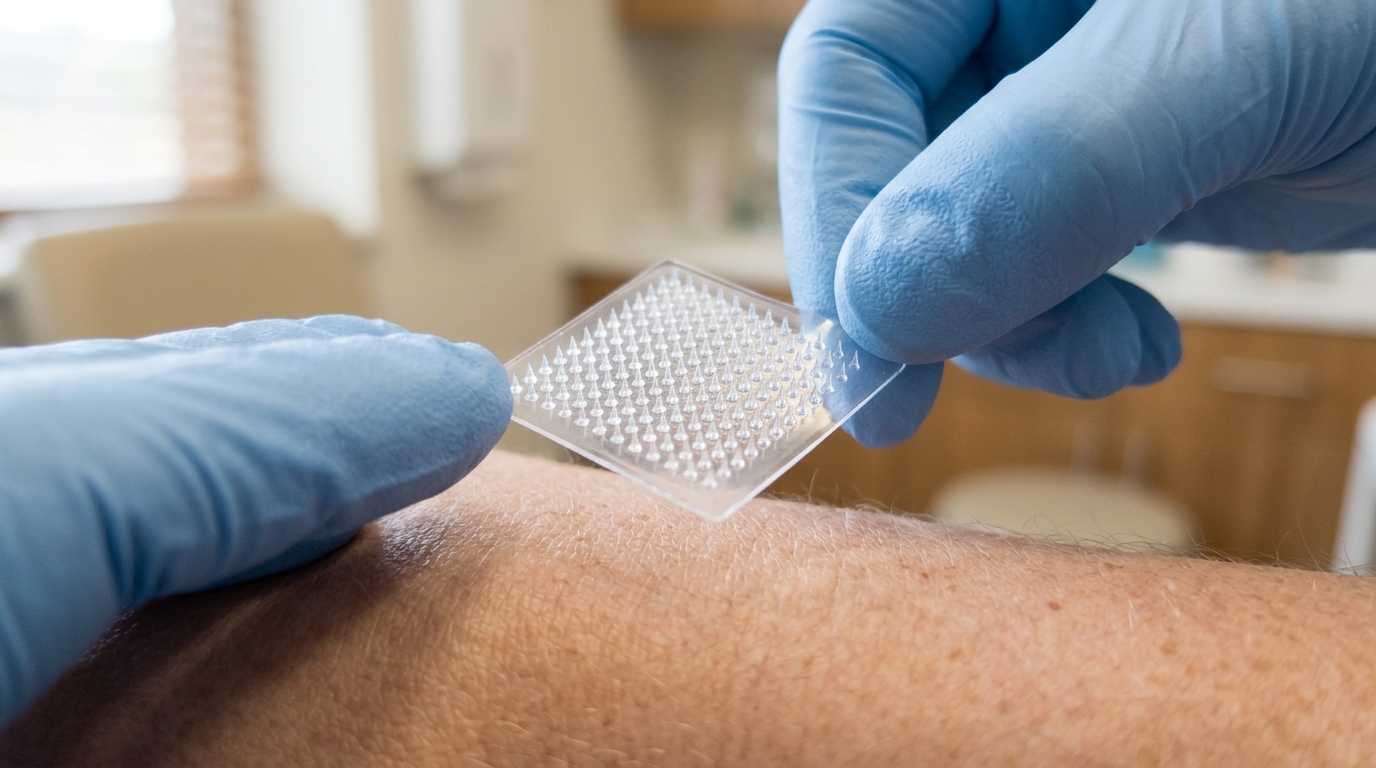
Transdermal drug delivery has emerged as a compelling conceptual approach to alleviate this treatment burden, yet the physical and biochemical protective barriers of human skin, alongside enzymatic degradation encountered with oral alternatives, historically restricted the bioavailability of large, complex therapeutic molecules used in fertility management. Microarray patches represent an innovative pharmaceutical formulation containing tiny projections called microneedles that puncture the outermost layer of the skin. By enabling the transdermal transport of macromolecules that were previously unsuitable for non-invasive delivery, microarray patches can provide patient-friendly, straightforward administration with minimal physical discomfort. Furthermore, depending on the specific formulation design, these patches can dissolve directly within the skin tissue to eliminate biohazardous sharp residues entirely while significantly enhancing active drug stability at room temperature. Although prior research extensively explored user acceptability for microarray vaccination, therapeutic drug monitoring, and continuous HIV prophylaxis, stakeholder perspectives regarding their application within complex fertility protocols remained largely unexamined until now.
To investigate these clinical considerations, a qualitative research study conducted in Ireland between September 2025 and January 2026 examined how patients, partners, and medical providers experience fertility injections and perceive the prospective introduction of microarray patches. Adhering to the Consolidated Criteria for Reporting Qualitative Research guidelines to ensure transparent and thorough reporting, the academic investigation secured formal institutional approval from the Social Research Ethics Committee at University College Cork under reference number 2025-109 in June 2025. The research team recruited participants through convenience sampling across professional networks, social media campaigns, and targeted outreach to reproductive clinics, aiming to capture diverse socioeconomic backgrounds, educational histories, and clinical backgrounds. Audio-recorded semi-structured interviews were conducted either in person or remotely via Microsoft Teams, following a structured topic guide that introduced participants to physical cosmetic or placebo microarray patch samples. Transcripts were analyzed verbatim utilizing Braun and Clarke’s reflexive thematic analysis methodology to identify recurring structural themes.
The study cohort comprised twenty-two participants, dividing evenly into eleven healthcare professionals and eleven individuals representing the patient community, which included ten treated patients and one domestic partner. Interviews averaged twenty-four minutes among patients and partners, ranging between fifteen and forty-two minutes, whereas professional interviews averaged sixteen minutes, ranging from six to twenty-seven minutes. Within the patient cohort, fifty-five percent resided in suburban locations, thirty-six percent lived in rural or semi-rural settings, and all held university credentials, with fifty-five percent completing master’s degrees and thirty-six percent attaining doctoral degrees. Only one patient held a means-tested Irish medical card, and experienced treatment exposure ranged between one and five distinct in vitro fertilization cycles. The professional cohort comprised four clinical nurses, four practicing pharmacists, two fertility midwives, and one reproductive consultant, with ninety-one percent identifying as female and clinical experience ranging from under four years to over two decades across urban and suburban practice sites.
Qualitative analysis generated five overarching themes, beginning with the intricate operational complexities of drug administration and formulation design. Healthcare professionals observed that while many patients eventually adapted to routine injection protocols, complicated regimens combining multiple pharmacological products generated ongoing distress. Localized tissue reactions, including persistent soreness, noticeable bruising, and subcutaneous lumps resulting from viscous oil-based preparations, presented frequent hurdles. Although patients generally tolerated subcutaneous self-administration using prefilled pens, deep gluteal intramuscular injections presented severe physical challenges due to demanding anatomical positioning and substantial needle gauges. Patient nine specifically recounted the physical struggle of attempting to inject into a mirror, noting that reaching the appropriate dorsal site required an unmanageable degree of physical dexterity. Consequently, participants across cohorts exhibited strong interest in microarray alternatives, emphasizing their potential for needle-free, painless application, especially for prolonged treatment protocols where multiple weekly administrations could replace deep tissue injections.
Beyond eliminating needle trauma, participants emphasized critical patch characteristics necessary for clinical adoption, including chemical excipient safety, secure skin adhesion, and flexible dosing capabilities. Because fertility patients frequently experience elevated anxiety regarding medication errors, several participants expressed apprehension over whether micro-projection matrices might leave unexpected chemical residues within dermal layers. Furthermore, because completing a conventional syringe injection offers unmistakable visual and tactile confirmation of delivery, patients expressed a desire for integrated visual delivery indicators on patches to provide equivalent psychological reassurance. Pharmacists underscored the necessity of sustained-release capabilities and adjustable dosing increments to accommodate individualized ovarian responses, with healthcare professional eleven highlighting that replacing daily injections with a patch applied every few days or weekly would represent a dramatic therapeutic improvement. Nevertheless, patients worried that technical patch detachment or improper placement could compromise cycle outcomes, amplifying stress in an already high-stakes medical process.
The second thematic domain centered on the essential role of interpersonal support systems encompassing domestic partners, clinical staff, and peer networks. Because devices like prefilled pens are designed for self-administration, healthcare professionals recommended that patients self-inject, though some sought assistance from partners, family members, or friends for challenging intramuscular injections. Passing injection responsibilities to a partner introduced logistical coordination friction, as reconciling two professional calendars to ensure precise daily administration times proved challenging for busy dual-income couples. Moreover, requiring partners to deliver painful injections sometimes introduced relationship strain and overly medicalized the intimate process of conception. Healthcare professional five suggested that partners might provide more meaningful emotional comfort through domestic care rather than clinical tasks, while patient partner one noted that having an administration format less reliant on needles would alleviate mutual distress when self-injection became unavoidable.
The third major theme illuminated the primacy of treatment efficacy and expectations management over personal physical convenience. Both patients and healthcare providers repeatedly affirmed that achieving a successful clinical pregnancy remained their overriding objective, causing participants to tolerate extreme discomfort if they believed existing injections maximized therapeutic odds. Patient ten emphasized a determination to do whatever was required regardless of format, while patient nine affirmed that enduring needle punctures was acceptable if it secured optimal efficiency. Consequently, therapeutic efficacy served as the indispensable prerequisite for microarray acceptance; participants cautioned that any perceived reduction in drug absorption, particularly among individuals with higher body mass index values, would deter adoption. Furthermore, clear pharmaceutical labelling without intimidating terminology such as needle was deemed vital to prevent distress among needle-phobic users, alongside transparent guidance regarding formal regulatory licensing to assure vulnerable patients that treatments are not experimental.
Logistical and lifestyle adjustments constituted the fourth core theme, highlighting the domestic disruption imposed by refrigerated storage and biological waste disposal. Managing bulky medication supplies that occupied substantial refrigerator space created ongoing domestic inconvenience and triggered privacy concerns when hosting household visitors or navigating workplace environments. Transporting temperature-sensitive injectables during travel necessitated burdensome cooler packs, whereas room-temperature patch stability was lauded as an innovation that would restore daily mobility, discretion, and personal spontaneity. In addition, handling biohazardous sharps bins generated significant practical friction, as patients frequently encountered disposal fees or retail pharmacies unwilling to accept used containers. For unsuccessful treatment cycles, disposing of the bright yellow sharps container represented a painful physical reminder of failure, as articulated by patient nine. Participants anticipated that dissolving, non-hazardous microarray patches would substantially diminish plastic medical waste while preserving domestic privacy.
The final theme addressed education and clinical training requirements spanning both patient instruction and professional healthcare knowledge. Participants widely praised structured injection demonstrations provided by clinic nurses and community pharmacists, noting that handling placebo training pens and reviewing step-by-step videos substantially alleviated initial procedural fears. However, patients voiced frustration when community pharmacists exhibited varying levels of familiarity with specialized reproductive regimens. Pharmacists explained that incomplete prescription details, off-label medication uses, and limited specialized fertility training hindered comprehensive patient counselling, prompting calls for closer collaborative alignment between community pharmacies and specialized fertility clinics. Regarding prospective microarray patches, healthcare professional two anticipated that clinical consultations would become notably shorter and less cumbersome than existing injection training, provided that standardized instructional materials clearly instruct patients on managing accidental patch dislodgement or local skin adhesion variables.
Synthesizing these findings within the broader scientific literature demonstrates that while physical burdens like bruising, needle apprehension, and storage constraints mirror challenges observed in chronic conditions such as diabetes, multiple sclerosis, and psoriasis, the psychological stakes of fertility care introduce unique behavioral dynamics. Unlike clinical vaccination settings where medical professionals administer microarray patches, fertility protocols depend almost entirely on domestic self-care within highly compressed therapeutic windows. The intense emotional and financial investments characterizing assisted reproduction cause patients to prioritize treatment efficacy far above lifestyle convenience, fostering caution toward unfamiliar technologies due to fears of treatment failure. Nonetheless, the substantial lifestyle benefits associated with ambient storage, elimination of biohazardous sharps, and reduced procedural error indicate that microarray formulations could fundamentally transform patient experiences if engineered to match the pharmacokinetic reliability of conventional injectables.
The researchers noted essential methodological strengths and limitations that contextualize the overall transferability of these qualitative findings. A primary methodological strength was the interprofessional composition of the investigative team, combining academic and clinical expertise across clinical pharmacy and pharmaceutics to mitigate individual interpretive biases during reflexive coding. Conversely, the study was constrained by a modest sample size of twenty-two participants located entirely within Ireland, limiting generalizability to international health jurisdictions operating under divergent clinical funding models. Furthermore, the patient sample exhibited pronounced homogeneity, characterized by universal university education, predominantly suburban or rural residence, and minimal public medical card representation, while the professional cohort was overwhelmingly female. Future acceptability studies that allow participants to test placebo microarray patches may provide additional insights into their potential use in fertility care.
Subject of Research: Qualitative evaluation of microarray patches as an alternative to injectable fertility medications
Article Title: Microarray patches as a potential alternative to injectable fertility medications: a qualitative study of patients’ and healthcare professionals’ perceptions
Article References: Koenitz, L., Quigley, M., Crean, A., Vucen, S., & O’Driscoll, M. (2026). Microarray patches as a potential alternative to injectable fertility medications: a qualitative study of patients’ and healthcare professionals’ perceptions. International Journal of Clinical Pharmacy, 48(6), 2429-2439. https://doi.org/10.1007/s11096-026-02220-1
Image Credits: AI Generated
DOI: 10.1007/s11096-026-02220-1
Keywords: microarray patches, fertility medications, in vitro fertilization, assisted reproductive technologies, transdermal drug delivery, microneedles, subcutaneous injections, intramuscular injections, controlled ovarian stimulation, qualitative research, thematic analysis, reproductive endocrinology, clinical pharmacy, patient burden, treatment acceptability, sharps waste, medication adherence, University College Cork
News Source: Ophelia Keating. (November 17, 2026). Fertility Patients and Clinicians in Qualitative Study See Potential in Microarray Patches. Scienmag.