• HOME
  • NEWS
  • EXPLORE
    • CAREER
      • Companies
      • Jobs
    • EVENTS
    • iGEM
      • News
      • Team
    • PHOTOS
    • VIDEO
    • WIKI
  • BLOG
  • COMMUNITY
    • FACEBOOK
    • INSTAGRAM
    • TWITTER
Saturday, February 7, 2026
BIOENGINEER.ORG
No Result
View All Result
  • Login
  • HOME
  • NEWS
  • EXPLORE
    • CAREER
      • Companies
      • Jobs
        • Lecturer
        • PhD Studentship
        • Postdoc
        • Research Assistant
    • EVENTS
    • iGEM
      • News
      • Team
    • PHOTOS
    • VIDEO
    • WIKI
  • BLOG
  • COMMUNITY
    • FACEBOOK
    • INSTAGRAM
    • TWITTER
  • HOME
  • NEWS
  • EXPLORE
    • CAREER
      • Companies
      • Jobs
        • Lecturer
        • PhD Studentship
        • Postdoc
        • Research Assistant
    • EVENTS
    • iGEM
      • News
      • Team
    • PHOTOS
    • VIDEO
    • WIKI
  • BLOG
  • COMMUNITY
    • FACEBOOK
    • INSTAGRAM
    • TWITTER
No Result
View All Result
Bioengineer.org
No Result
View All Result
Home NEWS Science News Biology

Bottle-brush design enhances cellular imaging

Bioengineer by Bioengineer
January 25, 2018
in Biology, Science News
Reading Time: 2 mins read
0
Share on FacebookShare on TwitterShare on LinkedinShare on RedditShare on Telegram
IMAGE

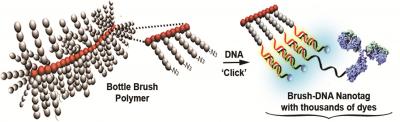
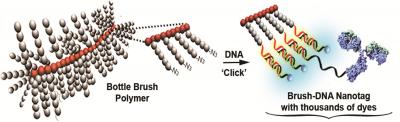
The bottle brush, with its long stalk and dense spray of plastic bristles, is the unsung hero of kitchens everywhere, fitting through the narrow necks of water bottles and vases and into the hard-to-reach interiors of mugs and tumblers. With the gadget's unique design as inspiration, researchers now report in ACS Central Science the development of bottle-brush nanotags that can contain thousands of fluorophores, greatly enhancing the detection and analysis of cells.

Fluorescent probes help researchers see particular cells or proteins. For example, these probes are often used to distinguish healthy cells from cancerous ones. The most common approach is to make a sandwich of a "primary" antibody specific for a certain protein on a cell and a "secondary" antibody connected to fluorophores. But if a protein is expressed at a low level, it can be difficult to detect. In those cases, many fluorophores are attached to the secondary antibody to amplify the signal. However, there's a limit to that strategy — when the fluorophores are too close together, self-quenching can actually reduce the signal. To overcome this challenge, teams in the labs of Krzysztof Matyjaszewski, Bruce Armitage and Subha R. Das found inspiration in the many bristles of the bottle brush.

The groups created brush-shaped polymers with side chains that resemble bristles. From there, they attached DNA to the tips of these bristles and used complementary DNA to create a double-stranded structure. Special fluorescent molecules that bind only inside double-stranded DNA were added. The bottle-brush structure could then serve as a new type of secondary antibody that could bind to thousands of fluorophores, enhancing the signal by about 10 times compared to existing methods. The design permits the use of different dyes so that a wide range of colors of these fluorescent nanotags can be readily obtained. The authors note that, with additional tweaking, the brushes also could someday deliver cancer therapeutics.

###

The authors acknowledge funding from the National Science Foundation and the David Scaife Charitable Foundation.

The paper will be freely available on Nov. 4 at this link: http://pubs.acs.org/doi/full/10.1021/acscentsci.5b00259 .

The American Chemical Society is a nonprofit organization chartered by the U.S. Congress. With more than 158,000 members, ACS is the world's largest scientific society and a global leader in providing access to chemistry-related research through its multiple databases, peer-reviewed journals and scientific conferences. Its main offices are in Washington, D.C., and Columbus, Ohio.

To automatically receive news releases from the American Chemical Society, contact [email protected]

Follow us: Twitter | Facebook
Share12Tweet7Share2ShareShareShare1

Related Posts

Evaluating Pediatric Emergency Care Quality in Ethiopia

February 7, 2026

TPMT Expression Predictions Linked to Azathioprine Side Effects

February 7, 2026

Improving Dementia Care with Enhanced Activity Kits

February 7, 2026

Decoding Prostate Cancer Origins via snFLARE-seq, mxFRIZNGRND

February 7, 2026
Please login to join discussion

POPULAR NEWS

  • Robotic Ureteral Reconstruction: A Novel Approach

    Robotic Ureteral Reconstruction: A Novel Approach

    82 shares
    Share 33 Tweet 21
  • Digital Privacy: Health Data Control in Incarceration

    63 shares
    Share 25 Tweet 16
  • Study Reveals Lipid Accumulation in ME/CFS Cells

    57 shares
    Share 23 Tweet 14
  • Breakthrough in RNA Research Accelerates Medical Innovations Timeline

    53 shares
    Share 21 Tweet 13

About

We bring you the latest biotechnology news from best research centers and universities around the world. Check our website.

Follow us

Recent News

Evaluating Pediatric Emergency Care Quality in Ethiopia

TPMT Expression Predictions Linked to Azathioprine Side Effects

Improving Dementia Care with Enhanced Activity Kits

Subscribe to Blog via Email

Success! An email was just sent to confirm your subscription. Please find the email now and click 'Confirm' to start subscribing.

Join 73 other subscribers
  • Contact Us

Bioengineer.org © Copyright 2023 All Rights Reserved.

Welcome Back!

Login to your account below

Forgotten Password?

Retrieve your password

Please enter your username or email address to reset your password.

Log In
No Result
View All Result
  • Homepages
    • Home Page 1
    • Home Page 2
  • News
  • National
  • Business
  • Health
  • Lifestyle
  • Science

Bioengineer.org © Copyright 2023 All Rights Reserved.