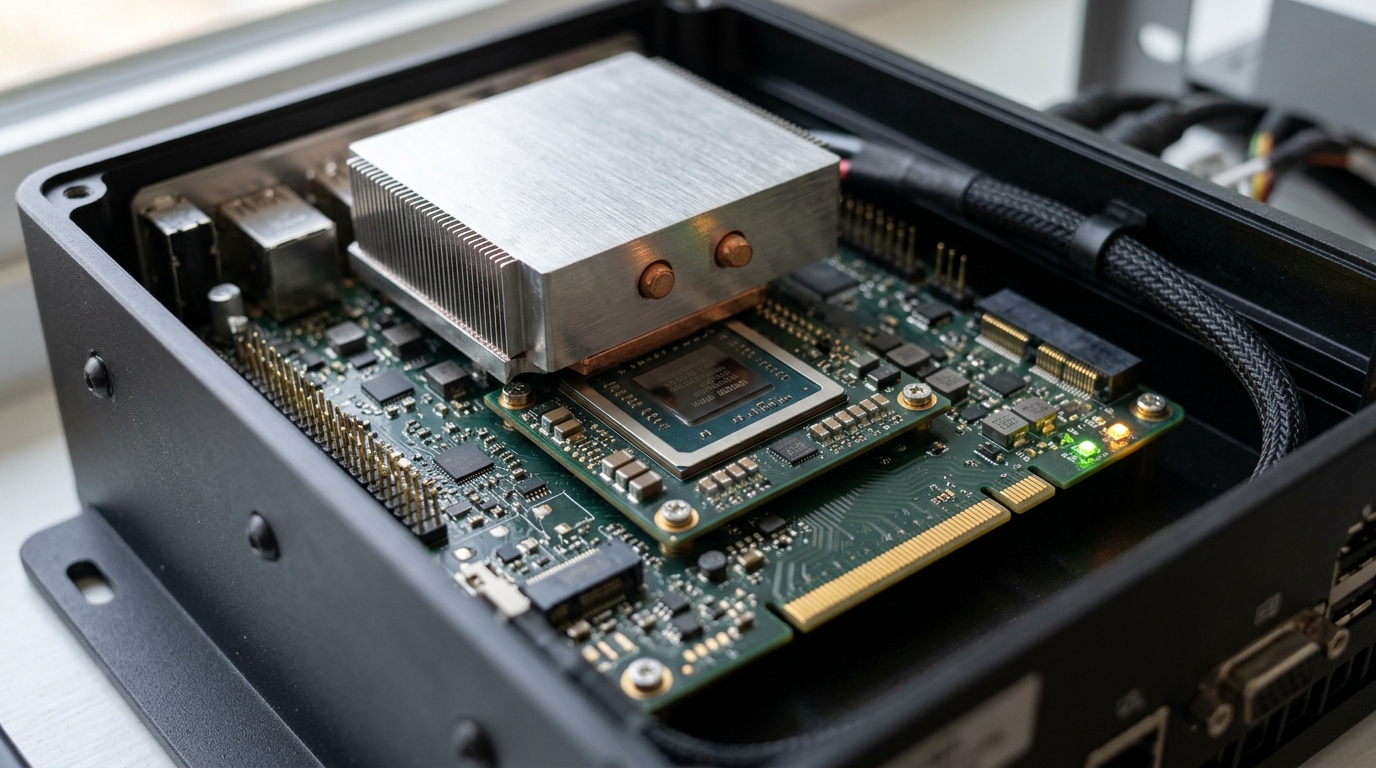
A simulation study exploring distributed deep neural network inference across edge devices and cloud regions shows that running lightweight vision models entirely on-device with dynamic voltage and frequency scaling yields lower carbon emissions than offloading computational layers to remote servers. Computer science researchers evaluated a multi-objective framework named GreenSplit designed to partition deep neural network layers between a local device and cloud data centers while balancing latency, operational carbon emissions, data privacy, and thermal constraints. Under the study’s modeled energy parameters, transferring intermediate activations across wide-area networks generated substantial energy and carbon overheads, causing offloaded configurations of a lightweight convolutional neural network to emit 5.8 to 6.7 times the operational carbon of local execution. Consequently, the optimization framework favored complete on-device execution for MobileNetV2 when environmental priorities governed scheduling decisions, behaving effectively as local execution managed by reactive thermal safeguards.
Distributed split computing has emerged in recent years as a prominent technique to overcome compute limitations on resource-constrained mobile and embedded platforms. By executing early neural network layers locally and routing intermediate activations to powerful remote servers to complete downstream inference, partition schemes historically sought to minimize end-to-end processing delays. However, prior split-computing systems typically treated cloud destinations as interchangeable entities differing solely in round-trip latency, ignoring spatial and temporal variations in electrical grid carbon intensity that can exceed a factor of four between geographic regions. Furthermore, early layer representations exhibit high mutual information with raw sensor inputs, exposing sensitive user data to passive network adversaries. Rapid continuous inference on mobile hardware also accelerates battery discharge and induces hardware thermal throttling, which one-shot latency estimators overlook.
To investigate these coupled trade-offs within a unified decision loop, researchers formulated GreenSplit around a four-term normalized cost function that simultaneously evaluates per-cycle latency, carbon emissions, privacy leakage, and forward-looking device temperature. To prevent disparate units—such as milliseconds, grams of carbon dioxide, and degrees Celsius squared—from numerically biasing scheduling choices, the system normalizes candidate costs dynamically over currently feasible split layers and cloud regions. The architecture incorporates an Adaptive Weight Controller designed to tune objective weights iteratively using multiplicative feedback based on operator-specified target thresholds. To protect data privacy, the framework pairs a soft continuous penalty with an inviolable structural exclusion zone that removes shallow, high-leakage layers from the feasible split set before optimization occurs. Additional protective layers include calibrated Laplace noise injected into transmitted activations, an active lumped thermal-capacitance forecast model, and a Dynamic Voltage and Frequency Scaling safeguard.
The experimental validation was conducted in a Python simulation environment modeling sustained inference loads on MobileNetV2 across three cloud regions designated as EU-West, US-East, and IN-South. Over 200 randomized continuous 60-second trials, each trial randomly sampled uplink bandwidth from a log-normal distribution with a 10 Mbps median, alongside initial device temperatures, ambient temperatures between 22 and 30 degrees Celsius, and battery states of charge. Under modeled baseline energy constants—including 4.0 watts of active edge compute power, a network energy intensity of 0.05 kilowatt-hours per gigabyte, a cloud server power draw of 300 watts, and an edge grid carbon intensity of 720 grams of carbon dioxide per kilowatt-hour—transmitting even the smallest intermediate activation tensor of 30.6 kilobytes incurred approximately 5.3 joules of network energy. This network energy significantly exceeded the 1.8 joules required to execute all 0.30 gigamac operations of MobileNetV2 locally on the simulated edge device.
Because the network transmission overhead dominated operational energy, GreenSplit selected the final layer—retaining the entire network locally—in every cycle of every trial under carbon-priority weighting. In this operating regime, the framework achieved an average carbon footprint of 66.0 percent relative to unmanaged local execution, closely matching a dedicated Local plus DVFS baseline at 65.9 percent while differing only by the orchestrator’s small per-cycle computational overhead of 4.0 times 10 to the negative seventh grams of carbon dioxide. In contrast, unmanaged offloading strategies, including Latency-First, Carbon-Aware Greedy, and Privacy-Aware Static Partitioning, emitted between 579.5 percent and 669.6 percent of local baseline carbon. These comparative reductions stemmed entirely from retaining execution locally combined with voltage-frequency scaling, rather than dynamic spatial routing among remote cloud regions.
When the researchers artificially forced offloading by removing local execution from the candidate set, the potential carbon reduction from selecting a lower-carbon cloud region depended heavily on unmeasured hardware and network constants. In the detailed cycle simulator, routing computation to EU-West rather than the latency-optimal IN-South region yielded an average carbon saving of only 0.7 percent, as regional carbon variations remained negligible compared to network transfer energy. Conversely, a coarser decision-level model with uniform remote compute durations yielded a mean regional routing saving of 20 percent. Extensive sensitivity sweeps revealed that regional routing potential fluctuated between 0.7 percent and 28.5 percent depending on assumed server wattage, edge-grid carbon intensity, and network transmission efficiency, underscoring that empirical field measurements are essential before deploying carbon-aware routing protocols in production systems.
Hardware thermal stability assessments under sustained 60-second execution streams demonstrated that unmanaged local processing led to device throttling in 100 percent of trials, while static offloading baselines throttled in 92.5 to 99.5 percent of trials due to inflexible initial layer assignments. GreenSplit and the Local plus DVFS baseline both reduced the throttling incidence to 32.5 percent under nominal thermal parameters. However, this protective effect arose exclusively from the reactive 20 percent clock frequency and voltage reduction rather than forecast-guided layer migrations. In the simulator, the one-step Euler thermal forecast relied primarily on mean per-block power consumption, which remained essentially uniform across network layers and failed to account for cooling duty cycles introduced by offloading idle time. Sensitivity analyses demonstrated that throttling rates ranged from 0 to 100 percent across plausible variations in thermal resistance, ambient temperature, and frequency steps, indicating that the simulated 32.5 percent rate is not a robust hardware prediction.
Rigorous evaluations of the differential privacy module on real neural network activations revealed severe operational limitations for additive Laplace perturbation mechanisms. When tested on a pretrained MobileNetV2 using 1,000 real ImageNet validation images across split layers 4, 8, 14, and 17, operating privacy budgets of epsilon equal to 0.5 or 1.0 degraded cloud classification accuracy to random chance, matching the 0.1 percent baseline. At accuracy-preserving privacy budgets between 30,000 and 300,000, mathematical differential privacy bounds became completely vacuous, and a maximum-likelihood gallery adversary successfully re-identified transmitted activations among the 1,000 reference images with 100 percent accuracy. Complementary evaluations on a custom MobileNetV2 architecture trained on MNIST digit data confirmed that utility and empirical privacy could not be achieved simultaneously, establishing that the structural exclusion zone, rather than noise addition, provided the only practical privacy protection.
Further investigation of the Adaptive Weight Controller highlighted critical behavioral sensitivities to cost normalization schemes during dynamic disturbances. In an idealized 200-cycle scenario featuring an isolated carbon-intensity spike and an ambient temperature rise, the controller reduced cumulative target excess by 50.7 to 60.9 percent compared to static environmental presets, verifying its theoretical one-step self-correction capability. However, when exposed to 60 randomized unseen test trajectories with overlapping disturbances, the original controller formulation using per-cycle min-max normalization exhibited severe weight oscillation and saturated against clipping boundaries in 88 percent of cycles. Restructuring excess calculations against fixed reference bounds stabilized adaptation and reduced excess over target from 0.84 to 0.28, but failed to deliver thermal improvements and degraded performance during simultaneous triple-objective disturbances.
Extending the decision framework to additional model architectures demonstrated that optimal partitioning behavior depends fundamentally on tensor geometry across network depth. For convolutional models like ResNet-50, where intermediate feature maps shrink progressively, the carbon-priority optimizer retained computation locally, yielding forced-offload carbon footprints 2.74 times higher than on-device processing. In contrast, vision transformer profiles—specifically ViT-Base and the CLIP ViT-B/32 image encoder—exhibited constant activation tensor dimensions across all 12 attention blocks. Because delaying split boundaries in transformer models offered no data-compression advantage while edge compute demands accumulated, the optimizer consistently selected the earliest privacy-feasible boundary, offloading almost the entire model. The authors emphasize that physical hardware validation on edge testbeds remains imperative to calibrate empirical energy, thermal, and network constants.
Subject of Research: Carbon-aware and privacy-preserving deep neural network partitioning across edge and cloud environments
Article Title: An adaptive spatio-temporal framework for carbon-aware and privacy-preserving DNN partitioning
Article References: Goel, S., & Veeragandham, S. (2026). An adaptive spatio-temporal framework for carbon-aware and privacy-preserving DNN partitioning. Frontiers in Artificial Intelligence, 9, Article 1961682. https://doi.org/10.3389/frai.2026.1961682
Image Credits: AI Generated
DOI: 10.3389/frai.2026.1961682
Keywords: edge computing, deep neural networks, split inference, carbon-aware computing, model partitioning, green AI, differential privacy, dynamic voltage and frequency scaling, thermal throttling, MobileNetV2, computational sustainability, cloud routing, embedded systems, vision transformers, activation leakage, multi-objective optimization
News Source: Denise Maddox. (November 17, 2026). Simulated Split DNN Framework Cuts Emissions Locally While Challenging Remote Offloading. Scienmag.