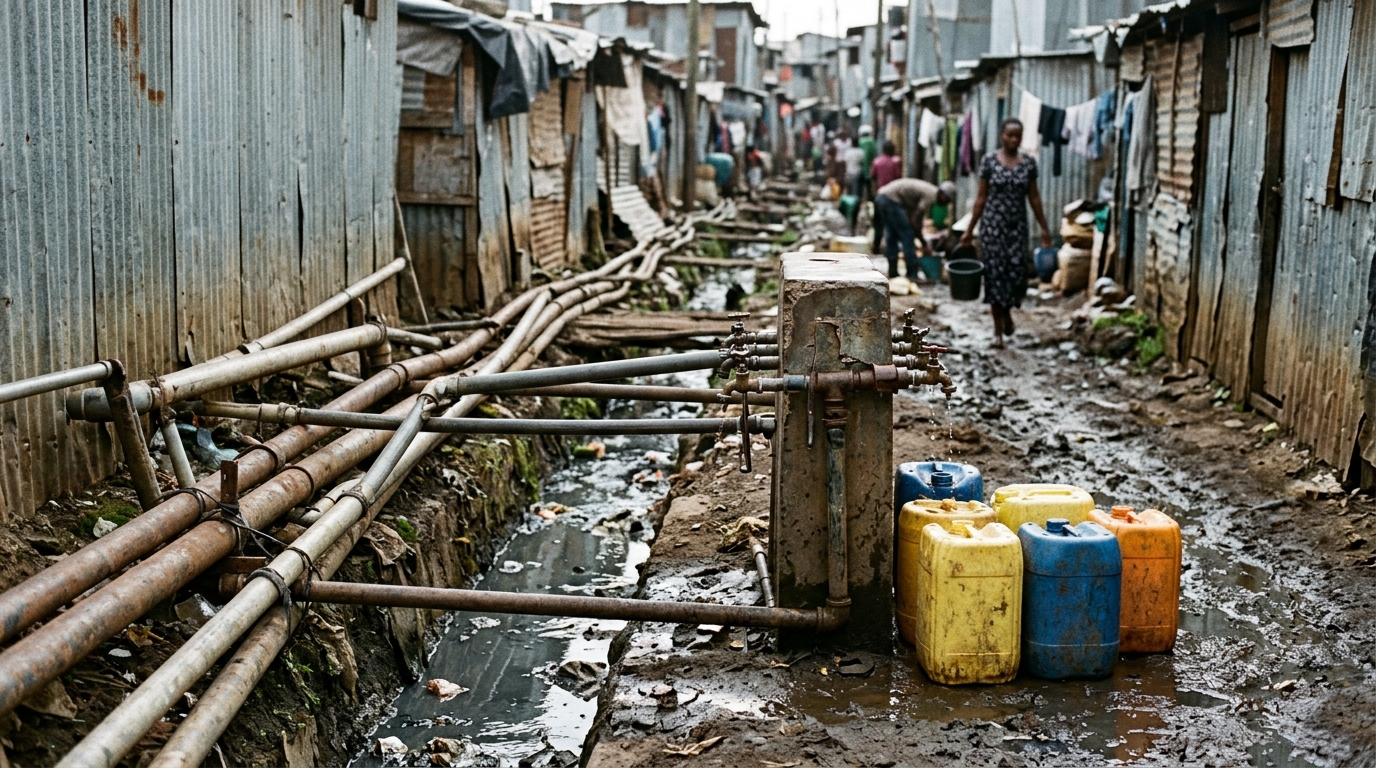
Urban informal settlements across the Global South, particularly within India, are characterized by a convergence of environmental risks that fundamentally reshape the relationship between water and public health. A new narrative review synthesizes evidence indicating that these communities do not merely experience isolated instances of water insecurity, but rather endure compounded, interacting challenges involving water scarcity, microbial contamination, recurrent flooding, inadequate sanitation infrastructure, and fragmented governance. This cluster of hazards functions to significantly amplify the prevalence of both water-borne diseases—such as diarrhoea, cholera, typhoid, and dysentery—and vector-borne illnesses including dengue, malaria, chikungunya, and leptospirosis. The review underscores that the health burdens identified in these dense, underserved settings are not inevitable consequences of poverty or density alone, but are instead outcomes of systemic exclusion from formal urban planning and service provision. By analyzing diverse evidence from epidemiology, WASH engineering, and urban governance, the authors argue that current technical interventions focused on singular service targets remain insufficient. Instead, effectively mitigating these health risks necessitates a justice-oriented, integrated approach that combines improved water supply, comprehensive sanitation chain management, flood adaptation, and stronger local accountability mechanisms.
The concept of water risk in the context of informal urbanism must be understood as a relational and multidimensional phenomenon rather than a simple metric of service coverage. While global monitoring indicators often report progress through city-wide averages, these figures consistently conceal the sharper deprivations and acute environmental exposures inherent in informal settlements. Residents frequently navigate a complex landscape where safe water access is constrained by cost, insecure land tenure, and physical remoteness from municipal trunk infrastructure. In such environments, the absence of reliable, continuous piped supply forces households to rely on standposts, shared taps, tankers, or unregulated informal vendors. This dependency is not simply a matter of convenience; it represents a fundamental failure in the reliability and quality assurance of essential services. Even where infrastructure exists on paper, intermittent service delivery often results in low-pressure network conditions that allow contaminants to enter pipelines during periods of stagnation, while the necessity of storing water in domestic containers creates ubiquitous, high-quality habitats for disease-carrying mosquitoes.
Water scarcity and water quality are inextricably linked to the socio-technical architecture of these settlements, where water-borne health impacts are driven by the entire journey of water from source to point of use. Chronic insufficiency or irregularity in supply limits the capacity for fundamental hygiene practices, such as handwashing and utensil cleaning, which directly elevates the risk of faecal-oral disease transmission. Furthermore, the reliance on shared or poor-quality facilities often means that water is stored for extended periods, frequently in conditions that promote microbial contamination. The review highlights that reliance on source type—such as labeling a source as ‘improved’—is an insufficient proxy for safety because it fails to account for the severe recontamination risks encountered during collection, transport, and storage in high-density, low-income settings. Consequently, diarrhoea, which remains a leading contributor to preventable mortality and morbidity, continues to be a central health marker in these communities, with incidence rates consistently higher among children living in the most deprived urban environments.
Flooding and drainage failure represent perhaps the most pervasive and under-prioritized environmental hazards in informal settlements, acting as catalysts for both water-borne and vector-borne disease pathways. Because informal settlements are disproportionately situated on floodplains, low-lying land, or riverbanks—locations deemed unsuitable or less attractive for formal development—they are uniquely vulnerable to the impacts of changing precipitation patterns and climate extremes. Recurrent inundation does not only constitute a physical disaster risk; it serves as a chronic health threat by mobilizing faecal waste from pit latrines and open defecation sites, damaging existing water points, and creating long-term stagnant water sites. These conditions are not solely natural hazards; they are mediated by the absence of adequate drainage maintenance and the accumulation of unmanaged solid waste, which frequently block stormwater flows and sustain breeding grounds for vectors like Aedes aegypti, the primary agent for dengue, Zika, and chikungunya outbreaks. The intersection of poor infrastructure with fragmented municipal waste management transforms even minor rainfall events into significant health events.
The challenge of sanitation in informal settlements extends far beyond the provision of individual toilets, requiring a rigorous assessment of the entire sanitation chain from initial containment to final treatment and disposal. In dense, under-resourced neighbourhoods, the fragility of this chain is evident: pit latrines are often located dangerously close to drinking-water sources or drainage channels, while the narrow, informal road networks prevent the passage of essential desludging vehicles. Without access to formal, affordable faecal-sludge management, households are often forced to rely on unsafe emptying practices or are left with no choice but to discharge waste into open drains. This systemic failure of the sanitation chain ensures that environmental exposure to pathogens remains constant. The review posits that sustainable public-health protection must therefore prioritize climate-sensitive sanitation designs that can withstand inundation and provide safe, gender-responsive access to facilities throughout the entire year, addressing the needs of populations whose daily survival is closely tied to the quality of their immediate shared environment.
Governance gaps and the systemic invisibility of informal residents further exacerbate the health impacts of water and sanitation deficits. Many informal settlements remain absent from official service maps and risk registers, effectively rendering their residents and their specific environmental exposures invisible to the administrative systems responsible for urban planning and public-health surveillance. This lack of legibility significantly delays responses to outbreaks and weakens the capacity for proactive prevention. Where populations are not counted, immunizations, primary care, and targeted vector control are rarely delivered with sufficient coverage. The review suggests that this institutional exclusion is not accidental but part of the broader political ecology of urban growth, where certain areas are treated as temporary anomalies rather than essential components of the urban economy. Consequently, community-driven data collection, including participatory mapping and resident-led environmental monitoring, has emerged as a critical pathway for generating the necessary evidence to hold local institutions accountable and to inform more equitable planning decisions.
The health impacts of these converging water risks are not limited to infectious disease, but extend to significant non-infectious burdens, including severe economic, psychosocial, and gendered stressors. The direct financial burden of illness—including treatment costs, lost wages, and lost productivity for unpaid caregivers—is substantial, creating a cycle of poverty and debt that further reduces household capacity to invest in safer water or more secure housing. Furthermore, the persistent struggle for water access in informal settlements is fundamentally gendered; women and girls typically bear the primary burden of water collection, which often necessitates early-morning or late-night trips that expose them to high risks of physical violence, harassment, and profound mental distress. These experiences of ’embodied water insecurity’ manifest in chronic anxiety, sleep deprivation, and the erosion of overall well-being, demonstrating that the health consequences of inadequate water infrastructure permeate every aspect of daily life, extending well beyond the symptomatic clinical outcomes typically captured in official morbidity reports.
This structured narrative review, grounded in the Scale for the Assessment of Narrative Review Articles criteria, draws on fifty distinct sources including empirical studies and policy documentation to synthesize patterns across the Global South. By utilizing a narrative synthesis approach rather than a meta-analysis, the researchers were able to accommodate the heterogeneous nature of the existing evidence base, which includes diverse observational designs, varying metrics of exposure, and non-comparable health outcome definitions across regions. Despite the methodological limitations inherent in comparing qualitative and cross-sectional data, the synthesis reveals remarkably consistent findings across sub-Saharan Africa, Latin America, and India. Specifically, the data consistently points toward empirical associations between breakdowns in the water-sanitation-drainage service chain and elevated infectious disease risk. While the current review identifies significant limitations—including a concentration of empirical evidence in large, well-studied Indian cities like Mumbai and Delhi and a relative dearth of longitudinal analysis—it nonetheless provides a compelling framework for future action.
Moving forward, the policy implications derived from this evidence demand an integrated, justice-oriented framework that moves beyond traditional, siloed infrastructure planning. Recognition of settlements within official registers is the necessary first step, serving as a prerequisite for the equitable delivery of trunk infrastructure and the effective implementation of public-health surveillance. Utilities must transition their performance targets away from city-wide production averages, which hide deep inequalities, toward settlement-level indicators that measure service continuity, water pressure, microbial quality at the point of use, and the real affordability of connections for low-income residents. Such measures must be supported by the regulation of informal water vendors, who currently fill service gaps at high cost and low safety standards, and by the prioritization of drainage and solid-waste management as critical public-health infrastructure rather than merely as engineering accessories.
Ultimately, the evidence suggests that the goal of achieving a healthy city will remain elusive if the infrastructure of safety and care is confined to formal or elite enclaves while environmental risk is externalized to informal margins. Reducing water-related health burdens requires that public institutions treat community participation not as a replacement for state responsibility, but as a mechanism for co-governance and accountability. Residents are essential partners in identifying contamination hotspots and maintaining services, yet their efforts cannot compensate for the persistent absence of mainstream municipal support, secure land tenure, or proper treatment capacity. By centering urban planning on the realities of the water-health nexus in informal environments, policymakers can address the structural drivers of preventable disease and move toward a model of development that respects the dignity, rights, and health of all urban residents, regardless of their legal status or settlement classification.
Subject of Research: Public health impacts of integrated water-related environmental risks in informal urban settlements.
Article Title: Health impacts of water risks through water-borne and vector-borne diseases in informal settlements in the Global South and India
Article References: Malik, S. (2026). Health impacts of water risks through water-borne and vector-borne diseases in informal settlements in the Global South and India. Discover Public Health, 23(1), Article 1811. https://doi.org/10.1186/s12982-026-03244-8
Image Credits: AI Generated
DOI: 10.1186/s12982-026-03244-8
Keywords: informal settlements, water insecurity, public health, sanitation chain, Global South, water-borne disease, vector-borne disease, urban planning, environmental justice, India, WASH, infrastructure, governance, flooding, epidemiology
News Source: Kristina Jarvis. (November 17, 2026). Interconnected Water Risks Amplify Infectious Disease in Informal Urban Settlements. Scienmag.