Patients who underwent robotic-assisted total knee arthroplasty achieved superior functional and patient-reported outcomes at one year compared with those treated using conventional surgical techniques, according to a quasi-randomised controlled trial conducted in Germany. The study evaluated 845 patients receiving primary knee replacements at an accredited high-volume orthopaedic center, comparing an advanced four-dimensional personalised alignment workflow guided intraoperatively by a dedicated knee balancing score against a standard femur-first mechanical alignment procedure. Researchers found that patients in the robotic-assisted cohort reported significantly less pain, reduced joint stiffness, improved mobility, and higher overall satisfaction with their surgical outcome at twelve months follow-up.
Total knee arthroplasty remains one of the most widely performed orthopaedic surgeries globally, offering reliable pain relief and functional restoration for advanced knee osteoarthritis. Despite high overall surgical success rates, historical series indicate that approximately 15 to 20 percent of recipients express dissatisfaction following surgery despite technically satisfactory component placement. This persistent paradox has driven surgeons to re-evaluate traditional surgical philosophies, particularly the conventional mechanical alignment paradigm that seeks a uniform neutral hip-knee-ankle axis across all patients. Because anatomical research shows that roughly half of non-arthritic individuals naturally deviate from a neutral mechanical axis, forcing every patient into a predetermined neutral position risks disrupting the native soft-tissue envelope rather than restoring balanced knee mechanics.
To address these biomechanical limitations, newer approaches such as kinematic, restricted kinematic, and functional alignment seek to reconstruct constitutional joint anatomy within safe limits while securing objective soft-tissue balance. Robotic-assisted platforms have emerged as tools to execute these sophisticated alignment strategies by integrating pre-resection three-dimensional planning, real-time feedback on implant orientation, and quantitative soft-tissue gap measurements before bone cuts are committed. However, prior comparative clinical trials examining robotic versus conventional procedures often produced heterogeneous functional outcomes. The investigators noted that many earlier studies treated the robotic device merely as an isolated technological instrument rather than evaluating the complete intraoperative planning and decision-making framework that robotic assistance enables.
The current prospective quasi-randomised trial enrolled adult patients presenting with symptomatic Kellgren-Lawrence grade II to IV knee osteoarthritis at the Department of Orthopaedic Surgery of the Eifelklinik St. Brigida in Simmerath between 2022 and 2025. Allocation was automated through the institution’s digital outpatient scheduling system, assigning patients to senior orthopaedic surgeons based on routine clinic availability. All participants received the identical posterior-stabilised implant design, fixed with Palacos cement, and completed uniform perioperative pathways that included standardised anaesthesia, continuous femoral nerve block analgesia for 48 hours, antibiotic prophylaxis, and identical postoperative physiotherapy. Four senior surgeons, each having completed more than 1500 procedures and operating well beyond their initial learning curves, carried out all surgeries within an EndoCert-certified center performing roughly 2000 joint replacements annually.
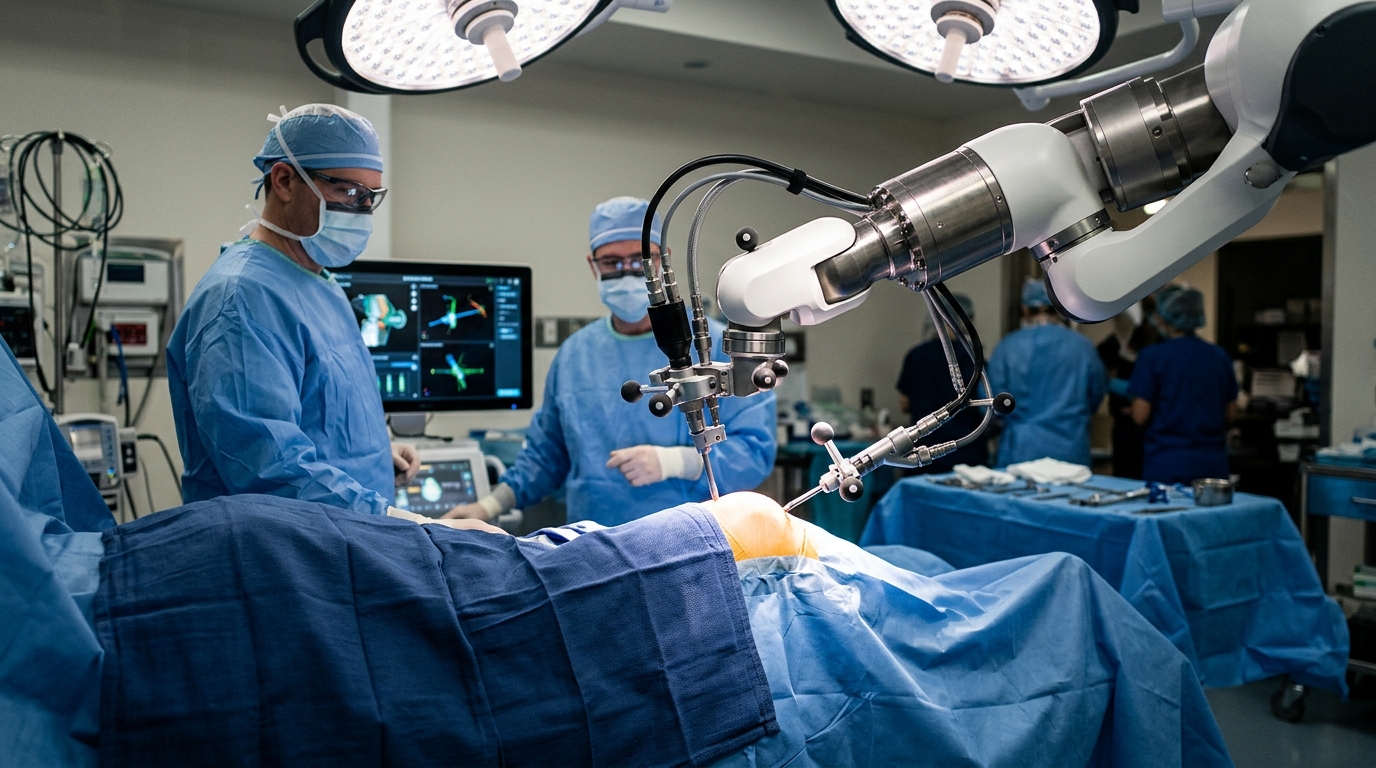
In the robotic-assisted cohort, surgeons utilized the handheld CORI Robotic System following a structured four-dimensional workflow addressing the coronal, sagittal, and transversal planes alongside soft-tissue balancing. Preoperative planning classified patient anatomy using the Coronal Plane Alignment of the Knee system based on long-leg radiographs, establishing tailored targets for medial proximal tibial and lateral distal femoral angles across three defined morphotypes. Before bone resection, the robotic platform registered passive joint positions in extension and 90 degrees of flexion under standardised varus-valgus stress, assessing joint balance via the Knee Balancing Score. If balancing thresholds were unmet, surgeons adjusted component alignment or resection slope virtually before committing to physical bone cuts, accepting the plan only when stability, limb alignment within 177 to 182 degrees, and joint line height were concurrently satisfied.
In contrast, conventional freehand replacements followed a restricted kinematic femur-first technique targeting zero degrees of varus-valgus at the distal femur and a proximal tibial cut perpendicular to the mechanical axis with approximately three degrees of posterior slope. Rotational alignment relied on anatomical landmarks including the posterior condylar axis, the transepicondylar axis, and the anterior femoral cortex. Unlike the robotic pathway, the conventional workflow lacked systematic preoperative morphotype planning, virtual gap simulation, and numerical tension measurement. Surgeons assessed ligament balance manually using tension gauges or spacer blocks after bone resection, performing corrective soft-tissue releases reactively when joint imbalance became clinically evident during trialling.
A total of 845 patients were initially enrolled, with 390 assigned to robotic assistance and 455 to conventional arthroplasty. At the one-year follow-up assessment, complete evaluations were gathered for 383 robotic-assisted and 445 conventional patients, representing minimal loss to follow-up across both groups. Baseline characteristics were well balanced, with a mean patient age of 67.4 years in the robotic group and 67.0 years in the conventional group, mean body mass indexes of 31.0 and 30.2, and comparable proportions of female patients and operative sides. The consistency of patient demographics confirmed that the computer-generated scheduling allocation produced closely matched comparative cohorts prior to surgery.
At the primary one-year endpoint, the robotic-assisted cohort demonstrated statistically significant superiority across all evaluated patient-reported outcome measures. Visual analogue scale pain scores were lower in the robotic cohort, with a mean difference of negative 0.75 points. The robotic group also achieved significantly better total WOMAC scores, displaying a mean difference of negative 6.14 points, alongside significant advantages across WOMAC subscales for pain, joint stiffness, and physical function. Tegner activity scores favoured the robotic group by an average difference of 0.33 points. Furthermore, patients treated with robotic assistance reported superior knee satisfaction, greater satisfaction with the overall procedure, improved performance in daily routines, enhanced knee stability, and greater walking endurance with fewer required rest breaks, although the groups did not differ in their ongoing use of walking aids.
Analyzing these findings, the investigators emphasized that the observed clinical improvements cannot be attributed merely to the mechanical cutting precision of a robotic tool. Instead, the benefits reflect the systematic intraoperative workflow that integrates quantitative soft-tissue gap measurements, pre-resection virtual optimization, and individualised anatomical restoration. For instance, the Knee Balancing Score provided objective criteria to ensure symmetry in extension while permitting physiological lateral laxity between two and four millimetres during flexion. Additionally, the robotic workflow accommodated the functional ligament releases that naturally accompany proximal tibial resection, enabling surgeons to dynamically adjust bone cuts rather than executing extensive soft-tissue releases that can compromise postoperative joint stability.
The study authors highlighted several methodological considerations and inherent limitations when interpreting their results. Because group assignment depended on routine outpatient scheduling rather than true double-blind randomisation, the quasi-randomised design cannot completely exclude residual confounding factors. Furthermore, surgical technique was paired with specific operators, as two surgeons routinely executed robotic procedures while two performed conventional surgeries, preventing full separation of individual surgeon nuances from technique-specific effects. Finally, as the trial was conducted at a single accredited high-volume European specialty center, outcomes may not immediately translate to smaller community hospitals, and the one-year duration evaluates early functional recovery without addressing long-term component survival or implant longevity.
To translate functional alignment principles into practice, the investigators relied on the Coronal Plane Alignment of the Knee framework to categorize patients into distinct anatomical morphotypes prior to surgery. For patients classified as type A, characterized by an arithmetic hip-knee-ankle angle within two degrees, surgeons reconstructed both joint angles using native articular surface references. In type B knees, exhibiting deviations between 2.5 and 5 degrees, the medial proximal tibial angle was reconstructed within 86 to 90 degrees and the lateral distal femoral angle within 87 to 92 degrees. For type C cases with deformities exceeding five degrees, surgeons adhered strictly to these angular boundaries while pre-planning soft-tissue releases or higher component constraint levels if balance proved unachievable. Sagittal planning utilized posterior referencing to match condylar offset and prevent patellofemoral overstuffing or anterior notch formation, maintaining combined femoro-tibial flexion below 10 degrees.
Patient selection followed rigorous exclusion parameters to ensure study comparability, screening out 91 candidates from an initial pool of 936. Reasons for exclusion encompassed uncontrolled coagulopathies, severe peripheral vascular or neuropathic disorders, inflammatory diseases, active malignancies, and irregular laboratory monitoring. Following surgery, participants adhered to a strict postoperative clinical pathway featuring intra-articular tranexamic acid injections and six weeks of daily subcutaneous enoxaparin thromboprophylaxis. Inpatient recovery incorporated two daily 60-minute continuous passive motion sessions starting on the second postoperative day, targeting progressive improvements in knee extension and flexion. Patients commenced supervised ambulation on day two and stair climbing on day four, remaining hospitalized for a minimum of five days until reaching approximately 90 degrees of knee flexion, after which they transitioned to at least three weeks of structured rehabilitation.
The institutional questionnaire administered under the EndoCert framework illuminated specific mobility gains that drove the broader satisfaction improvements in the robotic cohort. Patients treated with robotic assistance recorded meaningful advantages in walking-distance capacity (mean difference −0.25) and experienced fewer limitations when walking long distances (mean difference −0.16). They also reported reduced needs for rest breaks during ambulation (mean difference −0.16) alongside superior scores for daily routine performance. At the one-year evaluation, missing data remained minimal, with only seven robotic-assisted and ten conventional patients excluded from final calculations due to scheduling constraints or unreachable telephone contacts, reinforcing the completeness of the dataset.
Subject of Research: Robotic-assisted versus conventional total knee arthroplasty functional outcomes
Article Title: Robotic-assisted total knee arthroplasty demonstrates superior early functional outcomes compared with conventional total knee arthroplasty: a quasi-randomised controlled trial
Article References: Migliorini, F., Schäfer, L., Nobili, A., Kämmer, D., Schneider, J., & Bell, A. (2026). Robotic-assisted total knee arthroplasty demonstrates superior early functional outcomes compared with conventional total knee arthroplasty: a quasi-randomised controlled trial. Journal of Orthopaedics and Traumatology, 27(1), Article 63. https://doi.org/10.1186/s10195-026-00979-7
Image Credits: AI Generated
DOI: 10.1186/s10195-026-00979-7
Keywords: total knee arthroplasty, robotic-assisted surgery, orthopaedic surgery, knee osteoarthritis, quasi-randomised controlled trial, WOMAC score, functional outcomes, Knee Balancing Score, joint stability, surgical workflows, CORI robotic system, patient-reported outcomes, visual analogue scale, implant alignment, EndoCert
News Source: Ophelia Keating. (November 17, 2026). Robotic Knee Replacement Improves One-Year Functional Recovery Over Conventional Surgery in Trial. Scienmag.