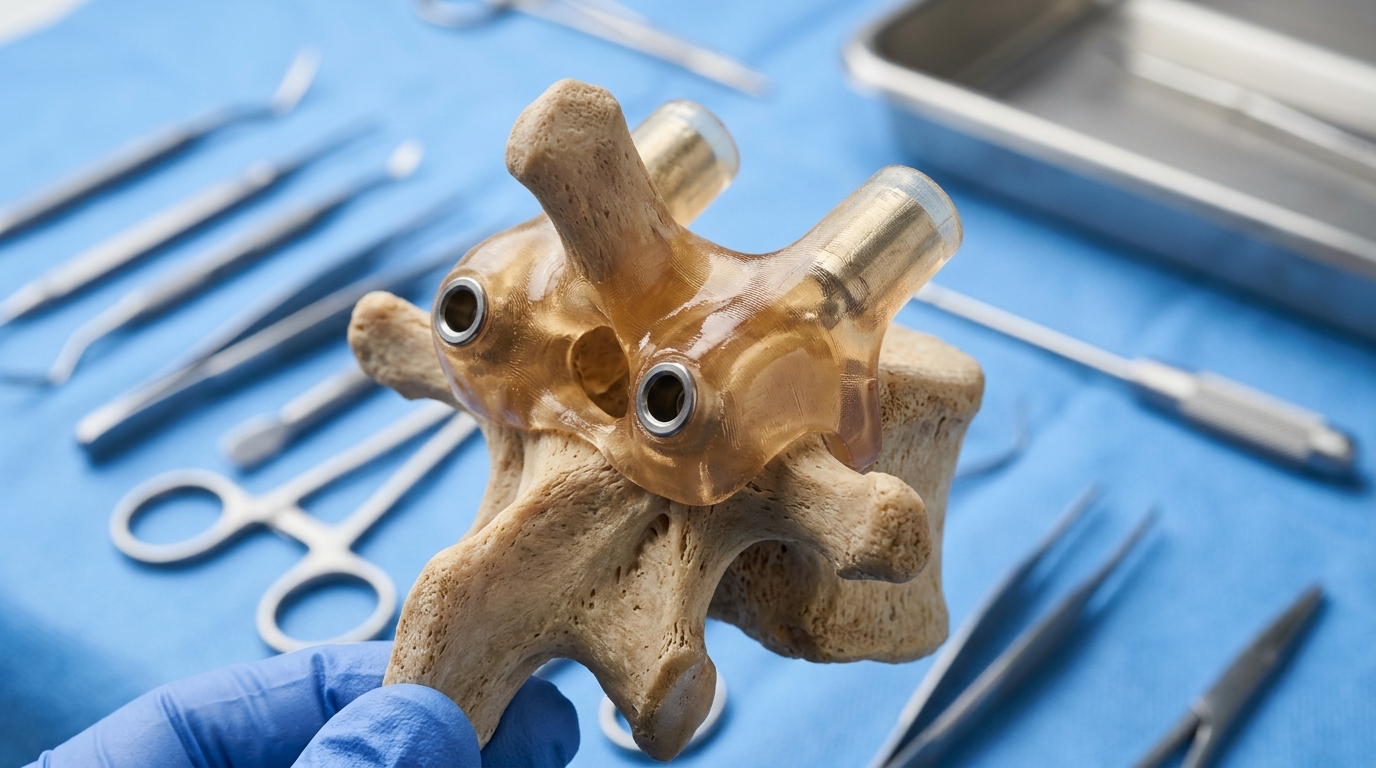
A combined digital-planning workflow utilizing a novel self-stabilizing mortise-tenon design 3D-printed guide template was associated with higher screw placement accuracy and greater major deformity angle correction compared to conventional freehand surgery in patients with complex and severe spinal deformity undergoing three-column osteotomy, according to a retrospective before-and-after cohort study published in the Journal of Orthopaedic Surgery and Research.
Complex and severe spinal deformity causes marked anatomical distortion, which substantially complicates the placement of pedicle screws and the execution of posterior three-column osteotomies. Although patient-specific surgical guides have been proposed to address these structural challenges, the authors observed that evidence supporting the clinical use of patient-specific 3D-printed guide templates in this severe operative setting has remained limited.
To evaluate the technique, investigators retrospectively reviewed forty patients with complex and severe spinal deformity who underwent posterior three-column osteotomy at a single tertiary center between 2020 and 2024. The observational cohort was split into two sequential chronological groups: patients treated between January 2020 and December 2021 underwent conventional freehand surgery as a control group, whereas patients treated between January 2022 and January 2024 received the combined digital-planning and mortise-tenon guide workflow as the template group.
The investigation evaluated two co-primary surgical outcomes, beginning with the major deformity angle correction rate, which was statistically adjusted for baseline preoperative major deformity angle using an analysis of covariance. Patients treated with the 3D-printed template achieved a mean correction rate of 58.5 percent plus or minus 13.1 percent, compared to 46.5 percent plus or minus 12.7 percent among conventional freehand controls, yielding an adjusted between-group difference of 12.8 percentage points with a 95 percent confidence interval spanning 4.5 to 21.0 percentage points.
The second co-primary endpoint measured acceptable adjacent-segment pedicle screw placement, defined by the researchers as Gertzbein-Robbins Grade A or Grade B and analyzed using mixed-effects logistic regression models. Patient-level screw accuracy reached 98.8 percent plus or minus 5.6 percent in the template group, compared to 85.0 percent plus or minus 12.6 percent in the freehand control group, corresponding to a statistically significant mixed-effects odds ratio of 10.42 with a 95 percent confidence interval from 1.93 to 56.32.
The authors also recorded sagittal alignment and operative safety measures, noting that preoperative sagittal vertical axis measurements were significantly greater at baseline in the template cohort at 30.8 plus or minus 26.6 millimeters compared to 7.4 plus or minus 18.5 millimeters in the freehand cohort. However, the subsequent change in sagittal vertical axis showed no statistically significant difference between the two surgical groups. In addition, postoperative neurological complications occurred in three patients managed with the guide workflow and seven patients managed with conventional freehand surgery, a difference that did not reach statistical significance.
For patients treated within the combined guide workflow, the surgical team assessed internal plan-to-execution fidelity by comparing planned osteotomy angles with executed anatomical angles. The planned and executed osteotomy angles achieved matching rates exceeding 91 percent, accompanied by mean signed biases of negative 2.35 degrees in the coronal plane and negative 4.19 degrees in the sagittal plane, alongside mean absolute errors of 3.99 degrees coronally and 5.51 degrees sagittally.
Despite these procedural observations, the authors emphasized the inherent methodological constraints of their retrospective historical-control cohort design, noting that the plan-to-execution findings confirm internal agreement but do not establish superior surgical execution over conventional control surgery. Furthermore, the observational study was not registered as a clinical trial, leading the investigators to conclude that prospective studies remain necessary to establish the independent surgical contribution of the template workflow, its long-term clinical benefits, and its definitive neurological safety profile.
Subject of Research: Surgical outcomes of 3D-printed guide templates in complex spinal deformity
Article Title: Overcoming anatomical distortion in complex and severe spinal deformity via a novel self-stabilizing mortise-tenon design 3D-printed guide template: a retrospective before-and-after cohort study
Article References: Zhang, Y., Huang, J., Yang, H., Zhang, Y., Wang, Y., Zhou, L., & Hai, Y. (2026). Overcoming anatomical distortion in complex and severe spinal deformity via a novel self-stabilizing mortise-tenon design 3D-printed guide template: a retrospective before-and-after cohort study. Journal of Orthopaedic Surgery and Research. https://doi.org/10.1186/s13018-026-07371-5
Image Credits: AI Generated
DOI: 10.1186/s13018-026-07371-5
Keywords: complex and severe spinal deformity, three-column osteotomy, pedicle screw placement, 3D-printed guide template, mortise-tenon design, digital surgical planning, major deformity angle, sagittal vertical axis, Gertzbein-Robbins scale, retrospective cohort study, historical-control study, freehand spinal surgery, adjacent-segment screw accuracy, osteotomy angle execution, neurological complications, orthopaedic surgery, spine deformity correction
News Source: Ophelia Keating. (November 17, 2026). 3D-Printed Guide Template Associated With Improved Spinal Deformity Correction in Cohort. Scienmag.