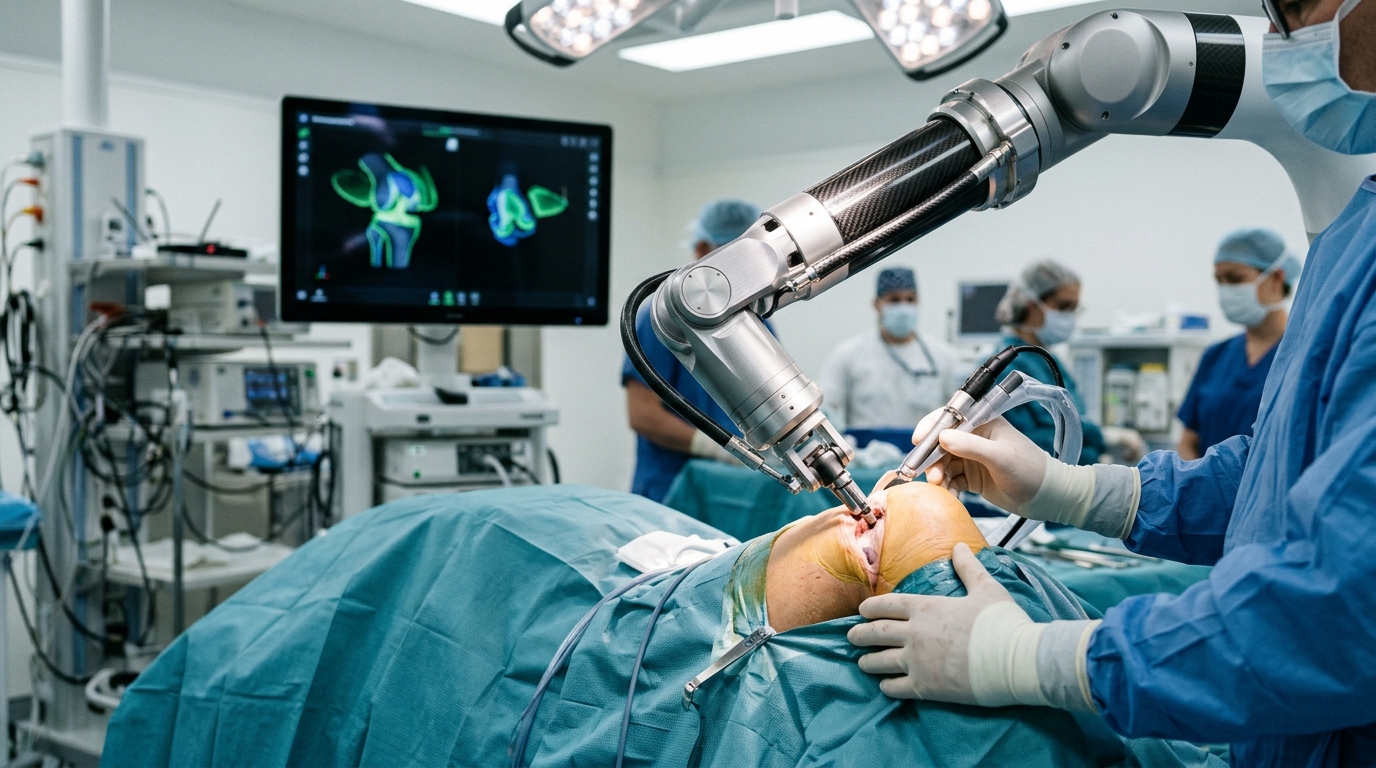
A retrospective software-based evaluation has demonstrated that a specialized machine-learning algorithm can generate bone-resection plans that closely align with virtual planning set points during robotic-assisted total knee arthroplasty. Across 836 evaluated gap observations derived from 209 surgical cases, the predictive model produced software-calculated joint gaps that differed from predefined target gaps by an overall mean absolute error of 1.016 millimeters. Rather than evaluating physical bone cuts or direct intraoperative ligament tension, the investigation examined the mathematical concordance between model-directed surgical recommendations and predefined set points inside standard robotic planning software. The researchers identified a minimal overall mean signed bias of negative 0.142 millimeters, demonstrating that the automated algorithmic proposals substantially reduced planning deviation when compared against initial preadjustment baselines. However, because the study relied entirely on computer-simulated software metrics rather than physical measurements taken from patients during or after surgery, the authors emphasized that the predictive system is designed strictly to assist surgeon judgment rather than replace direct clinical oversight.
Achieving stable soft-tissue balance across both flexion and extension remains one of the most demanding technical challenges encountered during total knee arthroplasty. To establish an optimal functional joint, orthopedic surgeons must balance multiple interdependent variables simultaneously, including femoral resection depth, tibial resection depth, component rotation, posterior slope, and implant sizing. In conventional and robotic workflows alike, balancing medial and lateral gaps often requires iterative intraoperative modifications that depend heavily on individual practitioner experience. While robotic-assisted surgical systems offer superior precision in physical tool execution and implant positioning relative to traditional manual instrumentation, formulating the initial digital plan remains a complex cognitive task. Recent artificial intelligence models have been introduced to address this operational burden by predicting optimal planning parameters from historical surgical datasets. The practical utility of these models rests on whether algorithmic planning proposals, when transferred back into the robotic console, generate predicted joint spaces that correspond reliably with predetermined surgical target set points.
To rigorously test this planning workflow, investigators analyzed records from consecutive primary robotic-arm-assisted total knee arthroplasty procedures conducted at a single high-volume academic orthopedic center between September 2024 and March 2026. All operations utilized the commercially available MAKO robotic system. Out of 237 initially screened surgical records, researchers excluded two revision procedures, three cases exhibiting incomplete target-gap tracking data, and 23 knees presenting severe deformities. The study protocol defined severe deformity as any condition precluding the completion of standard registration or gap capture, including marked structural bone loss or fixed flexion contractures exceeding 20 degrees that could not be corrected following initial soft-tissue release. The final complete-case analytical cohort comprised 209 distinct knees. Because each joint assessment evaluated medial extension, lateral extension, medial flexion, and lateral flexion, the complete analytical dataset yielded 836 discrete gap-level observations for primary software concordance processing.
The investigated proprietary machine-learning model had been previously trained on an independent developmental cohort of 375 primary robotic-assisted total knee arthroplasty cases treated at the identical medical center between November 2023 and September 2024. These underlying training records reflected contemporary personalized alignment strategies, specifically incorporating functional alignment and restricted kinematic alignment philosophies. Because the training cases and the subsequent testing cases shared the same clinical center and operating surgeons, the investigation constituted internal concordance validation rather than a true external generalization trial. At the inference stage, the algorithm processed 17 specific variables per knee, consisting of 13 initial preadjustment planning values alongside four predefined target-gap requirements. These inputs included initial component-orientation variables, baseline resection parameters, and preliminary gap measurements. The algorithm processed these parameters to propose revised resection depths and implant orientations, which were programmatically returned to the robotic console to compute the resulting virtual gaps.
Within this analytical feedback framework, the predefined target gaps represented software planning set points established prior to bone preparation rather than physical dimensions measured after cutting. In 819 of the 836 total gap observations, representing 98.0 percent of all analyzed instances, the clinical protocol specified an identical target gap of 18 millimeters across all four anatomical compartments. Specifically, an 18-millimeter target was established in 202 medial extension targets, 201 lateral extension targets, 208 medial flexion targets, and 208 lateral flexion targets. This uniform 18-millimeter dimension aligned with institutional surgical guidelines designed to match the combined mechanical thickness of the definitive femoral component and the tibial baseplate-plus-insert construct. Because these targets served as both explicit mathematical inputs to the algorithm and the ultimate reference standard for concordance, the experimental design tested target-conditioned computational alignment rather than unprompted target prediction.
Across all 836 gap-level observations, the software-derived gaps produced by the algorithmic proposals closely tracked the predefined targets. The overall mean signed target gap deviation was negative 0.142 millimeters with a standard deviation of 1.411 millimeters, confirming a slight overall tendency to plan gaps marginally tighter than nominal set points. Analysis of threshold achievement showed that 77.6 percent of all software-derived gaps landed within positive or negative 1.0 millimeter of the intended target, while 93.4 percent remained within a 2.0-millimeter margin. Exact numerical agreement, defined by zero deviation within the robotic software’s one-millimeter recording increments, occurred in 31.3 percent of observations. Bland-Altman statistical assessment confirmed an overall bias of negative 0.142 millimeters, accompanied by 95 percent limits of agreement extending from negative 2.907 millimeters to positive 2.623 millimeters. Relative to preadjustment plans, which exhibited a baseline mean absolute error of 2.002 millimeters, the predictive model cut absolute deviation nearly in half.
Although absolute deviation remained relatively uniform across anatomical regions—with compartment mean absolute errors ranging narrowly between 0.957 and 1.103 millimeters—mixed-effects modeling demonstrated statistically significant variations in directional bias across the four functional compartments. Signed target gap deviation showed a pronounced negative bias in the medial extension space, averaging negative 0.844 millimeters, indicating a regular systemic tendency toward tighter medial extension planning. Conversely, lateral flexion demonstrated a small positive bias averaging positive 0.301 millimeters, yielding slightly wider planned gaps. One-sample statistical testing confirmed that signed deviations in medial extension and lateral flexion differed significantly from zero, whereas lateral extension and medial flexion exhibited no statistically significant directional bias. Mixed-effects modeling accounting for intra-patient clustering yielded a significant compartmental effect for signed deviation but showed no statistically significant difference in absolute error magnitude across compartments.
Evaluation of whole-knee performance revealed that achieving tight tolerances simultaneously across all four joint compartments was substantially more challenging than achieving isolated gap-level targets. While more than three-quarters of individual gap measurements fell within one millimeter of target, only 43.1 percent of knees achieved within-one-millimeter concordance across every compartment at once. When the tolerance window was expanded to positive or negative 2.0 millimeters, whole-knee consistency rose to 83.7 percent. Furthermore, 76.6 percent of knees achieved within-one-millimeter accuracy in at least three compartments, and 92.8 percent met this benchmark in at least two. Absolute deviations exceeding 2.0 millimeters occurred in 6.6 percent of total gap observations, affecting 34 individual knees (16.3 percent of the cohort). Across the complete cohort, total gap deviations ranged from a minimum of negative 7 millimeters to a maximum of positive 5 millimeters, underscoring the occasional occurrence of substantial algorithmic outliers.
In a secondary reference analysis evaluating 206 knees with recorded surgeon-approved final plans, the algorithm-generated plans demonstrated close computational alignment with final human decisions. The mean absolute difference between model-generated gaps and final surgeon-approved software gaps was 0.858 millimeters, with 81.9 percent of model gaps falling within one millimeter and 96.0 percent within two millimeters of final surgeon selections. Notably, when the model generated outlying deviations greater than two millimeters, surgeons corrected 45 of those 55 instances (81.8 percent) back within two millimeters in their approved final plan. Feasibility screening of bone cuts revealed that only one knee (0.5 percent) produced an individual resection exceeding the prespecified 10-millimeter safety threshold, where the algorithm proposed an 11.5-millimeter lateral tibial resection. Additionally, five plans generated negative resection values, demonstrating that automated planning outputs occasionally violate geometric feasibility boundaries without manual surgeon correction.
Exploratory subgroup comparisons indicated that male patients experienced a higher mean absolute error than female patients (1.319 millimeters versus 0.888 millimeters) and achieved lower within-one-millimeter target attainment (67.3 percent versus 82.0 percent). Performance remained comparable when stratifying knees by coronal deformity magnitude, showing similar accuracy between joints with five degrees or less of deformity and those exceeding five degrees. The authors emphasized several structural limitations, noting that 98.0 percent of target gaps were fixed at 18 millimeters, the single-center retrospective design precluded testing across broader demographic cohorts, and the analysis did not capture actual post-resection physical gaps or long-term clinical recovery. Consequently, while the machine-learning model proved effective at reducing initial planning variance in a virtual feedback loop, it remains a supervised intraoperative decision aid that requires vigilant surgeon oversight.
Subject of Research: Software-based concordance analysis of a predictive planning model for robotic-assisted total knee arthroplasty
Article Title: Software-based concordance analysis of a predictive surgical planning model for target gap achievement in robotic-assisted total knee arthroplasty
Article References: Hu, M., Yu, M., Meng, F., Luo, Z., Xia, Y., Weng, X., Zhai, D., & Feng, B. (2026). Software-based concordance analysis of a predictive surgical planning model for target gap achievement in robotic-assisted total knee arthroplasty. Knee Surgery & Related Research, 38(1), Article 56. https://doi.org/10.1186/s43019-026-00357-x
Image Credits: AI Generated
DOI: 10.1186/s43019-026-00357-x
Keywords: robotic-assisted total knee arthroplasty, predictive surgical planning, machine learning, soft-tissue balancing, target gap deviation, MAKO robotic system, mean absolute error, Bland-Altman analysis, orthopedic surgery, predefined target gaps, internal concordance testing, virtual planning software, bone resection depth, retrospective cohort, medial extension gap, lateral flexion gap, decision support systems
News Source: Ophelia Keating. (November 17, 2026). Predictive Planning Model Nears Predefined Targets in Robotic Knee Surgery Analysis. Scienmag.