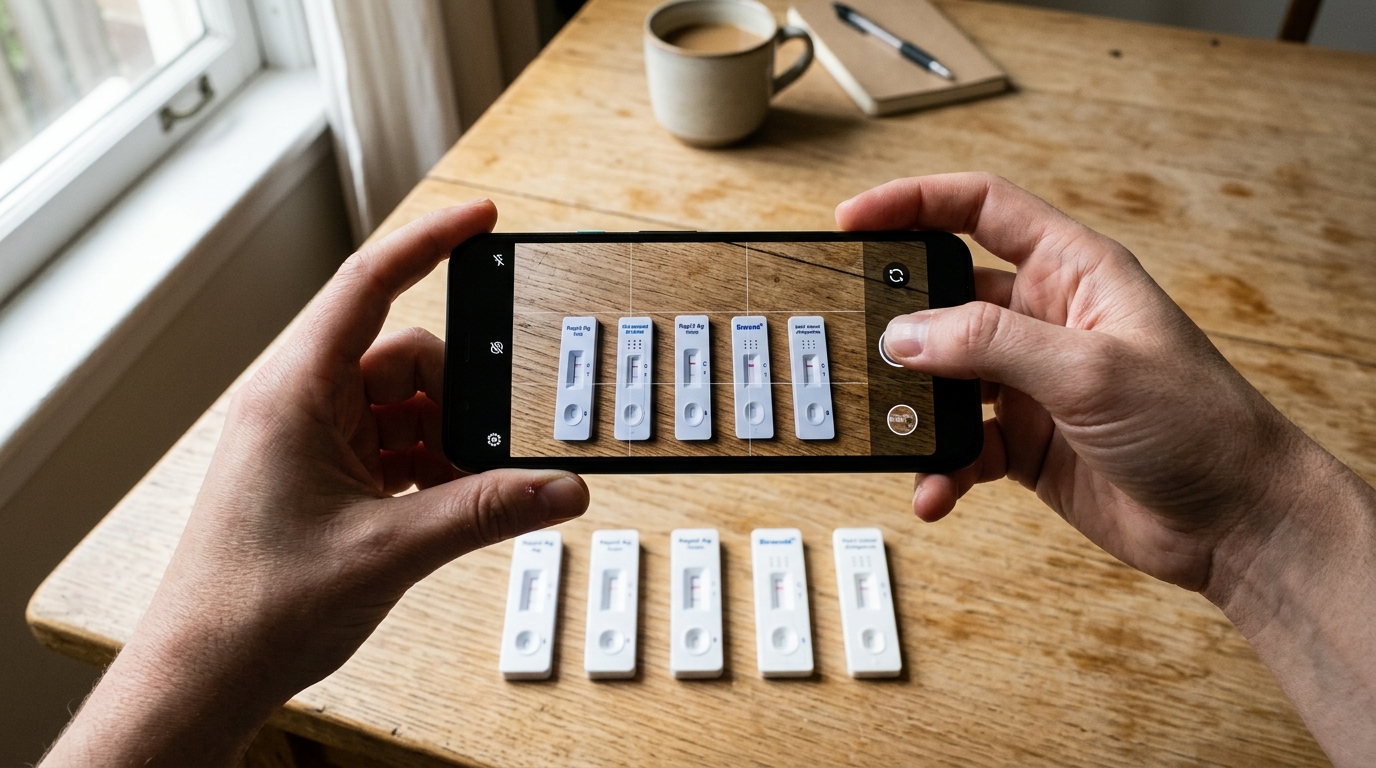
A universal artificial intelligence model integrated into a smartphone application can accurately digitize and interpret diagnostic results across multiple lateral flow assay types, according to a recent study. Lateral flow assays serve as indispensable rapid diagnostic tools for point-of-care patient management, disease surveillance, and disease burden assessment. However, clinical implementation often faces misinterpretation errors and unreported cases. The evaluated AI system was designed to provide quality-assured, affordable decision support during interpretation, establishing standardized digital records for epidemiological surveillance.
To assess universal interpretation capabilities, researchers evaluated the algorithm across 17 distinct lateral flow assay types produced by different manufacturers for various diseases. The evaluation incorporated both two-band and three-band test configurations. The underlying model was trained on a dataset of 22,576 images captured under diverse lighting conditions. These photographs were taken with different smartphone models using TiraSpot, a custom mobile application developed by Spotlab in Madrid, Spain.
To evaluate generalizability to new test formats, the investigators implemented a leave-one-out cross-validation framework. Under this validation design, each lateral flow assay type was iteratively excluded from model training and reserved exclusively for testing. In addition, model performance across the inference dataset was evaluated using bootstrapping techniques. This setup examined whether an algorithmic reader could reliably recognize diagnostic bands on test types omitted during development.
In tests assessing the model’s ability to generalize to new assay types not previously analyzed, the algorithm achieved an overall area under the curve of 95.3 percent for second band detection. This baseline outcome demonstrated that the universal reader could identify bands on unfamiliar assay designs without prior exposure.
Detection accuracy improved markedly when the team supplied modest quantities of test-specific data. Training the algorithm with 50 images of each specific assay type raised the overall second band area under the curve to 99.4 percent. At this operating level, the system achieved a sensitivity of 98.8 percent and a specificity of 98.2 percent, highlighting the benefit of incorporating targeted data for individual lateral flow assay formats.
A similar trend was observed for third band detection, where less training data was initially available. For unseen lateral flow assays, the system registered an overall area under the curve of 83.6 percent. Following supplementary training with 50 images per assay type, the third band area under the curve rose to 94.05 percent, achieving a sensitivity of 93.08 percent and a specificity of 87.87 percent.
The study demonstrates the practical feasibility of an artificial intelligence reader capable of interpreting lateral flow assay results across multiple test types using smartphone images. Adaptability across various infections and capture hardware highlights the tool’s potential to improve diagnostic consistency in point-of-care environments. Such systems could support standardized result interpretation and digital reporting, particularly where dependable data capture is required for epidemiological disease surveillance and diagnostic quality assurance.
Subject of Research: Smartphone artificial intelligence for lateral flow assay interpretation
Article Title: An AI-powered smartphone application for universal and standardized reading and interpretation of lateral flow assays
Article References: Bermejo-Peláez, D., Darias, O., Pastor, L., Vallés, R., Diez, N., Lin, L., García-Villena, J., Cuadrado, D., Vladimirov, A., Álamo, E., Postigo, M., Rodriguez-Dominguez, M., Cantón, R., Rodriguez-Tudela, J. L., Alastruey Izquierdo, A., Marchiol, A., Segura Alba, M. L., Cortés Cortés, L. J., Bohorquez, L. C., … Luengo-Oroz, M. (2026). An AI-powered smartphone application for universal and standardized reading and interpretation of lateral flow assays. PLOS Global Public Health, 6(11), e0005817. https://doi.org/10.1371/journal.pgph.0005817
Image Credits: AI Generated
DOI: 10.1371/journal.pgph.0005817
Keywords: lateral flow assays, artificial intelligence, smartphone diagnostics, rapid diagnostic tests, point-of-care testing, TiraSpot, Spotlab, test band detection, digital reporting, epidemiological surveillance, leave-one-out cross-validation, bootstrapping, sensitivity and specificity, area under the curve, diagnostic consistency, quality assurance, two-band assays, three-band assays
News Source: Ophelia Keating. (November 16, 2026). Universal Smartphone AI Accurately Interprets Multiple Lateral Flow Rapid Diagnostic Tests. Scienmag.