• HOME
  • NEWS
  • EXPLORE
    • CAREER
      • Companies
      • Jobs
    • EVENTS
    • iGEM
      • News
      • Team
    • PHOTOS
    • VIDEO
    • WIKI
  • BLOG
  • COMMUNITY
    • FACEBOOK
    • INSTAGRAM
    • TWITTER
Monday, November 16, 2026
BIOENGINEER.ORG
No Result
View All Result
  • Login
  • HOME
  • NEWS
  • EXPLORE
    • CAREER
      • Companies
      • Jobs
        • Lecturer
        • PhD Studentship
        • Postdoc
        • Research Assistant
    • EVENTS
    • iGEM
      • News
      • Team
    • PHOTOS
    • VIDEO
    • WIKI
  • BLOG
  • COMMUNITY
    • FACEBOOK
    • INSTAGRAM
    • TWITTER
  • HOME
  • NEWS
  • EXPLORE
    • CAREER
      • Companies
      • Jobs
        • Lecturer
        • PhD Studentship
        • Postdoc
        • Research Assistant
    • EVENTS
    • iGEM
      • News
      • Team
    • PHOTOS
    • VIDEO
    • WIKI
  • BLOG
  • COMMUNITY
    • FACEBOOK
    • INSTAGRAM
    • TWITTER
No Result
View All Result
Bioengineer.org
No Result
View All Result
Home NEWS Science News Technology

New Controller Stops Collisions and Cuts Angular Jerk in Omnidirectional Robots

by
November 16, 2026
in Technology
Reading Time: 2 mins read
0
New Controller Stops Collisions and Cuts Angular Jerk in Omnidirectional Robots

New Controller Stops Collisions and Cuts Angular Jerk in Omnidirectional Robots

Share on FacebookShare on TwitterShare on LinkedinShare on RedditShare on Telegram

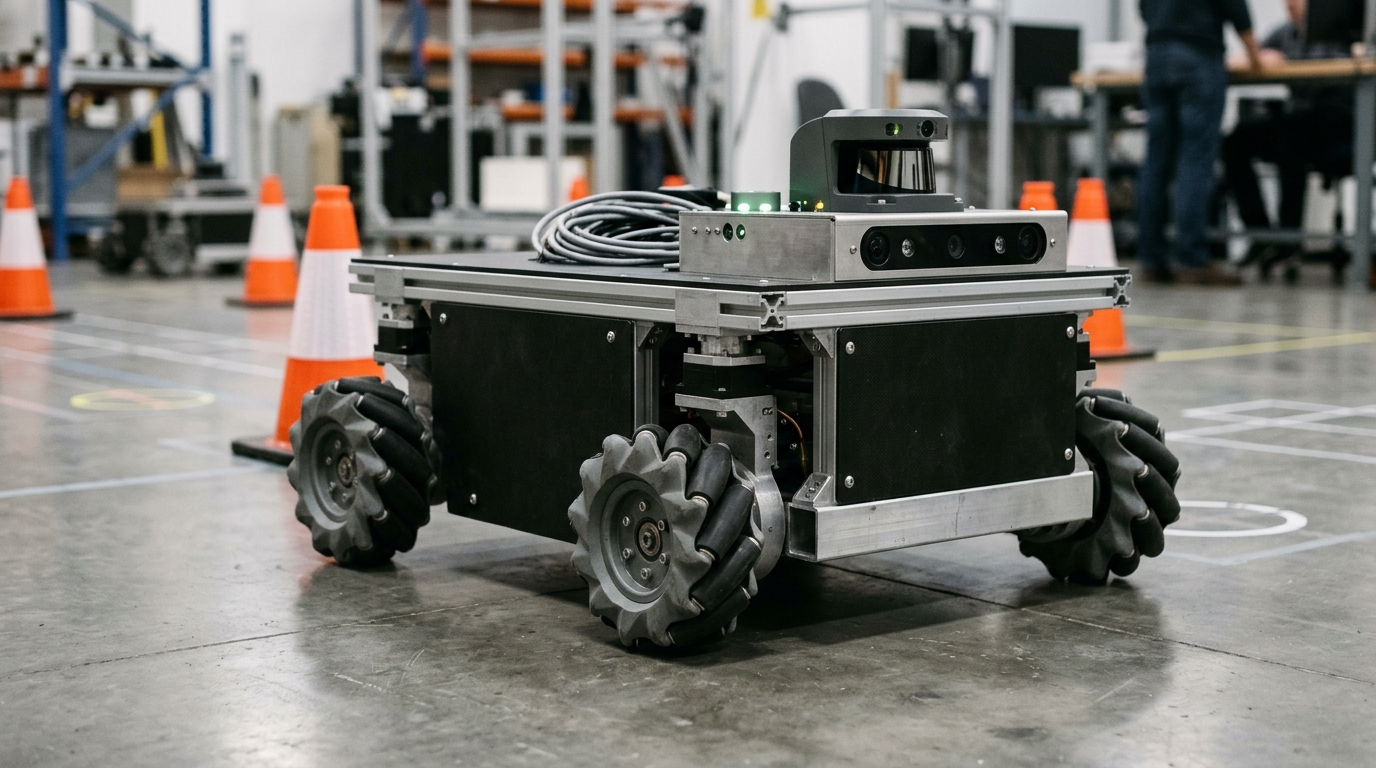
Researchers have introduced a CBF-critic-based, heading-aware Model Predictive Path Integral (MPPI) navigation architecture designed for omnidirectional mobile robots operating in narrow environments. The framework was developed to support the growing deployment of autonomous dual-arm wheeled humanoid robots as well as heavy-duty logistics robots, where both collision-free path execution and dynamic stability are critical operational requirements. In experimental evaluations, the newly proposed control scheme attained a 100 percent collision-free navigation success rate across both simulated environments and physical hardware trials.

The research addresses fundamental geometric and operational constraints inherent to four-wheel independent steering (4WS) platforms. Although four-wheel independent steering delivers superior maneuverability compared to conventional steering configurations, these platforms possess asymmetric rectangular footprints. When governed by traditional controllers that rely on circular approximations of the robot’s physical dimensions, this geometric mismatch frequently causes severe physical collisions and excessive variations in heading while the platform attempts to navigate confined areas.

To resolve these geometric shortcomings, the proposed navigation framework represents the robot’s perimeter as an Oriented Bounding Box (OBB). Within this geometric formulation, the researchers integrated Control Barrier Functions (CBF) directly into the Model Predictive Path Integral framework. This mathematical integration functions to approximate collision avoidance as a strict hard constraint rather than a soft penalty, effectively mitigating the optimization cost conflicts that typically arise when balancing multiple competing navigation objectives.

To complement the barrier function formulation, the architecture incorporates an online Adaptive Heading Critic driven by real-time LiDAR perception data. Operating continuously during navigation, this component dynamically enforces heading alignment as the robot negotiates narrow passages. By actively regulating orientation based on immediate environmental sensing, the critic effectively suppresses unnecessary angular jerk, preserving smooth trajectory motion and preventing sudden rotational movements.

The effectiveness of the architecture was demonstrated through extensive validation testing conducted in simulation and on real-world four-wheel independent steering robotic hardware. In addition to recording zero collisions across all experimental scenarios, the system proved particularly effective during a region-locked parallel parking benchmark. In that trial, the proposed framework maximized dynamic stability by reducing the robot’s maximum angular jerk by approximately 91.6 percent relative to a conventional soft-constraint baseline controller.

Subject of Research: Collision-free navigation and dynamic stability control for omnidirectional mobile robots

Article Title: CBF-Critic-Based Heading-Aware MPPI Navigation for Omnidirectional Mobile Robots

Article References: Kim, T., Seo, H., & Lee, C. (2026). CBF-Critic-Based Heading-Aware MPPI Navigation for Omnidirectional Mobile Robots. Journal of Intelligent & Robotic Systems. https://doi.org/10.1007/s10846-026-02485-8

Image Credits: AI Generated

DOI: 10.1007/s10846-026-02485-8

Keywords: omnidirectional mobile robots, model predictive path integral, control barrier functions, oriented bounding box, four-wheel independent steering, adaptive heading critic, angular jerk reduction, collision avoidance, dynamic stability, narrow passage navigation, real-time LiDAR, parallel parking scenario, dual-arm wheeled humanoid robots, logistics robots, hard constraint approximation, soft-constraint baseline, robot footprint modeling

News Source: Denise Maddox. (November 16, 2026). New Controller Stops Collisions and Cuts Angular Jerk in Omnidirectional Robots. Scienmag.


Tags: adaptive heading criticangular jerk reductioncollision avoidanceControl barrier functionsdual-arm wheeled humanoid robotsdynamic stabilityfour-wheel independent steeringhard constraint approximationlogistics robotsmodel predictive path integralnarrow passage navigationomnidirectional mobile robotsoriented bounding boxparallel parking scenarioreal-time LiDARrobot footprint modelingsoft-constraint baseline
Share12Tweet7Share2ShareShareShare1

Related Posts

Pit-less tailwater pump reduces rice irrigation water by 27 percent

Pit-less tailwater pump reduces rice irrigation water by 27 percent

November 16, 2026
Enhanced Lemurs Optimizer Boosts Task Scheduling Efficiency in Fog-Cloud Systems

Enhanced Lemurs Optimizer Boosts Task Scheduling Efficiency in Fog-Cloud Systems

November 16, 2026

China’s Carbon Trading Pilots Aggravated Energy Misallocation Under Distorted Allowance Prices

November 16, 2026

Simulated Aerial Reflecting Surfaces Improve Drone Energy Efficiency Up to 99.6 Percent

November 16, 2026

POPULAR NEWS

  • Longitudinal Molecular Profiling in ALK-Rearranged Lung Cancer: A Case Report

    Longitudinal Molecular Profiling in ALK-Rearranged Lung Cancer: A Case Report

    29 shares
    Share 12 Tweet 7
  • Periodontal Ligament Simulation Variations Do Not Alter Root Fracture Resistance In Vitro

    29 shares
    Share 12 Tweet 7
  • Museum Records Reveal 33,000 Non-Asilid Insect Specimens Collected by Jason Londt

    29 shares
    Share 12 Tweet 7
  • State Reconstruction Model Slashes Epidemic Infection Costs by 88 Percent

    29 shares
    Share 12 Tweet 7

About

We bring you the latest biotechnology news from best research centers and universities around the world. Check our website.

Follow us

Recent News

New Journal Leadership Outlines Strategy for Equitable Global LGBTQ+ Health Research

Single Human Neurons Execute Complex Logical Computations Through Dendritic Depolarization Block

Sulfonated Graphene Oxide Catalyzes One-Pot Synthesis of Antibacterial Oxadiazole Derivatives

Subscribe to Blog via Email

Enter your email address to subscribe to this blog and receive notifications of new posts by email.

Join 88 other subscribers
  • Contact Us

Bioengineer.org © Copyright 2023 All Rights Reserved.

Welcome Back!

Login to your account below

Forgotten Password?

Retrieve your password

Please enter your username or email address to reset your password.

Log In
No Result
View All Result
  • Homepages
    • Home Page 1
    • Home Page 2
  • News
  • National
  • Business
  • Health
  • Lifestyle
  • Science

Bioengineer.org © Copyright 2023 All Rights Reserved.