Credit: University of Alberta
If you need a reason to become a dog lover, how about their ability to help protect kids from allergies and obesity?
A new University of Alberta study showed that babies from families with pets–70 per cent of which were dogs–showed higher levels of two types of microbes associated with lower risks of allergic disease and obesity.
But don't rush out to adopt a furry friend just yet.
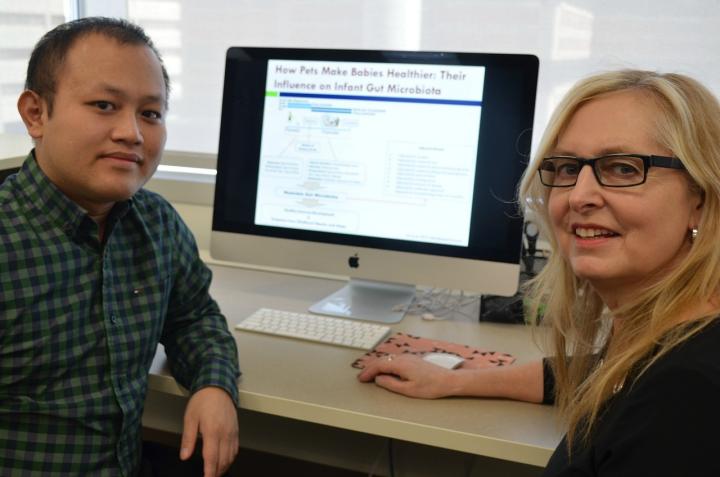
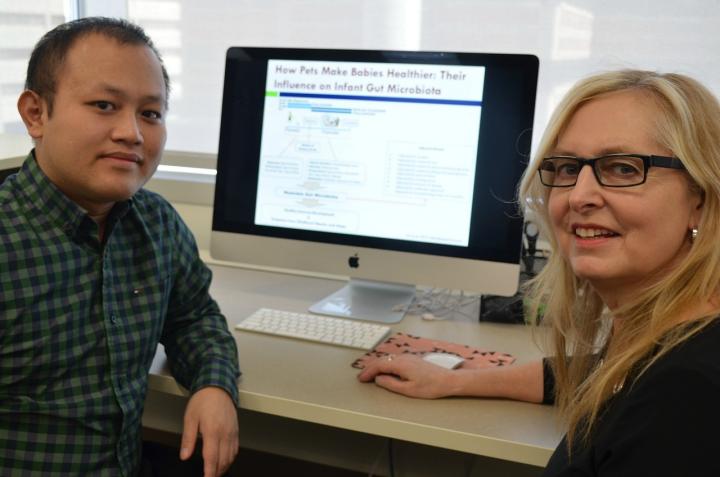
"There's definitely a critical window of time when gut immunity and microbes co-develop, and when disruptions to the process result in changes to gut immunity," said Anita Kozyrskyj, a U of A pediatric epidemiologist and one of the world's leading researchers on gut microbes–microorganisms or bacteria that live in the digestive tracts of humans and animals.
The latest findings from Kozyrskyj and her team's work on fecal samples collected from infants registered in the Canadian Healthy Infant Longitudinal Development study build on two decades of research that show children who grow up with dogs have lower rates of asthma.
The theory is that exposure to dirt and bacteria early in life–for example, in a dog's fur and on its paws–can create early immunity, though researchers aren't sure whether the effect occurs from bacteria on the furry friends or from human transfer by touching the pets, said Kozyrskyj.
Her team of 12, including study co-author and U of A post-doctoral fellow Hein Min Tun, take the science one step closer to understanding the connection by identifying that exposure to pets in the womb or up to three months after birth increases the abundance of two bacteria, Ruminococcus and Oscillospira, which have been linked with reduced childhood allergies and obesity, respectively.
"The abundance of these two bacteria were increased twofold when there was a pet in the house," said Kozyrskyj, adding that the pet exposure was shown to affect the gut microbiome indirectly–from dog to mother to unborn baby–during pregnancy as well as during the first three months of the baby's life. In other words, even if the dog had been given away for adoption just before the woman gave birth, the healthy microbiome exchange could still take place.
The study also showed that the immunity-boosting exchange occurred even in three birth scenarios known for reducing immunity, as shown in Kozyrskyj's previous work: C-section versus vaginal delivery, antibiotics during birth and lack of breastfeeding.
What's more, Kozyrskyj's study suggested that the presence of pets in the house reduced the likelihood of the transmission of vaginal GBS (group B Strep) during birth, which causes pneumonia in newborns and is prevented by giving mothers antibiotics during delivery.
It's far too early to predict how this finding will play out in the future, but Kozyrskyj doesn't rule out the concept of a "dog in a pill" as a preventive tool for allergies and obesity.
"It's not far-fetched that the pharmaceutical industry will try to create a supplement of these microbiomes, much like was done with probiotics," she said.
###
The study, funded by the Canadian Institutes of Health Research and the Allergy, Genes and Environment Network (AllerGen NCE), was published in the journal Microbiome, along with an editorial in Nature.
Media Contact
Ross Neitz
[email protected]
780-492-5986
@ualberta_fomd
http://www.med.ualberta.ca